Within Best Lists
Why best for labels beat plain rankings
Clear best-for labels help readers find the option that fits their budget, use case, audience, or problem without decoding a generic ranking.
On this page
- How reader situations change the shortlist
- Best for labels that support affiliate clicks
- Mistakes that make labels vague or repetitive
Page outline Jump by section
Introduction
Best-of pages earn affiliate revenue when they reduce decision-making effort. One of the simplest ways to do that is with clear “best for” labels. Instead of presenting a generic ranking and expecting readers to work out which recommendation applies to them, a strong shortlist assigns each option a specific role: best for beginners, best for tight budgets, best for small businesses, best for advanced users, best for travel, and so on.
 This approach matches how people actually make purchasing decisions. Readers arrive with a situation, constraint, audience, or problem in mind. A well-written best-for label lets them identify their likely match within seconds. It also creates a more useful review experience, aligning with Google’s preference for review content that offers genuine analysis and decision support rather than thin summaries of products.[Google for Developers]developers.google.comGoogle for DevelopersGoogle Search's Reviews SystemThe reviews system aims to better reward high quality reviews, which is content that p…
For affiliate sites, best-for labels are not merely a content feature. They are a conversion mechanism. They help visitors self-segment, reduce comparison fatigue, and move more confidently towards the offer that fits their circumstances.
Why Reader Situations Matter More Than Rankings
A plain ranking assumes that one product is objectively best for everyone. In practice, most categories contain multiple winners depending on what the reader values most.
Consider a page about accounting software:
- A freelancer may care about low monthly costs.
- A growing agency may care about automation.
- An accountant may care about reporting depth.
- A beginner may care about ease of use.
A simple “Top 10 Accounting Tools” ranking forces readers to interpret every recommendation themselves. A shortlist using labels such as “Best for freelancers”, “Best for growing agencies”, and “Best for beginners” removes that work.
This mirrors a broader usability principle: labels should be descriptive and immediately understandable. User-experience research consistently shows that clear, specific labels outperform clever or ambiguous wording because they reduce guesswork and help users find the right path more quickly.[Nielsen Norman Group]nngroup.comcategory names suckBe Descriptive and Relatable. Your navigation labels should be easily understood, even if they feel boring. Choose function over form.Rea…[Nielsen Norman Group]nngroup.comcategory names suckBe Descriptive and Relatable. Your navigation labels should be easily understood, even if they feel boring. Choose function over form.Rea…
On affiliate pages, the same principle applies. The reader is effectively navigating a set of recommendations. The clearer the labels, the easier it becomes to identify the right choice.
How Reader Situations Change the Shortlist
The same market can generate several different best-of pages because different reader situations create different decision criteria.
A scalable affiliate publishing system can classify situations into several repeatable patterns.
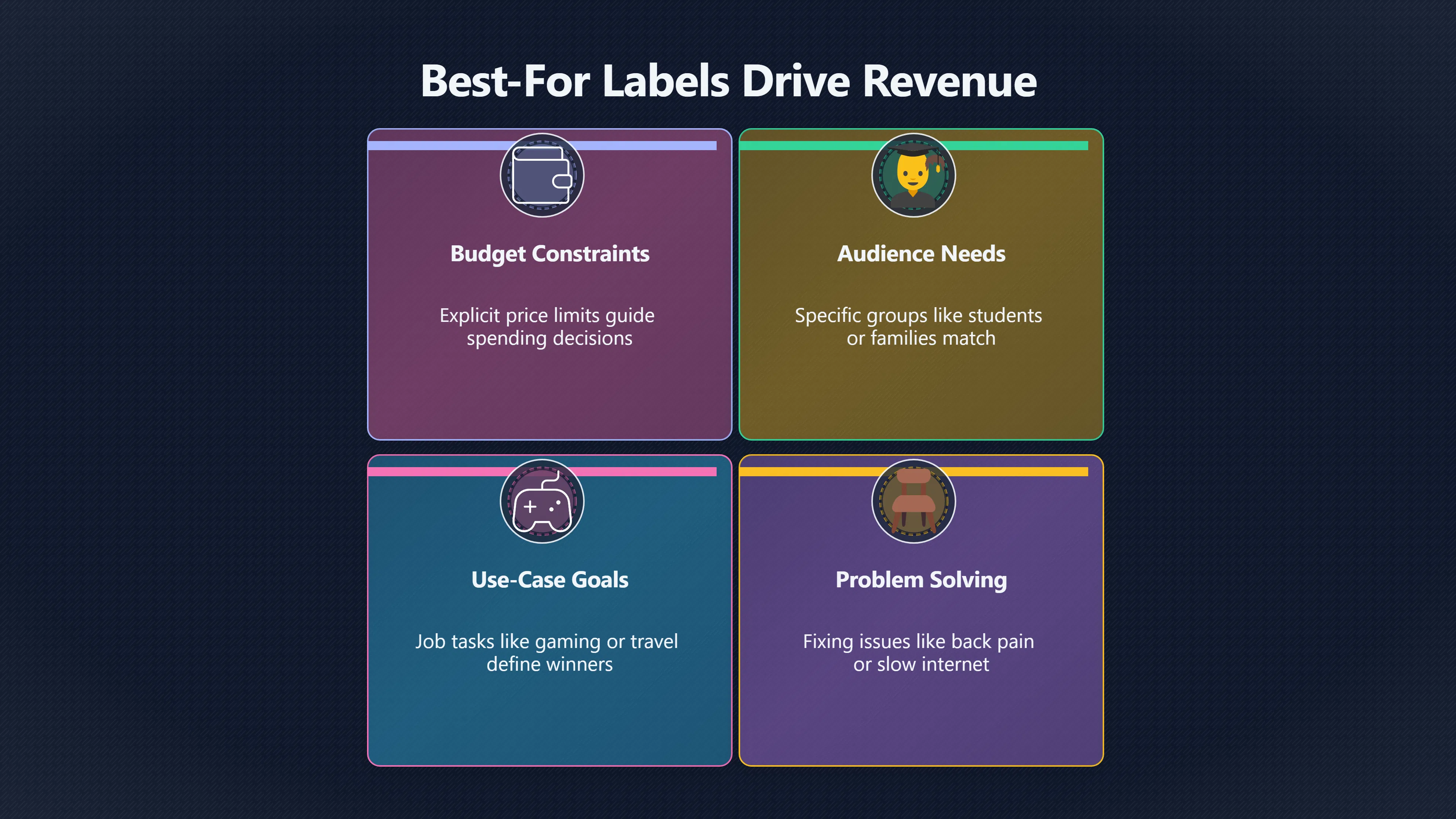
Budget-Constrained Readers
These visitors know what category they want but have a spending limit.
Examples include:
- Best laptops under £700
- Best VPN for under £5 per month
- Best office chair under £200
The label should make the constraint explicit. “Best value” is often too vague. “Best under £200” communicates a precise decision rule.
Audience-Based Readers
These readers belong to a specific group with distinct needs.
Examples include:
- Best for students
- Best for sole traders
- Best for beginners
- Best for families
The recommendation should explain why that audience benefits from the choice. The label alone is not enough; the reasoning must reinforce it.
Use-Case Readers
These visitors have a job they want to accomplish.
Examples include:
- Best for video editing[orbitmedia.com]orbitmedia.comHere is a video and checklist for website navigation best practicesOrbit Media StudiosWebsite Navigation: 9 Best Practices, Design Tips and…The structure and labels of your website navigation can have…
- Best for gaming
- Best for travel
- Best for remote teams
In these situations, the use case becomes the primary evaluation criterion. The winning product for gaming may not be the winning product for productivity.
Problem-Solving Readers
Some visitors are trying to fix a specific issue.
Examples include:
- Best for back pain
- Best for small rooms
- Best for slow internet connections
- Best for reducing business admin
Problem-focused labels often produce highly engaged visitors because they directly address the reason the search occurred.
Best-for Labels That Support Affiliate Clicks
The strongest labels reduce uncertainty before the reader reaches the affiliate button.
A useful label does three jobs simultaneously:
- Identifies a situation.
- Explains why the recommendation fits.
- Eliminates unsuitable alternatives.
For example:
Weak label
- Best premium option
Stronger label
- Best for professionals who need advanced reporting
The second version tells readers who should care and why.
This matters because affiliate conversions usually happen after a visitor believes they have found “their” recommendation. The goal is not simply to rank products. The goal is to create recognition.
A visitor thinking, “That’s me” is much closer to clicking than a visitor thinking, “I suppose that’s ranked number two.”
This also helps review quality. Google’s guidance for review content emphasises useful analysis and helping people understand which option is right for particular circumstances. Pages that explain suitability tend to provide more decision value than pages that merely list products in numerical order.[Google for Developers]developers.google.comGoogle for DevelopersGoogle Search's Reviews SystemThe reviews system aims to better reward high quality reviews, which is content that p…
What Good Best-for Labels Look Like
Strong labels are specific, practical, and based on real selection criteria.
Examples:
Weak labelStrong labelBest overallBest for most home usersBest premiumBest for professionals managing multiple clientsBest budgetBest under £100Best valueBest balance of price and performanceBest starter optionBest for complete beginnersBest advanced optionBest for power users who need automation
Notice that the stronger versions describe a person, constraint, or objective.
The reader immediately understands whether the recommendation applies to them.
Labels That Scale Across Large Affiliate Sites
For publishers building many best-of pages, best-for labels create a reusable framework.
Common label families include:
Budget labels
- Best under £50
- Best budget choice
- Best value for money
Experience labels
- Best for beginners
- Best for intermediate users
- Best for experts
Usage labels
- Best for travel
- Best for home use
- Best for daily use
Business labels
- Best for freelancers
- Best for small businesses
- Best for enterprise teams
Performance labels
- Best for speed
- Best for reliability
- Best for advanced features
Because these patterns repeat across categories, they help standardise content templates while still matching real user intent. A website-generation system can identify recurring reader situations and consistently map recommendations to those situations across hundreds of pages.
Mistakes That Make Labels Vague or Repetitive
Many affiliate pages use labels, but use them poorly.
Repeating the Same Meaning
A shortlist might contain:
- Best value
- Best budget
- Best affordable option
These labels overlap heavily. Readers struggle to understand the distinction.
Each recommendation should occupy a unique position.

Using Marketing Language Instead of User Language
Labels such as:
- Most innovative
- Most revolutionary
- Most powerful
often sound promotional rather than helpful.
Descriptive labels generally perform better because they communicate a concrete benefit rather than a marketing claim. Research into navigation and information architecture repeatedly finds that users respond more effectively to clear, familiar labels than creative or ambiguous wording.[Nielsen Norman Group]nngroup.comcategory names suckBe Descriptive and Relatable. Your navigation labels should be easily understood, even if they feel boring. Choose function over form.Rea…
Creating Artificial Categories
Sometimes publishers invent labels solely to justify another affiliate link.
Examples:
- Best blue option
- Best alternative pick
- Best unique choice
Unless these categories reflect a genuine buying consideration, they add noise rather than clarity.
Ignoring Real Trade-Offs
A recommendation cannot realistically be:
- Best budget
- Best premium
- Best for beginners
- Best for experts
at the same time.
Useful labels emerge from meaningful differences. If every recommendation seems suitable for everyone, the shortlist loses credibility.
The Conversion Advantage of Situation-Based Labels
The most effective best-of pages behave less like rankings and more like decision tools.
A reader rarely arrives wanting the absolute number-one product. More often, they want the right product for their circumstances. Best-for labels bridge that gap by translating a market full of options into a small number of recognisable situations.
For affiliate publishers, this creates a direct commercial benefit. Readers reach decisions faster, recommendations become easier to trust, and each shortlisted offer occupies a clear role rather than competing with every other recommendation on the page.
A ranking tells visitors what the publisher prefers. A well-designed best-for label tells visitors which option fits them. That distinction is often what turns a shortlist page from a traffic asset into a revenue-generating asset.
Amazon book picks
Further Reading
Books and field guides related to Why best for labels beat plain rankings. Use these as the next step if you want deeper reading beyond the article.
Don't Make Me Think, Revisited
Best-for labels reduce cognitive effort by making each recommendation’s role obvious.
Influence, New and Expanded
Best-for labels help readers self-select by matching recommendations to their situation.
Nudge
Rating: 3.5/5 from 29 Google Books ratings
Best-for labels are a form of choice architecture that guides readers without overwhelming them.
eBay marketplace picks
Marketplace Samples
Example marketplace items related to this page. Use the search link to explore similar finds on eBay.



Endnotes
1.
Source: developers.google.com
Link:https://developers.google.com/search/docs/appearance/[reviews
Source snippet
Google for DevelopersGoogle Search's Reviews SystemThe reviews system aims to better reward high quality reviews, which is content that p...
2.
Source: developers.google.com
Link:https://developers.google.com/search/docs/specialty/ecommerce/write-high-quality-reviews
Source snippet
Google for DevelopersWrite high quality reviewsWhen writing reviews, focus on the quality and originality of your reviews, not the length...
3.
Source: nngroup.com
Title: category names suck
Link:https://www.nngroup.com/articles/category-names-suck/
Source snippet
Be Descriptive and Relatable. Your navigation labels should be easily understood, even if they feel boring. Choose function over form.Rea...
4.
Source: nngroup.com
Title: Links should be Specific, Sincere, Substantial, and Succinct
Link:https://www.nngroup.com/videos/better-link-labels/
Source snippet
Nielsen Norman GroupBetter Labels for Website Links: the 4 Ss for Encouraging...4 guidelines for writing the link texts on websites to e...
5.
Source: nielsentam.com.au
Link:https://www.nielsentam.com.au/
Source snippet
Television • Audience • MeasurementNielsen Television Audience Measurement Australia (Nielsen TAM), an affiliate of Nielsen, was original...
Additional References
6.
Source: linkedin.com
Link:https://www.linkedin.com/pulse/clear-labels-better-ux-how-get-them-right-aleksandra-s–5093e
Source snippet
Clear Labels, Better UX: How to Get Them RightWhen navigation labels or category names are unclear, users often end up clicking on the wr...
7.
Source: linkedin.com
Link:https://www.linkedin.com/company/nielsen
Source snippet
NielsenNielsen shapes the world's media and content as a global leader in audience insights, data and analytics. Through our understandin...
8.
Source: thedecisionlab.com
Link:https://thedecisionlab.com/reference-guide/design/tree-testing
Source snippet
Tree TestingTree testing is a user experience (UX) research method to evaluate how easily users can find key resources and information on...
9.
Source: optimalworkshop.com
Title: information architecture vs navigation creating a seamless user experience
Link:https://www.optimalworkshop.com/blog/information-architecture-vs-navigation-creating-a-seamless-user-experience
Source snippet
Information Architecture vs Navigation: A Practical UX Guide21 Nov 2025 — Learn how information architecture and navigation work together...
10.
Source: orbitmedia.com
Title: Here is a video and checklist for website navigation best practices
Link:https://www.orbitmedia.com/blog/website-navigation/
Source snippet
Orbit Media StudiosWebsite Navigation: 9 Best Practices, Design Tips and...The structure and labels of your website navigation can have...
11.
Source: optimalworkshop.com
Title: how to develop a taxonomy for your information architecture
Link:https://www.optimalworkshop.com/blog/how-to-develop-a-taxonomy-for-your-information-architecture
Source snippet
10 Jan 2022 — In information architecture, taxonomy refers to how information is grouped, classified and labeled within a shared informat...
12.
Source: seozoom.com
Title: google reviews system the algorithm on product reviews
Link:https://www.seozoom.com/google-reviews-system-the-algorithm-on-product-reviews/
Source snippet
Google Reviews System: the algorithm on product reviews17 Apr 2023 — Guide to Reviews system, the Google algorithm evaluating reviews, an...
13.
Source: lovable.dev
Title: website navigation best practices that convert
Link:https://lovable.dev/guides/website-navigation-best-practices-that-convert
Source snippet
Website Navigation Best Practices for Better UX16 Mar 2026 — Descriptive, plain-language labels help visitors choose confidently and reac...
14.
Source: reddit.com
Link:https://www.reddit.com/r/UXDesign/comments/1kibmse/does_anyone_have_any_examples_of_this_in_article/
Source snippet
n mobile. I want to find more examples of this but I am not 100% sure...
15.
Source: yoast.com
Title: google product reviews update quality content
Link:https://yoast.com/google-product-reviews-update-quality-content/
Source snippet
What can Google's "Product reviews" update teach us...27 Apr 2021 — Learn how we can take Google's review guidelines, and apply them to...
Topic Tree