Within Trust Rules
What Makes an Affiliate Recommendation Feel Honest?
Balanced reviews, update dates, trade-offs, and testing notes help affiliate pages feel useful rather than purely sales-driven.
On this page
- Review details that reduce the sales pitch effect
- Trade offs that show editorial independence
- Template elements that build trust across many pages
Page outline Jump by section
Introduction
Readers do not trust affiliate recommendations simply because a page contains a disclosure. They trust recommendations when the page demonstrates that a real evaluation happened and that the recommendation survives honest scrutiny. A disclosure explains the commercial relationship; trust signals explain why the recommendation should still be taken seriously.
 For affiliate websites, this distinction matters commercially. Pages that feel like disguised adverts often struggle to convert informed buyers, especially in competitive sectors where visitors compare several reviews before purchasing. By contrast, pages that show evidence, trade-offs, testing notes, update history, and genuine selection criteria tend to keep users engaged for longer and make affiliate links feel like a logical next step rather than a sales funnel.
Trust signals are therefore not cosmetic additions. They are conversion assets that influence both user confidence and broader quality signals associated with trustworthy content. Google’s guidance repeatedly emphasises experience, expertise, and trustworthiness as markers of quality, particularly where recommendations influence purchasing decisions.[Google Services]services.google.comGoogle ServicesSearch Quality Rater Guidelines: An OverviewIn determining page quality, Raters must consider EEAT: The first-hand experie…[Google for Developers]developers.google.comHelpful, Reliable, People-First ContentGoogle's ranking systems are designed to present helpful, reliable information that's created to b…
Why Readers Distrust Many Affiliate Reviews
The average internet user has seen countless “best product” lists that appear to recommend every item equally. Several patterns immediately trigger scepticism:
- Every product receives an almost perfect score.
- No meaningful drawbacks are mentioned.
- The review appears copied from manufacturer specifications.
- There is no evidence the writer has used or evaluated the product.
- The article has not been updated for years.
- Recommendations seem driven by commission rates rather than user needs.
Trust problems often arise because affiliate publishers optimise purely for clicks. The result is content that looks commercially motivated before it looks helpful.
This creates a revenue problem. A visitor who suspects bias may still read the page, but is less likely to rely on its recommendations when making a purchase. The conversion path weakens because confidence weakens.
Google’s Search Quality Rater Guidelines also place significant emphasis on first-hand experience and trustworthiness when evaluating content quality. Pages that demonstrate real-world involvement with a subject are treated differently from pages that merely aggregate information.[Google Services]services.google.comGoogle ServicesSearch Quality Rater Guidelines: An OverviewIn determining page quality, Raters must consider EEAT: The first-hand experie…[RaterHub Guidelines]guidelines.raterhub.comRaterHub GuidelinesGeneral Guidelines11 Sept 2025 — Introduction to Search Quality Rating. 0.0 The Search Experience… no expertise or…
Review Details That Reduce the Sales-Pitch Effect
The strongest trust signals usually come from specific evidence rather than persuasive language.
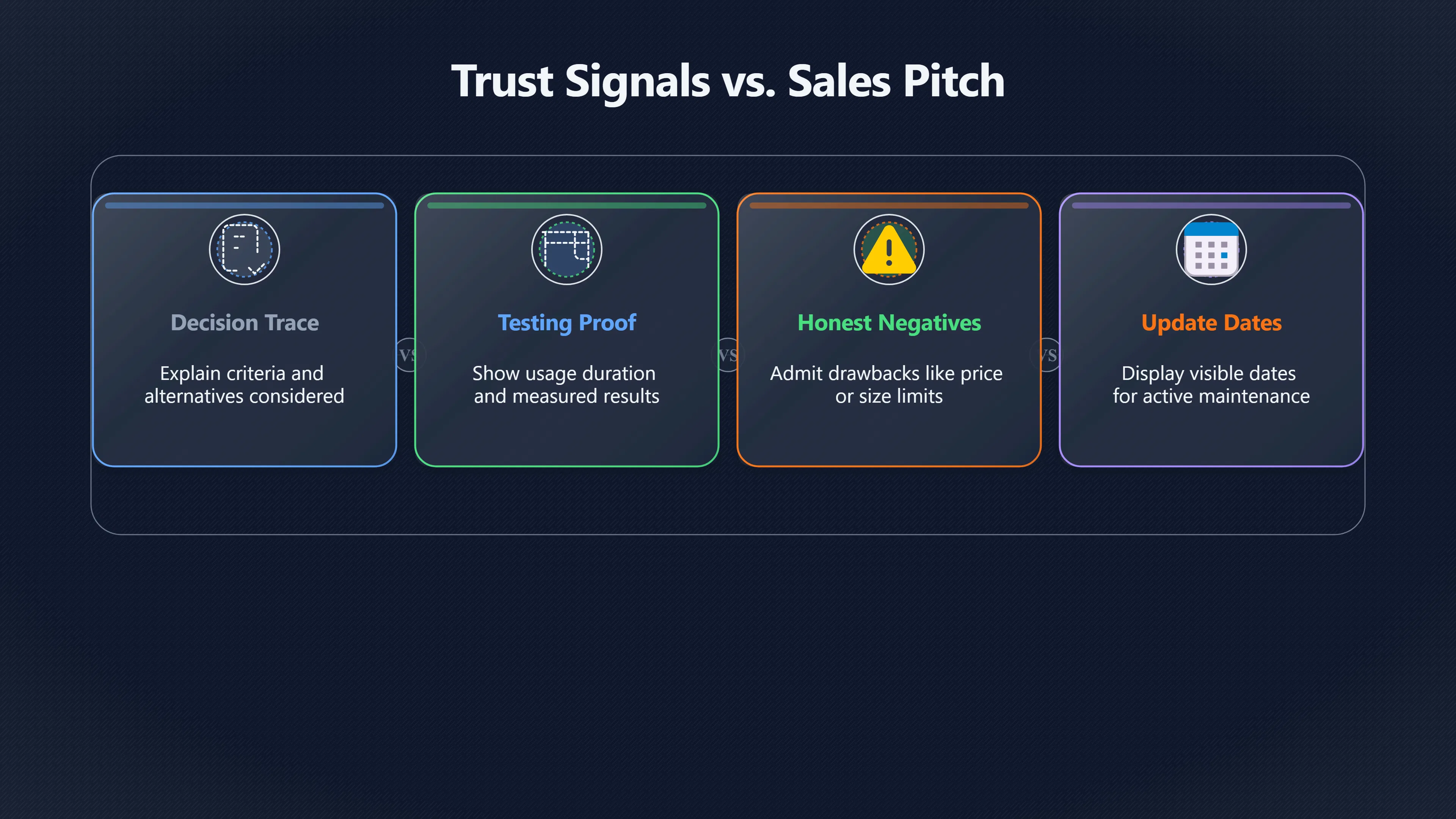
Showing how the recommendation was reached
Readers become more confident when they can see the decision process.
Instead of:
“This is the best laptop for students.”
A stronger recommendation explains:
- Who the product is for.
- What criteria were evaluated.
- Which alternatives were considered.
- Why this option won.
For example:
“We compared battery life, weight, keyboard quality, and price. This model offered the best balance for students carrying it daily between lectures.”
The recommendation becomes traceable rather than arbitrary.
For scalable affiliate systems, this means review templates should contain structured evaluation fields rather than generic promotional copy. Comparison criteria can become reusable data points across hundreds of pages.
Evidence of use or testing
Readers trust observations that sound difficult to fake.
Examples include:
- Original photographs.
- Testing notes.
- Usage duration.
- Measured results.
- Screenshots.
- Before-and-after comparisons.
Even simple statements such as:
“We used this standing desk for three weeks in a home office setup.”
carry more credibility than broad claims about quality.
Google’s quality guidance increasingly highlights experience as a meaningful trust factor. Content that demonstrates direct interaction with a product generally aligns more closely with what users expect from a recommendation page.[Google Services]services.google.comGoogle ServicesSearch Quality Rater Guidelines: An OverviewIn determining page quality, Raters must consider EEAT: The first-hand experie…[Search Engine Roundtable]seroundtable.comSearch Engine Roundtable E-E-A-TSearch Engine RoundtableE-E-A-T - "Experience" Added To Revised Search Quality…Dec 16, 2022 — The Google search quality raters guideli…
Specific observations beat marketing language
Readers recognise manufacturer copy immediately.
Compare:
“Exceptional audio quality and immersive sound.”
with:
“Speech remained clear during video calls, but bass performance was noticeably weaker than larger competing speakers.”
The second statement contains an observation. The first contains marketing language.
For affiliate websites at scale, this distinction is important because generic promotional wording creates detectable patterns that reduce perceived authenticity across an entire site.
Visible update dates
Product recommendations age quickly.
Software changes, prices move, products become unavailable, and competitors release improved alternatives.
A visible update date signals active maintenance. It reassures visitors that the recommendation was not abandoned years ago.
This is particularly valuable on:
- Product comparison pages.
- Best-of lists.
- Software recommendations.
- Hosting reviews.
- Technology buying guides.
A scalable affiliate system should treat freshness as part of trust infrastructure rather than an editorial extra. Pages affecting commercial decisions benefit when update status is obvious.
Trade-Offs That Show Editorial Independence
One of the fastest ways to make a recommendation feel credible is to admit where it falls short.
Honest negatives increase confidence
A review that contains no drawbacks often appears dishonest.
Readers know every product has limitations.
Examples include:
- Higher price.
- Steeper learning curve.
- Poor mobile experience.
- Limited integrations.
- Weaker customer support.
- Large physical size.
When a page openly discusses these issues, readers become more willing to trust positive claims elsewhere on the page.
The recommendation starts to resemble advice rather than advertising.
Explaining who should avoid the product
This is one of the strongest trust signals available.
For example:
“This hosting platform is excellent for high-traffic WordPress sites, but it is probably excessive for hobby projects with fewer than 1,000 monthly visitors.”
The recommendation deliberately excludes some users.
Counterintuitively, this often improves conversions because readers feel the recommendation is being matched to their needs rather than pushed universally.
For affiliate site systems, “Who should avoid this?” sections can become standard template elements across commercial content types.
Ranking products differently for different users
Many low-trust affiliate pages attempt to identify a single universal winner.
Higher-trust pages recognise that different readers have different priorities.
Examples:
- Best budget option.
- Best premium option.
- Best for beginners.
- Best for professionals.
- Best for portability.
- Best long-term value.
This approach demonstrates editorial judgement and creates more natural offer matching.
It also improves monetisation because multiple products can be recommended legitimately without making the page look manipulated.

Acknowledging uncertainty
Not every recommendation needs absolute confidence.
Sometimes evidence is mixed.
Examples include:
- New products with limited testing history.
- Recently released software.
- Rapidly changing markets.
- Services with inconsistent support quality.
A statement such as:
“Early reviews are promising, but long-term reliability data is still limited.”
often increases credibility because it reflects genuine uncertainty rather than pretending complete knowledge.
Trust Signals Around Disclosure Itself
Affiliate disclosure and recommendation credibility reinforce one another.
Research examining affiliate disclosures found that users often fail to understand vague or abbreviated disclosure wording, while clearer explanatory disclosures improve understanding of the commercial relationship.[arXiv]arxiv.orgEndorsements on Social Media: An Empirical Study of Affiliate Marketing Disclosures on YouTube and PinterestSeptember 3, 2018…
The most trusted affiliate pages tend to combine:
- Clear disclosure placement.
- Plain-language commission explanations.
- Independent review criteria.
- Visible editorial standards.
A disclosure becomes more believable when the rest of the page also demonstrates independence.
For example, a disclosure saying:
“We may earn a commission from purchases.”
carries more weight when the article also contains criticism, alternatives, and decision criteria.
Without those supporting signals, the disclosure can reinforce the impression that the page exists primarily to generate commissions.
Template Elements That Build Trust Across Many Pages
Large affiliate websites cannot rely on handcrafted credibility for every page. Trust signals need to be repeatable.
Consistent review framework
Using the same evaluation structure across a category creates predictability.
A review template might include:
- Summary verdict.
- Key strengths.
- Key weaknesses.
- Best use case.
- Alternative options.
- Testing notes.
- Update date.
Readers quickly learn how recommendations are being evaluated.
This consistency also helps website-generation systems standardise page quality across large content clusters.
Comparison tables with clear criteria
Comparison tables reduce suspicion because readers can inspect the evidence themselves.
Useful comparison fields include:
- Price range.
- Features.
- Warranty.
- Performance metrics.
- Support options.
- Suitable user type.
Trust increases when the table explains differences rather than merely ranking products.
The recommendation becomes transparent.
Author and reviewer information
Trust improves when readers know who created the recommendation.
Useful signals include:
- Named authors.
- Relevant expertise.
- Review methodology.
- Editorial policies.
- Contact information.
Google’s quality frameworks repeatedly connect trustworthiness with clear information about who created content and why users should trust them.[Google Services]services.google.comGoogle ServicesSearch Quality Rater Guidelines: An OverviewIn determining page quality, Raters must consider EEAT: The first-hand experie…[RaterHub Guidelines]guidelines.raterhub.comRaterHub GuidelinesGeneral Guidelines11 Sept 2025 — Introduction to Search Quality Rating. 0.0 The Search Experience… no expertise or…
For affiliate sites covering specialised topics such as finance, health, software, or technical equipment, author transparency can become a significant differentiator.
Editorial policy pages
An editorial policy can explain:
- How products are selected.
- Whether commissions influence rankings.
- How updates are handled.
- How corrections are made.
Most visitors will never read the full policy.
However, its existence still acts as a trust signal because it demonstrates that recommendations operate within defined standards.
Visible correction and update history
A simple note such as:
“Updated May 2026 to reflect pricing changes and newly released alternatives.”
signals ongoing maintenance.
This is particularly useful for:
- Software recommendations.
- Hosting comparisons.
- Technology reviews.
- Financial product comparisons.
The page appears managed rather than abandoned.
Which Trust Signals Tend to Influence Revenue Most
Not all credibility signals produce equal commercial value.
For affiliate-focused websites, the signals most closely connected to conversion performance tend to be:
- Clear explanation of why a product was chosen.
- Honest discussion of drawbacks.
- Evidence of testing or real-world use.
- Visible update dates.
- Comparison against realistic alternatives.
- User-specific recommendations rather than one-size-fits-all rankings.
- Transparent disclosure of affiliate relationships.
These elements reduce friction at the decision stage because they answer the question most visitors are already asking:
“Can I trust this recommendation?”
When affiliate pages consistently answer that question with evidence rather than persuasion, recommendations feel less like adverts and more like informed guidance. That shift is often what turns traffic into revenue.
Amazon book picks
Further Reading
Books and field guides related to What Makes an Affiliate Recommendation Feel Honest?. Use these as the next step if you want deeper reading beyond the article.
Trust Me, I'm Lying
Shows why audiences become sceptical when online recommendations appear commercially distorted.
Everybody Writes
Helps affiliate writers create evidence-rich, honest recommendations that do not feel like sales copy.
Building a StoryBrand 2.0
Supports reader-centred recommendation templates that foreground the buyer’s problem, not the commission.
Made to Stick
Useful for making trade-offs, criteria, and trust signals clear and persuasive.
eBay marketplace picks
Marketplace Samples
Example marketplace items related to this page. Use the search link to explore similar finds on eBay.




Endnotes
1.
Source: services.google.com
Link:https://services.google.com/fh/files/misc/hsw-sqrg.pdf
Source snippet
Google ServicesSearch Quality Rater Guidelines: An OverviewIn determining page quality, Raters must consider EEAT: The first-hand experie...
2.
Source: developers.google.com
Link:https://developers.google.com/search/docs/fundamentals/creating-helpful-content
Source snippet
Helpful, Reliable, People-First ContentGoogle's ranking systems are designed to present helpful, reliable information that's created to b...
3.
Source: guidelines.raterhub.com
Link:https://guidelines.raterhub.com/searchqualityevaluatorguidelines.pdf
Source snippet
RaterHub GuidelinesGeneral Guidelines11 Sept 2025 — Introduction to Search Quality Rating. 0.0 The Search Experience... no expertise or...
4.
Source: arxiv.org
Link:https://arxiv.org/abs/1809.00620
Source snippet
Endorsements on Social Media: An Empirical Study of Affiliate Marketing Disclosures on YouTube and PinterestSeptember 3, 2018...
Published: September 3, 2018
5.
Source: arxiv.org
Link:https://arxiv.org/abs/1803.08488
6.
Source: google.com
Link:https://www.google.com/
Source snippet
Search the world's information, including webpages, images, videos and more. Google has many special features to help you find exac...
7.
Source: google.com
Link:https://www.google.com/intl/en_us/search/howsearchworks/how-search-works/ranking-results
Source snippet
How Does Google Determine Ranking ResultsDiscover how key factors such as meaning, relevance, and quality are used to generate how websit...
8.
Source: youtube.com
Title: How To Build Trust Online In Affiliate Marketing
Link:http://www.youtube.com/watch?v=m__413T78AY
Source snippet
What is Google E-E-A-T (plus tools to improve yours)...
9.
Source: youtube.com
Title: What is Google E-E-A-T (plus tools to improve yours)
Link:http://www.youtube.com/watch?v=Nrz_4P3QCt4
Source snippet
EEAT in Google for Beginners (Experience, Expertise, Authoritativeness, and Trustworthiness)...
10.
Source: youtube.com
Link:http://www.youtube.com/watch?v=EgFjMHBSFus
Source snippet
How to Repurpose Podcast Interviews Into Website Content + Build E-E-A-T for Google & AI Visibility...
11.
Source: youtube.com
Link:http://www.youtube.com/watch?v=ET5Wjh_V7xs
Source snippet
Ways to Use EEAT to Rank Higher on Google (Beginner Guide)...
12.
Source: youtube.com
Title: Ways to Use EEAT to Rank Higher on Google (Beginner Guide)
Link:http://www.youtube.com/watch?v=0dRko7mF3LE
Source snippet
Build trust affiliate marketing product reviews website credibility (PLR) EZ Online Credibility Review – Build Trust & Grow Your List in...
13.
Source: seroundtable.com
Title: Search Engine Roundtable E-E-A-T
Link:https://www.seroundtable.com/google-e-e-a-t-experience-search-quality-raters-guidelines-34576.html
Source snippet
Search Engine RoundtableE-E-A-T - "Experience" Added To Revised Search Quality...Dec 16, 2022 — The Google search quality raters guideli...
14.
Source: hikeseo.co
Link:https://www.hikeseo.co/learn/technical/google-eeat
Source snippet
Google's Search Quality Rater Guidelines...
15.
Source: youtube.com
Link:https://www.youtube.com/watch?v=pAWcYSBQHNc
Additional References
16.
Source: federalregister.gov
Title: guides concerning the use of endorsements and testimonials in advertising
Link:https://www.federalregister.gov/documents/2023/07/26/2023-14795/guides-concerning-the-use-of-endorsements-and-testimonials-in-advertising
Source snippet
Guides Concerning the Use of Endorsements and...26 Jul 2023 — The Federal Trade Commission (FTC or Commission) is adopting revised Guide...
17.
Source: nielsen.com
Link:https://www.nielsen.com/
Source snippet
Audience Is Everything®A global leader in media measurement, analytics and insights, Nielsen shapes the future of media with ac...
18.
Source: qualia-academy.co.uk
Link:https://qualia-academy.co.uk/google-e-e-a-t-guidelines/
Source snippet
Google's E-E-A-T Important GuidelinesOne of the most influential frameworks guiding Google's content evaluation process is E-E-A-T, which...
19.
Source: iubenda.com
Link:https://www.iubenda.com/en/blog/affiliate-disclosure/
Source snippet
How to Write an Effective Affiliate DisclosureAccording to the FTC, endorsements must reflect the honest opinions and experience of the e...
20.
Source: adamigo.ai
Link:https://www.adamigo.ai/blog/ultimate-guide-to-ftc-ad-disclosures
Source snippet
Ultimate Guide to FTC Ad DisclosuresMaterial Connections That Require Disclosure. A material connection refers to any relationship betwee...
21.
Source: federal-lawyer.com
Link:https://federal-lawyer.com/ftc-defense/affiliate-disclosure/
Source snippet
Understanding the FTC's Affiliate Disclosure RulesLearn what affiliate marketers and companies need to know about the FTC's affiliate dis...
22.
Source: ftc.gov
Title: influencers are your materialconnection disclosures clearandconspicuous
Link:https://www.ftc.gov/business-guidance/blog/2017/04/influencers-are-your-materialconnection-disclosures-clearandconspicuous
Source snippet
Influencers, are your #materialconnection #disclosures...19 Apr 2017 — If there is a material connection between an endorser and an adve...
23.
Source: dglaw.com
Link:https://www.dglaw.com/the-deep-dive-ftc-updates-endorsement-guides-for-modern-marketing-and-advertising/
Source snippet
The Deep Dive: FTC Updates Endorsement Guides...11 Jul 2023 — On June 29, the FTC announced new Endorsement Guides (Endorsement Guides)...
24.
Source: ftc.gov
Title: s endorsement guides what people are asking
Link:https://www.ftc.gov/business-guidance/resources/ftcs-endorsement-guides-what-people-are-asking
Source snippet
Federal Trade CommissionFTC's Endorsement Guides: What People Are Asking29 Jun 2023 — Here are answers to some of the most frequently ask...
25.
Source: mangools.com
Link:https://mangools.com/blog/e-e-a-t/
Source snippet
E-E-A-T & SEO: How does Google evaluate content quality?24 Oct 2023 — Google EEAT stands for Experience, Expertise, Authoritativeness, an...
Topic Tree