Within Affiliate Engines
Why Equal Traffic Does Not Mean Equal Earnings
Revenue per visitor rises only when intent, clicks, merchant conversion, and commission value work together.
On this page
- Intent, click through, conversion, and commission
- Where the revenue chain breaks
- Using the model to prioritise pages

Page outline Jump by section
Introduction
Revenue per visitor is a decision model for affiliate websites because it explains why equal traffic does not produce equal earnings. A page earns only when the visitor’s intent, the page’s click-through behaviour, the merchant’s conversion ability, and the commission value work together. In simple terms, a page with 1,000 visitors can outperform a page with 10,000 visitors if its readers are closer to buying, its affiliate links are better placed, its merchants convert reliably, and its payout per sale is higher.
For websites built around affiliate links, this model is more useful than traffic volume alone. Affiliate networks track clicks, conversions, basket values and commission outcomes, which means the publisher can judge pages by commercial performance rather than page views alone. Awin describes affiliate tracking as a way to see which online activity generates visitors, conversions and clicks, while Amazon Associates pays commission only on qualifying purchases made after users follow tracked links from an Associate’s site.[Awin]awin.comWhat is affiliate link tracking and how to use it?What is affiliate link tracking and how to use it?June 4, 2020 — 22 Nov 2022 — Why is affiliate tracking important? Find out how to t…
The practical model is:
Revenue per visitor = affiliate click-through rate × merchant conversion rate × commission per conversion
That simple chain turns affiliate publishing into a prioritisation system. It helps decide which topics deserve more pages, which page types should be standardised, which offers should be tested, and where a website-generation system should send internal links.
Intent, click-through, conversion and commission work as one chain
Revenue per visitor starts before the affiliate link appears. It starts with the reason the person arrived. A visitor searching for “best trail running shoes for muddy paths” is usually more commercially useful than a visitor searching for “history of running shoes”, even if the second page attracts more traffic. The first reader is comparing options; the second may simply be learning. This is why keyword intent cannot be separated from monetisation.
A useful affiliate page therefore has four linked parts:
- Intent: Does the visitor have a decision to make?
- Click-through: Does the page give a clear, trustworthy reason to visit the merchant?
- Merchant conversion: Does the merchant page turn referred visitors into buyers or leads?
- Commission value: Is the sale, lead or bounty worth enough to matter?
Affiliate platforms make this chain measurable. Awin says advertisers can record and report data points including basket value, product type, new or existing customer status, coupon use and click-to-sale lag time. Its publisher tools also give visibility into sales, order value, click-to-sale lag and contribution where a publisher influenced a sale but did not secure the last click.[Awin]awin.comOpen source on awin.com.
This matters because a page can be strong at one part of the chain and weak at another. A well-written guide may attract engaged readers but generate few clicks because the buying moment is hidden. A product roundup may get clicks but send users to a merchant with weak product pages, poor stock or unattractive prices. A high-commission programme may still produce low revenue per visitor if the merchant converts poorly.
The key is to avoid treating “traffic”, “clicks” and “sales” as separate reports. They are connected stages in one commercial path. A page’s job is not merely to receive a visitor. It must move the right visitor towards a tracked action.

Why equal traffic does not mean equal earnings
Two affiliate pages can have the same number of visits and completely different revenue. The difference is usually not mysterious; it comes from the revenue chain.
Imagine three pages, each receiving 10,000 monthly visitors:
Page typeVisitor intentAffiliate click-throughMerchant conversionCommissionEstimated revenueGeneral information articleWeak0.5%2%£5£5Buying guideMedium4%3%£8£96High-intent comparison pageStrong10%5%£20£1,000
The traffic number is identical, but the page economics are not. The general information article sends only 50 visitors to a merchant; at 2% conversion and £5 commission, that produces roughly one sale and £5. The comparison page sends 1,000 visitors; at 5% conversion and £20 commission, that produces 50 sales and £1,000.
The numbers are illustrative, but the logic reflects how affiliate reporting works. Earnings per click, or EPC, is widely used in affiliate marketing to show average earnings from affiliate clicks. PartnerStack defines EPC as the average dollar value earned each time someone clicks an affiliate link, while Post Affiliate Pro frames it as a way to compare campaigns and forecast earnings from click volume.[PartnerStack]partnerstack.comSource details in endnotes.
Revenue per visitor is slightly broader than EPC. EPC starts after the affiliate click. Revenue per visitor includes the page’s ability to create the click in the first place. For a content site, that distinction is crucial. A merchant with a strong EPC may still perform badly on a page where readers are not ready to click. Equally, a page with strong click-through can disappoint if the merchant fails to convert.
Where the revenue chain breaks
The revenue per visitor model is most useful when it shows exactly where a page is failing. Low earnings are often blamed on “bad traffic”, but the break can happen at several points.
The page attracts the wrong intent
A topic can look valuable because search volume is high, but if the query is informational rather than commercial, the earning path may be weak. A recipe-style article, definition page or broad advice guide may still have a role in a site, but it should not be judged as though every visitor is ready to buy.
Baymard has warned against comparing conversion rates without accounting for traffic source and buyer journey. The same ecommerce site can show very different conversion rates depending on whether traffic comes from broad visitors or highly related buying keywords such as “buy cellphone battery”.[Baymard Institute]baymard.comInstitute Comparing Conversion Rates is NonsenseInstitute Comparing Conversion Rates is Nonsense
For affiliate sites, this means topic selection should score the buying situation, not just the keyword volume. Queries containing words such as “best”, “review”, “alternatives”, “vs”, “for”, “discount”, “cheap”, “near me”, “compatible with” or “replacement” often indicate a decision point. A page generation system should treat those as different commercial classes from “what is”, “history of”, “meaning of” or “how does”.
The page answers the question but fails to create a commercial next step
Some pages provide useful information but do not explain why a product, service or merchant visit is the next logical step. This is not solved by adding more affiliate links. The link needs to appear at the moment where the reader’s decision is naturally forming.
For example, a page about “how to stop trainers smelling” may earn little if it only explains causes. It becomes more commercially useful when it maps symptoms to solutions: deodorising spray for odour, washable insoles for sweat, shoe dryers for damp storage, or replacement running shoes when the midsole is worn out. The affiliate link is then attached to a decision, not dropped into unrelated text.
Nielsen Norman Group’s ecommerce product-page guidance emphasises that online shoppers need product questions answered, help comparing options, customer experiences and a way to start the purchase process. Those same tasks apply one step earlier on an affiliate page: the publisher’s page should prepare the reader to make sense of the merchant page, not merely send a blind click.[Nielsen Norman Group]nngroup.comNielsen Norman Group UX Guidelines for Ecommerce Product PagesNielsen Norman Group UX Guidelines for Ecommerce Product Pages
The merchant receives clicks but loses the sale
Affiliate publishers do not control the merchant checkout, product stock, delivery promise or trust signals. Yet those factors still affect publisher earnings because the commission depends on the merchant converting the referred visitor.
This is why offer selection should not be based only on commission percentage. A merchant paying 12% can be worse than one paying 4% if the higher-paying merchant has poor availability, weak product pages, confusing delivery information or a checkout flow that users abandon. Baymard’s product-page UX benchmark found that only 49% of ecommerce sites had “decent” or “good” product-page UX, with 51% rated mediocre or worse, so merchant-side friction is a real variable rather than a theoretical detail.[Baymard Institute]baymard.comInstitute Comparing Conversion Rates is NonsenseInstitute Comparing Conversion Rates is Nonsense
For a scalable affiliate site, merchant testing should therefore include more than the headline commission. The useful question is: “How much revenue does this merchant produce per visitor we send from this page type?” That blends conversion rate, order value, payout rules and user fit.
The sale happens but the commission is lower than expected
Commission value is not just “the programme pays X%”. It depends on programme rules, qualifying purchases, excluded categories, bounty events, cookie windows, basket value, cancellations and attribution.
Amazon Associates UK, for example, states that commission income is calculated as a percentage of qualifying revenue and that qualifying purchases depend on users clicking through special links. It also lists different standard commission rates by category, including 4% for categories such as beauty, luggage, personal care appliances and sports and fitness, 2.5% for appliances and mobile electronics, 1% for some grocery and video game categories, and 0% for certain gift card and related categories.[Amazon Associates]pwskills.comamazon associates
That means two product recommendations with similar prices can have different earning value. A £100 item at 4% produces £4 before adjustments; a £100 item at 1% produces £1. If both require the same content effort and attract similar traffic, the page pointing to the higher effective commission has a different commercial ceiling.
Using revenue per visitor to prioritise pages
A revenue per visitor model helps decide what to build next. It prevents a website from overproducing pages that attract attention but do not create tracked commercial outcomes.
A practical prioritisation approach is to classify pages into four groups:
Page groupWhat the data suggestsBest next decisionHigh traffic, low revenue per visitorIntent mismatch, weak link placement, poor offer fit or low commissionDiagnose the weakest stage before producing more similar pagesLow traffic, high revenue per visitorStrong commercial intent or strong offer fitExpand into adjacent keywords and internal linksHigh traffic, high revenue per visitorScalable winning patternStandardise the page template and replicate carefullyLow traffic, low revenue per visitorWeak demand and weak monetisationDeprioritise unless it supports topical authority or internal linking
This is where revenue per visitor becomes more than an analytics metric. It becomes a page-production rule. If “best X for Y” pages in one cluster repeatedly produce higher revenue per visitor than broad “how to” explainers, the system should create more specific comparison and buying-guide pages. If review pages get clicks but low merchant conversion, the system should test different merchants or place stronger pre-click qualification on the page.
The model also helps avoid a common affiliate mistake: chasing the highest commission first. A high payout is only one part of the equation. A niche software offer may pay far more per conversion than a low-cost physical product, but if the traffic is early-stage and the merchant requires a long sign-up journey, the page may not produce the expected revenue per visitor. Conversely, a lower-commission retailer with strong brand trust and fast checkout may outperform a generous but unfamiliar merchant.
Awin’s pricing examples show how affiliate payouts can be set as a percentage of transaction value, while Amazon’s policies show how rates vary by product category. These programme economics should be combined with page-level behaviour, not read in isolation.[Awin]awin.comOpen source on awin.com.
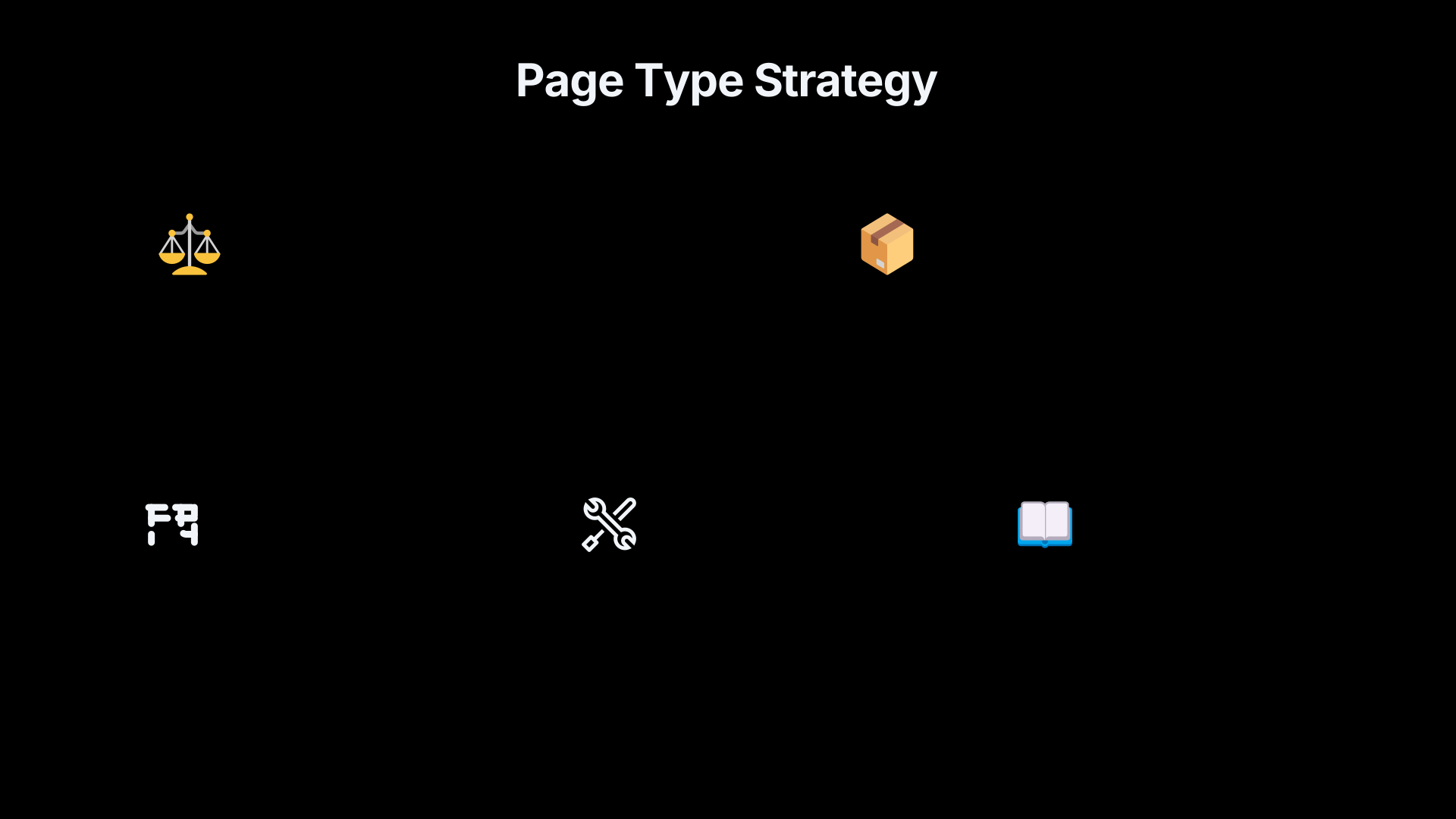
The page type should match the commercial moment
Revenue per visitor improves when the page format fits the visitor’s decision stage. Different page types are not interchangeable.
A comparison page is strongest when the reader has narrowed the field and needs help choosing between options. It should make differences visible: price, use case, compatibility, durability, drawbacks, merchant choice and who should avoid each option.
A single review works when the reader is already interested in a named product or service. Its job is to confirm fit, explain trade-offs and answer objections before the merchant click.
A best-for guide works when the reader has a problem but not a product. “Best standing desks for small flats” is not just a list; it is a decision tool organised around space, stability, budget and delivery.
A problem-solution article can earn when it connects symptoms to buying paths. “Why does my laptop overheat?” may lead to cleaning kits, cooling stands, repair services or replacement decisions, but only if the page distinguishes cheap fixes from cases where a product is not the answer.
A definition or background page usually has lower direct revenue per visitor, but it can still support the site by explaining terms and linking readers towards commercial pages. The mistake is treating it as equal to a high-intent page in production planning.
Nielsen Norman Group notes that ecommerce pages should help users compare products and start the purchase process; Baymard’s research similarly shows that product-page UX problems can cause users to abandon otherwise suitable products. For affiliate publishers, the lesson is that page templates should reduce decision friction before the visitor leaves the site.[Nielsen Norman Group]nngroup.comNielsen Norman Group UX Guidelines for Ecommerce Product PagesNielsen Norman Group UX Guidelines for Ecommerce Product Pages
Offer matching is not the same as adding more links
More affiliate links do not automatically raise revenue per visitor. They can reduce trust, distract from the decision, or send users to weak merchants. The better question is which offer matches the visitor’s intent at that point in the page.
A visitor reading “best cordless vacuum for pet hair” does not simply need any vacuum link. They need offers that match pet hair performance, floor type, battery life, filtration, weight, replacement parts and price sensitivity. A visitor reading “Dyson V15 vs Shark Stratos” needs a different path: direct comparison, best current merchant options, warranty differences and reasons to choose one over the other.
Offer matching should consider:
- Product fit: Does the offer solve the exact problem described by the page?
- Merchant fit: Is the retailer trusted, stocked and easy to buy from?
- Commission fit: Is the payout meaningful after exclusions and category rules?
- User-flow fit: Does the merchant landing page continue the decision started on the affiliate page?
- Compliance fit: Is the commercial relationship disclosed clearly enough?
The compliance point is not separate from revenue. In the UK, the Advertising Standards Authority says affiliate content may need additional disclosure so that it is obviously identifiable as a marketing communication, especially where the wider context looks editorial. The UK government’s guidance for creators similarly says commercial content must be correctly labelled and clearly identifiable, and that affiliate links alone are not enough.[Asa]asa.org.ukaffiliate marketingaffiliate marketing
For a scalable website system, disclosure should be standardised rather than improvised page by page. Clear disclosure protects trust and prevents the commercial model from being hidden in a way that undermines the reader’s ability to judge recommendations.

Evidence beats assumptions when deciding what to scale
Revenue per visitor is valuable because it replaces attractive guesses with evidence. A topic may feel commercial but produce weak revenue. A page format may look simple but repeatedly outperform more elaborate articles. A merchant may advertise a generous rate but underperform after real visitors click through.
The most useful evidence is not one metric in isolation. It is the pattern across the chain:
- Search impressions and visits show whether the topic can attract readers.
- Affiliate click-through rate shows whether the page creates a commercial next step.
- EPC or revenue per affiliate click shows how valuable the referred clicks are.
- Revenue per visitor combines page behaviour and merchant performance.
- Refunds, reversals and excluded transactions show whether gross earnings are reliable.
- Internal-link paths show which supporting pages feed commercial pages.
Affiliate attribution also complicates the picture. Rakuten Advertising explains that different programmes may use last-click, first-click or multi-touch attribution models to decide which partner receives credit for a conversion. Awin’s publisher tools also refer to “influence contribution”, where a publisher had a touchpoint in a sale but did not secure the last click.[Rakuten Advertising Blog]blog.rakutenadvertising.comRakuten Advertising Blog How Affiliate Tracking WorksRakuten Advertising Blog How Affiliate Tracking Works
That means a page may be commercially useful even if it is not always the final converting page. A buying guide may introduce a reader to a category, while a later coupon, brand search or retargeting touchpoint captures the last click. For internal decision-making, the site should still distinguish direct revenue pages from assist pages. Both can be useful, but they should not be judged by the same narrow metric.
A practical scoring model for affiliate page production
A scalable affiliate site can use revenue per visitor as both a reporting metric and a production filter. Before creating a page, estimate the likely value of each stage. After publishing, replace the estimate with observed data.
A simple pre-publication score might ask:
- Is there a clear commercial decision?
The strongest pages help the reader choose, compare, replace, subscribe, book or buy.
- Is there a natural affiliate click?
The page should have a reason for the reader to leave for a merchant, not merely a place to insert a link.
- Are there multiple credible merchants or offers?
More than one offer allows testing and reduces dependence on a single programme.
- Is the likely commission meaningful?
The model should account for category rates, average order value, lead value and exclusions.
- Can the page pattern be repeated?
A page that works for “best X for small flats” may scale into other product categories where space, budget and fit matter.
- Can performance be measured cleanly?
Links, page types and offers should be tagged well enough to compare patterns later.
After data arrives, the decision changes from “Should we publish this?” to “Should we expand this pattern?” A high-revenue-per-visitor page may justify more internal links, more adjacent comparisons, fresher product coverage, richer tables, or additional merchant tests. A low-revenue-per-visitor page may need a different offer, a clearer buying path, or demotion in the content plan.
The central discipline is to avoid scaling traffic for its own sake. A website-generation system should scale patterns that repeatedly turn the right visits into tracked commercial outcomes.
The model keeps affiliate content honest about value
Revenue per visitor can sound purely mechanical, but it has an editorial consequence: the page must be genuinely useful at the moment where money could be made. If the content does not help the reader decide, the click is weak. If the recommendation does not fit the intent, the merchant may not convert. If the commercial relationship is hidden, trust and compliance suffer.
Research into affiliate disclosures on YouTube and Pinterest found that only around one-tenth of affiliate marketing content contained any disclosure, and that users often failed to understand short, non-explanatory disclosures. That study was about social platforms rather than affiliate websites, but it underlines a broader point: monetised recommendations work best when users can recognise the commercial relationship and still find the advice useful.[arXiv]arxiv.orgSource details in endnotes.
For public-facing affiliate websites, the durable approach is not to maximise clicks at any cost. It is to maximise qualified clicks: clicks from readers who understand the recommendation, know there may be a commission, and are being sent to a merchant that fits their decision. Those are the clicks most likely to convert, produce commission, and justify building more pages in the same pattern.
Revenue per visitor is therefore a practical decision model for affiliate publishing. It shows why traffic alone is incomplete, why intent matters, why page type and offer matching should be planned together, and why the best patterns are the ones that can be measured, repeated and improved without relying on guesswork.
Amazon book picks
Further Reading
Books and field guides related to Why Equal Traffic Does Not Mean Equal Earnings. Use these as the next step if you want deeper reading beyond the article.
Lean Analytics
Directly supports measuring the commercial chain behind revenue per visitor and prioritising pages.
Conversion Optimization
Explains conversion rate, testing, friction, and page-level monetisation mechanics.
The Lean Startup
Rating: 4.0/5 from 5 Google Books ratings
Affiliate page systems benefit from testing assumptions, measuring outcomes, and iterating.
Traction
Helps compare traffic sources and understand why equal traffic channels do not produce equal value.
eBay marketplace picks
Marketplace Samples
Example marketplace items related to this page. Use the search link to explore similar finds on eBay.








Endnotes
1.
Source: awin.com
Title: What is affiliate link tracking and how to use it?
Link:https://www.awin.com/gb/affiliate-marketing/everything-you-need-to-know-about-affiliate-tracking
Source snippet
What is affiliate link tracking and how to use it?June 4, 2020 — 22 Nov 2022 — Why is affiliate tracking important? Find out how to t...
Published: June 4, 2020
2.
Source: awin.com
Link:https://www.awin.com/gb/advertisers/tools
3.
Source: awin.com
Link:https://www.awin.com/gb/publishers/tools
4.
Source: partnerstack.com
Link:https://partnerstack.com/glossary/earnings-per-click-epc
5.
Source: baymard.com
Title: Institute Comparing Conversion Rates is Nonsense
Link:https://baymard.com/blog/comparing-conversion-rates-is-nonsense
6.
Source: baymard.com
Link:https://baymard.com/research/product-page
7.
Source: awin.com
Link:https://www.awin.com/gb/pricing/advertisers
8.
Source: baymard.com
Title: current state ecommerce product page ux
Link:https://baymard.com/blog/current-state-ecommerce-product-page-ux
9.
Source: arxiv.org
Link:https://arxiv.org/abs/1809.00620
10.
Source: baymard.com
Link:https://baymard.com/
11.
Source: baymard.com
Link:https://baymard.com/research/checkout-usability
12.
Source: baymard.com
Link:https://baymard.com/research/mcommerce-usability
13.
Source: baymard.com
Link:https://baymard.com/resources
14.
Source: baymard.com
Link:https://baymard.com/ux-benchmark
15.
Source: affiliate-program.amazon.com
Link:https://affiliate-program.amazon.com/help/node/topic/GRXPHT8U84RAYDXZ
16.
Source: awin.com
Title: how to use affiliate marketing to drive low cost conversions for your brand
Link:https://www.awin.com/us/how-to-use-awin/how-to-use-affiliate-marketing-to-drive-low-cost-conversions-for-your-brand
17.
Source: success.awin.com
Title: how are transactions tracked and correctly allocated to publishers
Link:https://success.awin.com/s/article/how-are-transactions-tracked-and-correctly-allocated-to-publishers
18.
Source: awin.com
Link:https://www.awin.com/
19.
Source: success.awin.com
Title: How can I see the sales commissions I am earning
Link:https://success.awin.com/s/article/How-can-I-see-the-sales-commissions-I-am-earning
20.
Source: help.awin.com
Title: understanding affiliate tracking
Link:https://help.awin.com/docs/understanding-affiliate-tracking
21.
Source: success.awin.com
Title: How can I ensure my affiliate sales are tracked correctly
Link:https://success.awin.com/s/article/How-can-I-ensure-my-affiliate-sales-are-tracked-correctly
22.
Source: awin.com
Link:https://www.awin.com/gb/publishers/content-creator-influencer
23.
Source: awin.com
Title: affiliate tracking masterclass
Link:https://www.awin.com/gb/sector-insights/affiliate-tracking-masterclass
24.
Source: awin.com
Title: what the cap code means for affiliates
Link:https://www.awin.com/gb/compliance-and-regulations/what-the-cap-code-means-for-affiliates
25.
Source: youtube.com
Link:https://www.youtube.com/watch?v=I-O2_L-xD1U
26.
Source: youtube.com
Link:https://www.youtube.com/watch?v=YjdQHuG_Fbs
27.
Source: youtube.com
Title: 312% + Your Affiliate Marketing Income Using EPC formula Affiliate e Book
Link:https://www.youtube.com/watch?v=pufJdX8XVSE
28.
Source: youtube.com
Title: EPC and How to Use it in the Affiliate Channel
Link:https://www.youtube.com/watch?v=1dmLqgfT4IU
Source snippet
Earnings Per Click Explained - How Conversion Rates Help Your EPC...
29.
Source: youtube.com
Title: Earnings Per Click Explained
Link:https://www.youtube.com/watch?v=tkiUM_pp7G4
Source snippet
3x Affiliate Marketing Revenue by Calculating EPC (Earning Per Click)...
30.
Source: youtube.com
Title: 3x Affiliate Marketing Revenue by Calculating EPC (Earning Per Click)
Link:https://www.youtube.com/watch?v=sGTd0szG9YM
Source snippet
Earnings Per Click? Pay Attention to This Metric...
31.
Source: youtube.com
Title: Earnings Per Click? Pay Attention to This Metric!
Link:https://www.youtube.com/watch?v=bpPY5wGy5mQ
Source snippet
Mastering Affiliate Marketing: Essential KPIs for Success in 2024 | Wati...
32.
Source: youtube.com
Link:https://www.youtube.com/watch?v=PYrfMu72UpA
33.
Source: affiliate-program.amazon.co.uk
Link:https://affiliate-program.amazon.co.uk/help/node/topic/GWJ4AHCH7U5LCL86
34.
Source: nngroup.com
Title: Nielsen Norman Group UX Guidelines for Ecommerce Product Pages
Link:https://www.nngroup.com/articles/ecommerce-product-pages/
35.
Source: affiliate-program.amazon.co.uk
Link:https://affiliate-program.amazon.co.uk/help/operating/policies
36.
Source: affiliate-program.amazon.co.uk
Link:https://affiliate-program.amazon.co.uk/help/node/topic/GRXPHT8U84RAYDXZ
37.
Source: asa.org.uk
Title: affiliate marketing
Link:https://www.asa.org.uk/advice-online/affiliate-marketing.html
38.
Source: blog.rakutenadvertising.com
Title: Rakuten Advertising Blog How Affiliate Tracking Works
Link:https://blog.rakutenadvertising.com/marketing-strategies/how-affiliate-tracking-works-the-complete-guide-for-brands-publishers/
39.
Source: omr.com
Title: affiliate tracking
Link:https://omr.com/en/[reviews
40.
Source: linkedin.com
Link:https://www.linkedin.com/posts/baymard-institute_product-list-ux-best-practices-2025-baymard-activity-7371921940611231744-8YD1
41.
Source: pwskills.com
Title: amazon associates
Link:https://pwskills.com/blog/digital-marketing/amazon-associates
Additional References
42.
Source: ftc.gov
Link:https://www.ftc.gov/business-guidance/advertising-marketing/endorsements-influencers-reviews
43.
Source: impact.com
Link:https://impact.com/affiliate/5-effective-affiliate-commission-structures/
44.
Source: wecantrack.com
Link:https://wecantrack.com/insights/affiliate-conversion-statistics/
45.
Source: theapma.co.uk
Link:https://theapma.co.uk/wp-content/uploads/2024/01/The-APMA-Tracking-Guide-2021.pdf
46.
Source: trackier.com
Link:https://trackier.com/affiliate-attribution-modelstypes-and-how-it-works/
47.
Source: wecantrack.com
Link:https://wecantrack.com/insights/affiliate-click-through-rate-statistics/
48.
Source: affonso.io
Link:https://affonso.io/resources/affiliate-commission-calculator
49.
Source: salsify.com
Link:https://www.salsify.com/glossary/affiliate-commission-rate-meaning
50.
Source: coinis.com
Link:https://coinis.com/glossary/affiliate-network
51.
Source: thebcma.info
Link:https://www.thebcma.info/onewebmedia/DOWNLOADABLE%20DOCUMENTS/BCMA%20Influencer%20Marketing%20Guidelines%20and%20Best%20Practice%20UK.pdf
Topic Tree
Follow this branch
Parent topic
Affiliate EnginesRelated pages 8
- Best Lists What Makes a Best Of Page Convert?
- Comparisons Why A Versus B Pages Drive Clicks
- Intent Topics Which Affiliate Topics Are Worth Building?
- Offer Fit Are High Commissions Always Better?
- Reviews Why Thin Reviews Fail Affiliate Buyers
- Support Pages Can Informational Pages Still Earn Revenue?
- Trust Rules How Affiliate Sites Keep Reader Trust
- User Journeys How Internal Links Create Affiliate Paths