Within Affiliate Engines
What Makes a Best Of Page Convert?
Best-of pages work when they help readers quickly understand which option fits their situation and why.
On this page
- When shortlist pages match reader intent
- Use case recommendations beyond thin rankings
- Selection criteria that build trust
Page outline Jump by section
Introduction
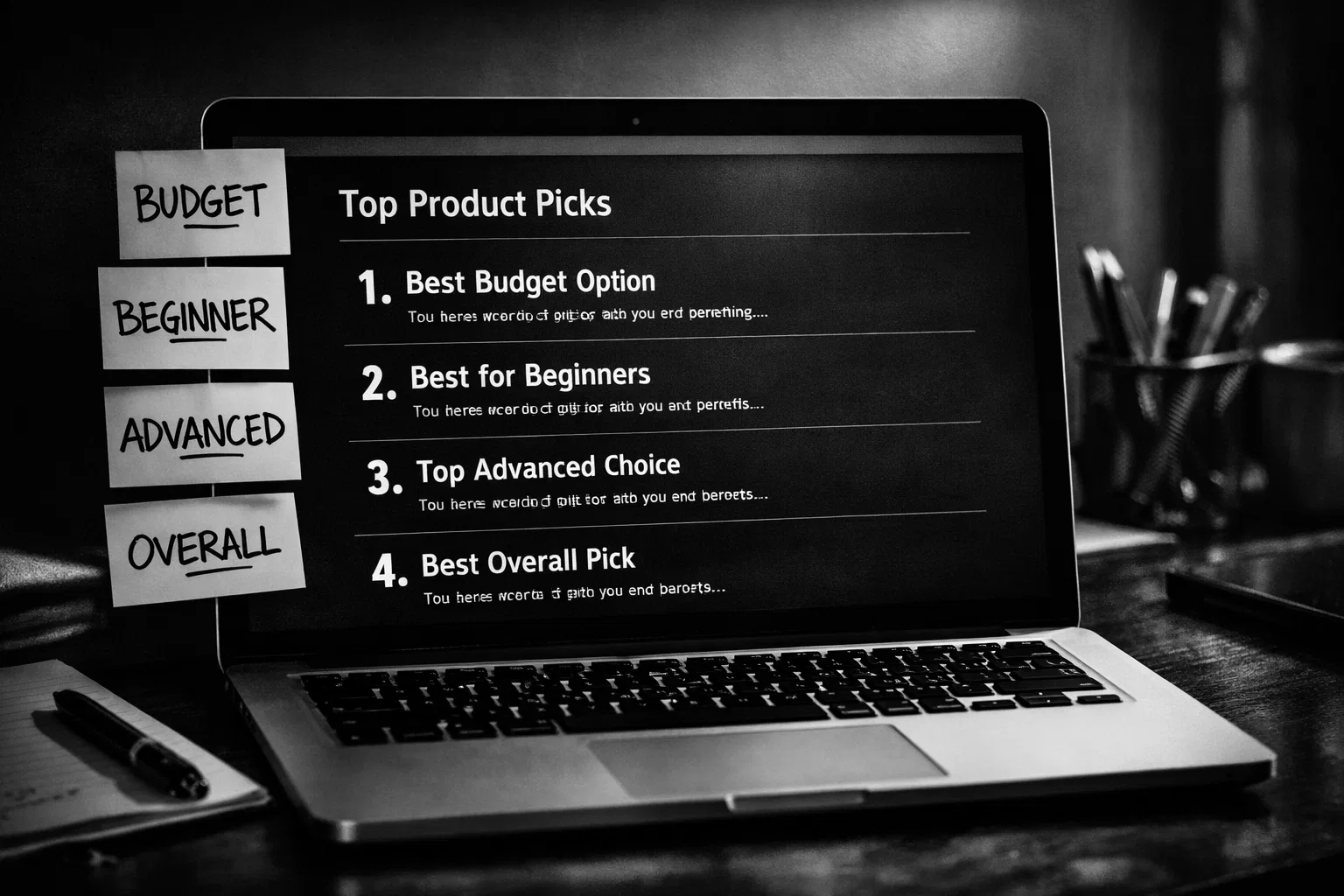
Best-of pages convert when they do more than rank products. A strong shortlist page helps a reader quickly answer: “Which option fits my situation, and why should I trust this recommendation?” In affiliate publishing, that matters because the page is often the final decision layer before a revenue-generating click. A thin “10 best” list may attract search traffic, but it gives the reader little reason to believe the order, understand the trade-offs, or choose one offer over another.
The better model is a guided shortlist: a small set of recommended choices, each matched to a clear use case, with transparent selection criteria, meaningful comparisons, and visible reasons why some options were included or excluded. This aligns with Google’s guidance that useful review content should provide insightful analysis, original research, and evidence of real knowledge rather than simply summarising products.[Google for Developers]developers.google.comGoogle for DevelopersGoogle Search's Reviews SystemThe reviews system aims to better reward high quality reviews, which is content that p…
For a website built around affiliate links, best-of pages are valuable because they sit close to buying intent. They can turn category-level searches such as “best standing desk”, “best accounting software for freelancers”, or “best protein powder for beginners” into clicks by reducing uncertainty. The page earns its place when it narrows the market honestly, not when it pretends every reader needs the same “number one” product.
When shortlist pages match reader intent
A best-of page works best when the reader already knows the broad category but has not yet chosen the specific product, service, or provider. They are not asking “what is this?” in a purely educational sense. They are asking “which one should I choose?” That means the page has to support a decision, not merely describe a market.
The strongest intent signals usually include phrases such as “best”, “top”, “best for”, “alternatives”, “compare”, “for beginners”, “for small rooms”, “for heavy users”, “for students”, or “under £100”. These queries imply that the reader expects a shortlist, not a long encyclopaedic article. A page targeting “best noise-cancelling headphones for travel” should therefore make travel-related factors central: battery life, comfort on long journeys, case size, call quality, noise cancellation, and price. A generic headphone ranking would miss the commercial intent because the reader’s situation is the real filter.
This is why best-of pages can outperform broad reviews in affiliate systems. A single-product review answers “is this product good?” A best-of page answers “which product should I buy from this category?” The second question often creates more internal linking opportunities: each shortlisted item can link to a deeper review, each use case can link to a specialised page, and each recommendation can point to one or more merchants.
For a scalable site system, the key is to classify best-of pages by the reader’s decision stage:
- Category shortlist: “best air fryers” or “best VPNs” where the reader wants a broad winner set.
- Use-case shortlist: “best laptops for video editing” where the category is filtered by a job.
- Constraint shortlist: “best office chairs under £200” where budget or availability shapes the choice.
- Audience shortlist: “best accounting software for sole traders” where the reader identity determines what matters.
- Problem shortlist: “best mattress for back pain” where claims, evidence, and caution become more important.
The more specific the intent, the more damaging a generic ranking becomes. A page about “best running shoes for beginners” should not simply reuse the same products as “best running shoes overall” with a different introduction. It should change the criteria, the explanation, and possibly the affiliate offers.
Why thin rankings fail to build enough trust
Thin best-of pages often fail because they create a decision without showing the decision process. They list products, add stock descriptions, include affiliate buttons, and hope that the reader clicks. That can produce some clicks from impatient visitors, but it is a weak long-term pattern because the page gives search engines, readers, and merchants few signals of quality.
Google’s product review guidance is directly relevant here. Its reviews system says high-quality review content should show insightful analysis, original research, and expertise or enthusiasm. Google’s earlier product reviews update also stated that people value reviews with in-depth research rather than thin content that simply summarises a group of products.[Google for Developers]developers.google.comGoogle for DevelopersGoogle Search's Reviews SystemThe reviews system aims to better reward high quality reviews, which is content that p…
For affiliate pages, the practical takeaway is simple: the ranking is not enough. The page must explain the evidence behind the ranking. That does not always mean laboratory testing. In some categories, the evidence may be hands-on use, expert interviews, product specifications, support policies, warranty comparisons, user review patterns, long-term availability, or analysis of merchant terms. But the reader should be able to see why the shortlist exists.
Thin pages also create a conversion problem. A reader who lands on a “best CRM for small businesses” page may not be ready to click the first button. They may need to know whether the recommendation suits a solo consultant, a five-person sales team, or a service business with recurring clients. If the page collapses all of those situations into one list, the reader has to do the real comparison work alone.
A stronger shortlist page makes the recommendation logic visible. It can say, for example:
- “Best overall for most small teams”
- “Best low-cost option for freelancers”
- “Best for businesses that need phone support”
- “Best for teams already using Microsoft 365”
- “Not ideal if you need advanced reporting”
This approach does not reduce monetisation. It often improves it because the reader sees a path that matches their situation. It also creates more qualified outbound clicks: the reader who clicks has already been warned about the main trade-offs.
Use-case recommendations beat one-size-fits-all winners
The most useful best-of pages usually combine a main recommendation with situational winners. “Best overall” still has a role, but it should not carry the whole page. Readers arrive with different constraints, and the page converts better when it acknowledges those differences.
Nielsen Norman Group’s guidance on comparison tables is useful here because it treats comparison as a decision-support task. A comparison table uses products or services as columns and attributes as rows so users can quickly compare characteristics. Successful comparison tables help people make decisions quickly when they are simple, consistent, and genuinely informative.[Nielsen Norman Group]nngroup.comNielsen Norman Group3 Rules for Better Comparison Tables (VideoNN/GSuccessful comparison tables help people make decisions quickly. Simplicity, consistency, and informational are qualities of good com…
On a best-of affiliate page, that means the shortlist should not be a random sequence of products. Each entry should have a job. A good pattern is:
- Best overall: the safest recommendation for the broadest relevant reader group.
- Best budget option: the lowest-cost option that still clears the quality threshold.
- Best premium option: the choice that justifies a higher price through specific benefits.
- Best for a defined use case: the product that fits a particular reader situation.
- Best alternative: the option for readers who reject the top pick’s main weakness.
This structure is more useful than a numbered list because it explains difference, not just order. It also helps a website-generation system choose repeatable page templates. The page can require each shortlist item to have a role, a reason, a trade-off, and a matching affiliate offer. If an item cannot be assigned a distinct role, it may not belong on the page.
A concrete example makes the difference clear. A weak “best web hosting” page might rank ten hosts and use similar wording for all of them: fast, reliable, affordable, easy to use. A stronger page would separate “best for WordPress beginners”, “best for high-traffic content sites”, “best cheap shared hosting”, and “best for developer control”. The affiliate offer then matches the reader’s situation rather than forcing all visitors through the same call to action.
This is also where internal linking becomes commercially useful. A broad best-of page can link to deeper pages such as “best WordPress hosting for beginners”, “cheap web hosting compared”, or individual reviews. The broad page captures general buying intent; the deeper pages absorb readers who need more specific reassurance before clicking.
Selection criteria that build trust
Selection criteria are the backbone of a converting best-of page. They tell the reader what was valued, what was ignored, and why the final shortlist is credible. Without criteria, a best-of page looks like a commission-driven list.
Good criteria are specific to the category. For a mattress page, comfort, firmness, returns, trial period, delivery, materials, and long-term sagging concerns may matter. For accounting software, the criteria might be VAT support, bank feeds, invoicing, payroll, accountant access, customer support, integrations, and monthly cost. For lawnmowers, terrain, cutting width, storage, battery life, repairability, and grass-box capacity may matter.
The same public-facing page can express the criteria simply while still being structured enough for scalable production. A practical best-of template should include:
- Who the shortlist is for: the reader group or buying situation.
- What counted most: the main criteria used to judge the options.
- What was excluded: products that were unavailable, poor value, too niche, or unsuitable for the reader intent.
- What the trade-offs are: the reason a reader might choose a lower-ranked option.
- How to choose quickly: a short decision rule near the top and again near the end.
This matters because comparison design is not just visual. Baymard’s ecommerce UX research has found that many sites still underperform on product list usability, with weak product lists and filtering making it harder for users to find suitable products. In its 2025 product list benchmark, Baymard reported that 58% of desktop ecommerce sites and 78% of mobile ecommerce sites had “poor” to “mediocre” product list UX.[Baymard Institute]baymard.comcurrent state product list and filteringBaymard InstituteProduct List UX Best Practices 2025August 22, 2024 — 22 Aug 2024 — Discover the top 8 Product List UX best practices to…
Affiliate best-of pages are not ecommerce category pages, but they face a similar problem: the reader is scanning a set of options and trying to decide which one fits. If the page hides the key differentiating information inside long paragraphs, the reader has to work too hard. The best format usually combines short recommendation cards, a comparison table, and deeper explanations below.
The page structure that turns shortlists into clicks
A high-converting best-of page normally needs a clear path from intent to recommendation to click. The structure should not make readers wait through a long essay before seeing useful choices, but it also should not push affiliate buttons before trust has been established.
A strong structure often looks like this:
- Direct answer near the top: a short summary of the best choices and who each one is for.
- Disclosure near commercial links: a plain explanation that the page may earn commission from affiliate links.
- Quick comparison table: the shortlist, main use case, price/value signal, standout feature, and main drawback.
- Recommendation cards: each pick gets a clear label, a concise reason, a trade-off, and a call to action.
- Selection criteria: how the options were chosen and what mattered most.
- Deeper buying guidance: what to consider before choosing.
- Related internal links: individual reviews, alternatives, budget pages, and adjacent category guides.
The disclosure is not just a legal formality. The FTC’s endorsement guidance says that where there is a connection between an endorser and a seller that consumers would not expect and that would affect how they evaluate the endorsement, that connection should be disclosed clearly. Amazon Associates also requires affiliates to include a legally compliant disclosure and identify themselves as Associates when sharing affiliate links.[Federal Trade Commission]ftc.govSource details in endnotes.
Disclosure also protects trust. Research on affiliate disclosures has found that many affiliate marketing disclosures are absent or poorly understood. A study of YouTube and Pinterest affiliate content found that only about one-tenth of affiliate content contained disclosures, and that users often failed to understand short, unexplained disclosures.[arXiv]arxiv.orgSource details in endnotes.
For a website system, this suggests a standard rule: every commercial shortlist template should include a clear disclosure in plain language close enough to the affiliate context that readers notice it. Burying disclosure in a footer or using vague phrases such as “partner links may be present” is weaker than saying plainly that the site may earn a commission if the reader buys through links on the page.
Matching offers to the shortlist role
A best-of page does not monetise only through the products it names. It monetises through the fit between recommendation, merchant, and reader expectation. A “best budget” pick should not lead to a merchant where the product is out of stock or unusually expensive. A “best for business users” pick may convert better through a direct software trial than a marketplace listing. A “best premium” pick may need a merchant with strong warranty information and trustworthy delivery.
This is where affiliate page design becomes a revenue-per-visitor problem. The same product can perform differently depending on the merchant, commission rate, cookie window, stock reliability, price competitiveness, and checkout experience. A page that sends all users to one retailer because it is easy to integrate may leave revenue on the table if another merchant better matches the reader’s intent.
A useful shortlist should therefore separate the recommendation from the offer. The recommendation answers “which option fits?” The offer answers “where should the reader go next?” For each pick, the page should decide whether to link to:
- the manufacturer’s direct offer;
- a marketplace listing;
- a specialist retailer;
- a free trial or demo page;
- a comparison or pricing page;[baymard.com]baymard.comSource details in endnotes.
- a deeper on-site review before sending the click out.
This is especially important for software and services. A reader comparing accounting software may need a free trial, pricing page, or feature comparison, not just a “buy now” button. A reader comparing physical products may want a retailer with fast delivery, returns, and clear stock information. The affiliate link should match the next decision step, not simply the highest available commission.

How many products should a best-of page shortlist?
There is no universal right number, but “as many as possible” is usually the wrong answer. A shortlist page should reduce choice overload, not recreate the entire market. The best number depends on category complexity and reader intent.
For narrow, high-intent searches, three to five options may be enough. “Best standing desks for small spaces” does not need fifteen picks if only a few genuinely fit the constraint. For broad, competitive categories, seven to ten recommendations may be justified, but each item should have a distinct role. If the tenth product adds no new use case, budget point, or trade-off, it is probably filler.
Baymard’s work on product lists reinforces the importance of helping users compare and identify suitable products efficiently. Its research on list entries says individual list entries should help users quickly understand each option and support comparison, almost as if each entry were a small webpage.[Nielsen Norman Group]nngroup.comNielsen Norman Group3 Rules for Better Comparison Tables (VideoNN/GSuccessful comparison tables help people make decisions quickly. Simplicity, consistency, and informational are qualities of good com…
That principle translates well to affiliate shortlists. Each entry should contain enough information to make the next click feel informed:
- the recommended role;
- the main reason to choose it;
- the main reason not to choose it;
- the reader type it suits;
- the key comparison attribute;
- the relevant merchant action.[baymard.com]baymard.commass merchant best practicesmass merchant best practices
This also helps prevent automated or large-scale content from becoming bloated. A scalable system should not expand every best-of page to the same length. It should expand when there are genuinely different reader needs to cover, and stop when additional picks no longer improve the decision.
The role of comparison tables
Comparison tables are often the fastest way to make a best-of page useful. They work because they let readers compare options across the same attributes instead of piecing together scattered paragraphs. But a poor table can be as thin as a poor list if it compares the wrong things.
Nielsen Norman Group defines comparison tables as rows of attributes and columns of products or services, allowing quick comparison of features and characteristics. Its guidance also warns that comparison tables are most effective only when they genuinely help decision-making rather than adding visual clutter.[Nielsen Norman Group]nngroup.comNielsen Norman Group3 Rules for Better Comparison Tables (VideoNN/GSuccessful comparison tables help people make decisions quickly. Simplicity, consistency, and informational are qualities of good com…
For affiliate best-of pages, the most useful table attributes are usually not generic. “Price”, “rating”, and “best for” are a start, but the table should reflect the decision being made. For “best website builders for affiliate sites”, useful rows might include content scaling, template control, affiliate-link handling, site speed, SEO controls, pricing, and learning curve. For “best coffee grinders for espresso”, useful rows might include grind consistency, burr type, adjustment range, retention, noise, cleaning, and counter space.
A good comparison table should:[youtube.com]youtube.comSource details in endnotes.
- compare the same attribute across all products;
- avoid rows that are unknown or irrelevant for most items;
- include the main drawback, not just positives;
- keep mobile readability in mind;
- link each product name or action button to the relevant offer or review;
- match the page’s stated selection criteria.
The table should not replace the recommendation copy. It should let readers narrow their likely choice, while the text explains the reasoning behind each pick.

Evidence, testing, and the Wirecutter lesson
The best-known affiliate shortlist model is the editorial testing site: pick a category, test or research the market, recommend a small number of winners, and earn through affiliate links when readers buy. Wirecutter is the most cited example because its public reputation is built around testing, transparent recommendations, and trust rather than generic list production.
Digital Content Next’s interview with Wirecutter’s commerce leadership frames trust as central to its affiliate strategy, while Awin’s discussion of the “Wirecutter effect” describes how a recommendation from the site can drive a surge in retailer sales.[Digital Content Next]digitalcontentnext.orgDigital Content Next Audience trust drives Wirecutter's affiliate strategyDigital Content Next Audience trust drives Wirecutter's affiliate strategy
Not every affiliate site can or should imitate Wirecutter’s testing depth. Full hands-on testing is expensive and difficult to scale across thousands of pages. But the lesson is not “test everything or do nothing”. The lesson is that readers need a reason to trust the shortlist. A scalable site can build trust through different levels of evidence, clearly labelled:
- Hands-on tested: the site used the product directly.
- Expert-assessed: the recommendation is based on specialist analysis.
- Specification-led: the category can be compared reliably using measurable features.
- Policy-led: warranties, returns, support, contracts, or service terms drive the decision.
- Review-pattern-led: user feedback is analysed for recurring strengths and weaknesses.
- Availability-led: current stock, pricing, and merchant reliability affect the recommendation.
The problem is pretending that all of these evidence types are the same. If a page has not tested the products, it should not imply that it has. If a recommendation is based on specifications and user review patterns, say so plainly. That honesty can be built into a standard template and is more scalable than manufacturing false authority.
Best-of pages as part of a wider affiliate site
A best-of page should rarely stand alone. It is usually the hub of a commercial cluster. The page captures broad buying intent and then routes readers to deeper pages where needed.
For example, a site about home office equipment might use:
- “Best office chairs” as the broad shortlist page.
- “Best office chairs under £200” as a budget shortlist.
- “Best ergonomic chairs for back support” as a problem-led shortlist.
- Individual chair reviews for readers who want detail.
- “Mesh vs leather office chairs” as a comparison explainer.
- “How to choose an office chair for a small room” as supporting guidance.
This internal structure improves monetisation because readers do not all need the same level of persuasion. Some will click from the top table. Others will need a narrower page. Others will read an individual review before leaving the site. The best-of page should therefore act as a decision hub, not a dead-end list.
For a website-generation system, that means the page type should trigger internal-linking rules. Broad best-of pages should link down to narrow use-case pages. Narrow best-of pages should link sideways to alternatives and up to the broader category. Individual reviews should link back to the relevant shortlist so readers can compare before buying. The system should not scatter affiliate links randomly; it should create a clear commercial path.
Common failure modes to avoid
The most common failure is ranking products without a visible reason. A reader sees “best overall”, “best value”, and “best premium”, but the page does not define what overall, value, or premium means. Those labels only work when they are tied to criteria.
Another failure is creating too many near-duplicate pages. “Best laptops”, “best laptops for work”, “best laptops for home working”, and “best laptops for productivity” may all be legitimate pages, but not if they contain the same shortlist with minor wording changes. That pattern weakens trust and creates internal competition. Each page should have a distinct intent, criteria set, and recommendation mix.
A third failure is hiding trade-offs. Affiliate pages sometimes avoid negatives because they fear losing clicks. In practice, credible drawbacks can improve click quality. “Best for beginners, but not ideal for advanced reporting” helps the right reader click and the wrong reader continue comparing. That is better than sending poorly matched visitors to a merchant where they are unlikely to buy.
Other recurring problems include:
- using merchant descriptions as if they were independent analysis;
- overloading the page with affiliate buttons before giving any reason to trust them;
- recommending unavailable or outdated products;
- failing to update prices, stock, features, or programme availability;
- using ratings without explaining their source;
- mixing different product types in one table as if they were directly comparable;
- making every pick sound equally good.
These are not just editorial weaknesses. They affect revenue because confused readers hesitate, mismatched clicks fail to convert, and search engines have less reason to treat the page as genuinely helpful.
A practical decision framework for scalable shortlist pages
A repeatable best-of page should answer five questions before publication.
First, what is the reader choosing between? The page should have a clear category boundary. If the market includes fundamentally different product types, the page may need separate sections or separate pages.
Second, which criteria matter for this exact intent? A budget page should weight price and minimum acceptable quality. A professional-use page may weight reliability, support, and advanced features. A beginner page may weight ease of use, setup, and low regret.
Third, what role does each recommendation play? Every pick should have a distinct reason to exist. If two products have the same role, the page should explain the difference or remove one.
Fourth, what evidence supports the shortlist? The page should be honest about whether the recommendation is based on testing, expert review, specification comparison, policy analysis, user feedback, or merchant availability.
Fifth, what is the next best click? The answer may be an affiliate merchant, a free trial, a pricing page, an individual review, or another comparison page. The link should match the reader’s remaining uncertainty.
This framework keeps the page useful while making it easier to scale. It gives writers, editors, or automated content systems a standard way to decide what belongs on the page without reducing every page to a generic template.
What makes a best-of page convert?
A best-of page converts when it reduces the reader’s decision effort and increases confidence in the next click. The shortlist must be narrow enough to be useful, broad enough to cover real use cases, and transparent enough to feel trustworthy.
The strongest pages do three things at once. They match a clear commercial intent, such as choosing a product or service. They explain the shortlist through criteria, trade-offs, and comparison. And they route each reader towards an offer or deeper page that fits their situation.
For affiliate websites, this makes best-of pages one of the most important monetisation formats. But the format only works when the page behaves like a decision guide rather than a commission list. The reader should leave thinking, “I know which option is probably right for me,” not “I have seen ten products with buy buttons.”
Amazon book picks
Further Reading
Books and field guides related to What Makes a Best Of Page Convert?. Use these as the next step if you want deeper reading beyond the article.
Building a StoryBrand 2.0
Best-of pages need clear positioning that helps readers quickly choose the right option.
Don't Make Me Think, Revisited
Shortlist pages convert better when comparisons, links, and decisions are effortless to scan.
Conversion Optimization
Directly supports improving offer presentation, calls to action, and decision pages.
Made to Stick
Helps turn selection criteria and product recommendations into convincing, memorable explanations.
eBay marketplace picks
Marketplace Samples
Example marketplace items related to this page. Use the search link to explore similar finds on eBay.








Endnotes
1.
Source: developers.google.com
Link:https://developers.google.com/search/docs/appearance/reviews-system
Source snippet
Google for DevelopersGoogle Search's Reviews SystemThe reviews system aims to better reward high quality reviews, which is content that p...
2.
Source: developers.google.com
Title: product reviews update
Link:https://developers.google.com/search/blog/2021/04/product-reviews-update
Source snippet
Google for DevelopersWhat creators should know about Google's April 2021...8 Apr 2021 — We're sharing an improvement to our ranking syst...
Published: April 2021
3.
Source: baymard.com
Title: current state product list and filtering
Link:https://baymard.com/blog/current-state-product-list-and-filtering
Source snippet
Baymard InstituteProduct List UX Best Practices 2025August 22, 2024 — 22 Aug 2024 — Discover the top 8 Product List UX best practices to...
Published: August 22, 2024
4.
Source: ftc.gov
Link:https://www.ftc.gov/business-guidance/resources/ftcs-endorsement-guides-what-people-are-asking
5.
Source: affiliate-program.amazon.com
Link:https://affiliate-program.amazon.com/help/node/topic/GHQNZAU6669EZS98
6.
Source: arxiv.org
Link:https://arxiv.org/abs/1809.00620
7.
Source: awin.com
Title: wirecutter affiliate partner success
Link:https://www.awin.com/gb/how-to-use-awin/wirecutter-affiliate-partner-success
8.
Source: support.google.com
Link:https://support.google.com/merchants/answer/14620160?hl=en-GB
9.
Source: support.google.com
Link:https://support.google.com/webmasters/thread/180636419/does-the-ratio-of-commercial-content-on-the-site-vs-informative-matter-for-product-reviews-sites?hl=en
10.
Source: developers.google.com
Title: write high quality reviews
Link:https://developers.google.com/search/docs/specialty/ecommerce/write-high-quality-reviews
11.
Source: developers.google.com
Title: creating helpful content
Link:https://developers.google.com/search/docs/fundamentals/creating-helpful-content
12.
Source: google.com
Link:https://www.google.com/intl/en_us/search/howsearchworks/how-search-works/ranking-results
13.
Source: baymard.com
Link:https://baymard.com/ecommerce-design-examples/39-comparison-tool
14.
Source: baymard.com
Link:https://baymard.com/research/ecommerce-product-lists
15.
Source: baymard.com
Title: user friendly comparison tools
Link:https://baymard.com/blog/user-friendly-comparison-tools
16.
Source: baymard.com
Title: list item design ecommerce
Link:https://baymard.com/blog/list-item-design-ecommerce
17.
Source: baymard.com
Title: provide comparison features
Link:https://baymard.com/blog/provide-comparison-features
18.
Source: baymard.com
Title: mass merchant best practices
Link:https://baymard.com/blog/mass-merchant-best-practices
19.
Source: baymard.com
Title: current state ecommerce product page ux
Link:https://baymard.com/blog/current-state-ecommerce-product-page-ux
20.
Source: baymard.com
Link:https://baymard.com/research
21.
Source: baymard.com
Title: product page suggestions information
Link:https://baymard.com/blog/product-page-suggestions-information
22.
Source: baymard.com
Title: ecommerce search query types
Link:https://baymard.com/blog/ecommerce-search-query-types
23.
Source: baymard.com
Title: ecommerce product lists report and benchmark
Link:https://baymard.com/blog/ecommerce-product-lists-report-and-benchmark
24.
Source: baymard.com
Link:https://baymard.com/research/mcommerce-usability
25.
Source: baymard.com
Title: desktop ux ecommerce
Link:https://baymard.com/blog/desktop-ux-ecommerce
26.
Source: baymard.com
Link:https://baymard.com/research/checkout-usability
27.
Source: youtube.com
Link:https://www.youtube.com/watch?v=BVmmlN_yfds
28.
Source: youtube.com
Link:https://www.youtube.com/watch?v=khLXlseXffs
29.
Source: youtube.com
Link:https://www.youtube.com/watch?v=Z0RkLSgwQS4
30.
Source: youtube.com
Link:https://www.youtube.com/watch?v=POsaV2YzRr8
31.
Source: youtube.com
Title: Affiliate Site Case Study
Link:https://www.youtube.com/watch?v=a9CT_Vd_118
32.
Source: youtube.com
Title: I Designed the PERFECT Affiliate Website. Here’s what Happened
Link:https://www.youtube.com/watch?v=cX395xZqjxc
Source snippet
Avoid this #1 SEO Content Mistake...
33.
Source: youtube.com
Title: Avoid this #1 SEO Content Mistake
Link:https://www.youtube.com/watch?v=GaW6Q8sF0EI
Source snippet
Write High Converting Product Roundup Reviews With Product AI...
34.
Source: youtube.com
Title: Write High Converting Product Roundup Reviews With Product AI
Link:https://www.youtube.com/watch?v=8mB0P0JHB3E
Source snippet
9 TOP Affiliate Marketing Strategies in 2026...
35.
Source: youtube.com
Link:https://www.youtube.com/watch?v=2fepIzIcdh8
Source snippet
How To Build An Affiliate Marketing Website 2025 | For Beginners...
36.
Source: youtube.com
Link:https://www.youtube.com/watch?v=7V5zYjHIfx8
37.
Source: nngroup.com
Link:https://www.nngroup.com/articles/comparison-tables/
Source snippet
Nielsen Norman GroupComparison Tables for Products, Services, and FeaturesFebruary 9, 2024 — 9 Feb 2024 — A table that uses columns for p...
Published: February 9, 2024
38.
Source: nngroup.com
Title: Nielsen Norman Group3 Rules for Better Comparison Tables (Video)
Link:https://www.nngroup.com/videos/ux-rules-comparison-tables/
Source snippet
NN/GSuccessful comparison tables help people make decisions quickly. Simplicity, consistency, and informational are qualities of good com...
39.
Source: nngroup.com
Title: Nielsen Norman Group The Anatomy of a List Entry
Link:https://www.nngroup.com/articles/list-entries/
40.
Source: nngroup.com
Link:https://www.nngroup.com/videos/comparison-tables/
41.
Source: digitalcontentnext.org
Title: Digital Content Next Audience trust drives Wirecutter’s affiliate strategy
Link:https://digitalcontentnext.org/blog/2022/06/30/audience-trust-drives-wirecutters-affiliate-strategy/
42.
Source: linkedin.com
Link:https://www.linkedin.com/posts/baymard-institute_product-page-ux-2025-15-pitfalls-and-best-activity-7285002885770182656-N_YX
Additional References
43.
Source: ecfr.gov
Link:https://www.ecfr.gov/current/title-16/chapter-I/subchapter-B/part-255
44.
Source: federalregister.gov
Title: guides concerning the use of endorsements and testimonials in advertising
Link:https://www.federalregister.gov/documents/2023/07/26/2023-14795/guides-concerning-the-use-of-endorsements-and-testimonials-in-advertising
45.
Source: nichesiteproject.com
Link:https://nichesiteproject.com/amazon-affiliate/examples/
46.
Source: tapfiliate.com
Link:https://tapfiliate.com/blog/affiliate-product-reviews/
47.
Source: geniuslink.com
Link:https://geniuslink.com/blog/amazon-affiliate-disclosure-guide/
48.
Source: termly.io
Link:https://termly.io/resources/articles/amazon-affiliate-disclosure/
49.
Source: yesplz.ai
Link:https://yesplz.ai/resource/dont-make-these-product-filtering-mistakes-baymard-checklist-2023
50.
Source: linkedin.com
Link:https://www.linkedin.com/pulse/best-practices-writing-affiliate-product-reviews-lsvlc
51.
Source: reddit.com
Link:https://www.reddit.com/r/juststart/comments/j5ovev/how_are_you_disclosing_your_amazon_affiliate/
52.
Source: instagram.com
Link:https://www.instagram.com/p/DXhMolTgG52/?img_index=4
Topic Tree
Follow this branch
Parent topic
Affiliate EnginesRelated pages 8
- Comparisons Why A Versus B Pages Drive Clicks
- Intent Topics Which Affiliate Topics Are Worth Building?
- Offer Fit Are High Commissions Always Better?
- Revenue Model Why Equal Traffic Does Not Mean Equal Earnings
- Reviews Why Thin Reviews Fail Affiliate Buyers
- Support Pages Can Informational Pages Still Earn Revenue?
- Trust Rules How Affiliate Sites Keep Reader Trust
- User Journeys How Internal Links Create Affiliate Paths