Within Support Pages
Do tools make better buying paths?
Calculators, checklists and comparison tools can move readers from vague questions into buying paths that fit their situation.
On this page
- When a tool is better than an article
- Inputs that reveal product fit segments
- Routing results into useful buying pages
Page outline Jump by section
Introduction
Decision‑tool pages are an increasingly important class of informational content that help affiliate websites convert early‑stage interest into meaningful buying actions. Rather than a static article that explains a concept, these interactive mechanisms ask visitors targeted questions about their specific need or context, then route them to the right products or comparison pages based on that input. This creates a structured path from uncertainty to confidence — transforming a vague query (e.g. “what should I buy?”) into a personalised shortlist that feels relevant and actionable. Because they match intent to use case, decision tools can raise conversion rates, reduce bounce, and improve user satisfaction when designed well.

When a tool is better than an article
Traditional explanatory pages (e.g. “what size mattress do I need?”) answer a question; decision tools translate that answer into a next step by systematically applying the visitor’s context to product outcomes. Interactive flows such as short questionnaires, calculators or branching logic serve three commercial functions that prose alone rarely achieves:
- Clarifying trade‑offs: Tools like guided quizzes or product finders ask users to weigh priorities (budget, features, constraints) and surface the most fitting options instead of a generic list. This aligns with how buyers research online — they often know what matters to them but not which product meets that profile.[Formsuite]formsuite.coProduct Recommendation Quizzes | Guide Customers to the Right Choice | FormsuiteFormsuite | Product Recommendation Quizzes | Guide Customers to the Right Choice | Formsuite…
- Reducing decision paralysis: Too many choices overload visitors, leading to abandonment. Product recommendation tools systematically narrow choices based on use case, which ecommerce conversion research shows can lift conversion and engagement versus simple lists.[Involve.me]involve.meGrow sales conversions with product finders | involve.meGrow sales conversions with product finders | involve.me
- Earning trust before selling: By asking for input first and explaining why a result fits, decision tools establish credibility before presenting affiliate links, compared with a list that feels like “just another sales table.”[decisionwidget.net]decisionwidget.netDecision WidgetDecision Widget
Rather than pushing affiliate links at the first sign of interest, the tool earns the click by answering a machine‑assisted version of “which product fits me?” — a critical cognitive shift for buyers who otherwise default to broader comparison pages.
Inputs that reveal product‑fit segments
The core mechanism of decision tools is contextual input — collecting simple but discriminating signals that distinguish use cases. High‑performing decision pages focus on inputs that:
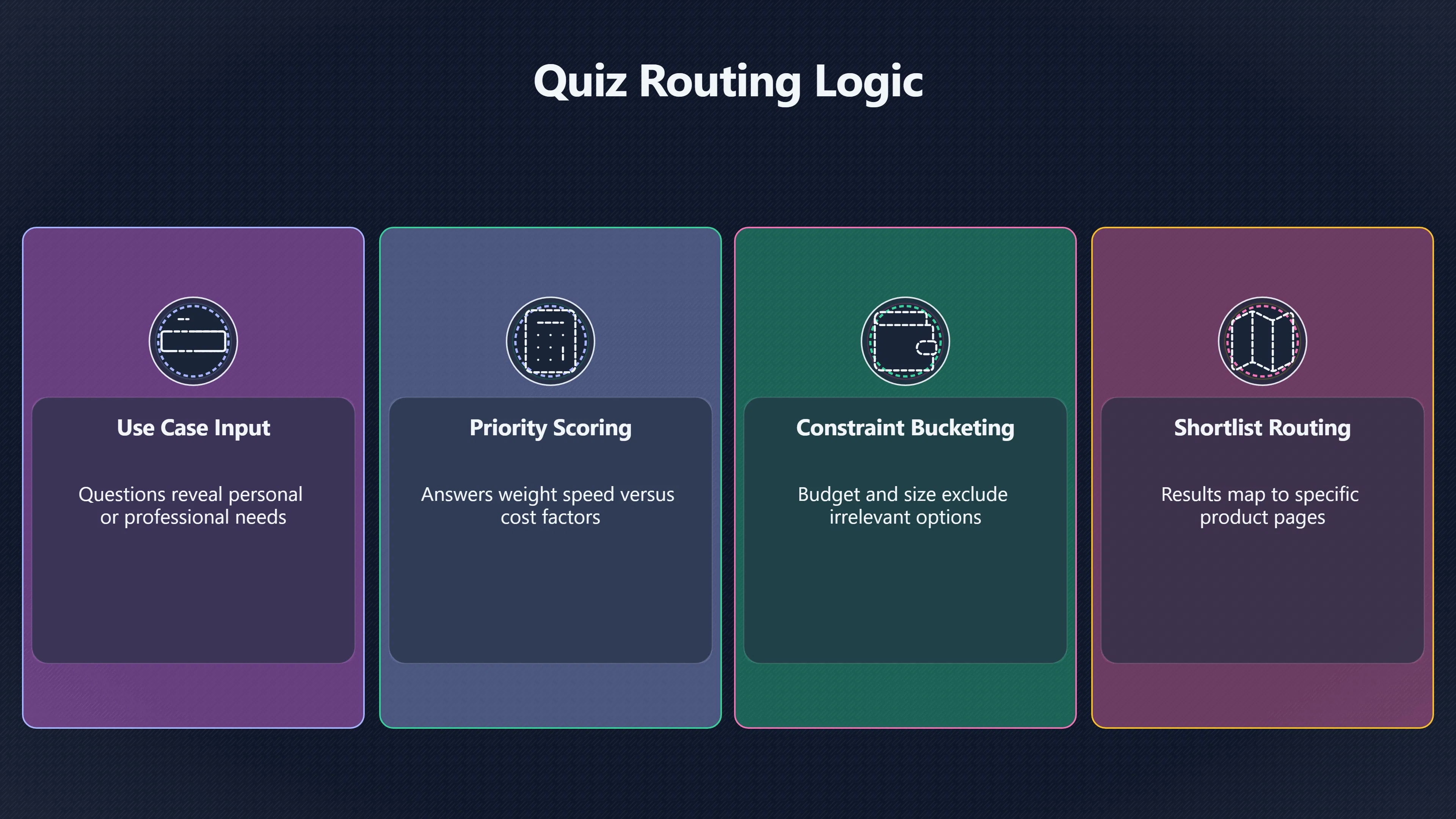
- Reveal use case scenarios: Questions that identify how, where or why someone wants a solution (e.g. “Will it be for personal or professional use?”, “Is portability essential?”, “Indoor or outdoor application?”) help segment buyers into meaningful groups rather than treating all visitors the same.
- Quantify priorities: Visitors often struggle to articulate priorities until they’re framed (e.g. “speed vs cost”, “battery life vs weight”). Built‑in scoring or weighting based on answers helps the tool produce a ranked shortlist rather than a flat set of options.[Formsuite]formsuite.coProduct Recommendation Quizzes | Guide Customers to the Right Choice | FormsuiteFormsuite | Product Recommendation Quizzes | Guide Customers to the Right Choice | Formsuite…
- Bucket by constraints: Inputs like budget range, size, compatibility or technical metrics narrow categories and exclude irrelevant products early in the flow. Many product finder tools embed this logic, often pushing different product tables or comparison paths based on the answers.[LeadQuizzes]leadquizzes.comLead Quizzes Product Recommendation Calculators | Lead QuizzesLead Quizzes Product Recommendation Calculators | Lead Quizzes
Well‑designed tools minimise cognitive effort — asking only what is necessary to shift someone from “unsure” to a defined search intent, often in two to five questions. This intentional simplicity is key to retaining participation and completing the routing stage.
Routing results into useful buying pages
The final step in a decision tool is output routing — where a visitor lands once the tool has done its scoring or ranking. Smart affiliate sites treat routing as the core monetisation opportunity, with several patterns emerging:
- Tailored shortlists: Based on input, users are sent to a specific recommended product page or category list that aligns with their use case, rather than a broad top‑10 list. Tools like AI Choice Engine demonstrate how a personalised shortlist can present reasons, cautions and direct next steps.[AI Choice Engine]aichoiceengine.comSource details in endnotes.
- Segment‑specific comparison pages: Rather than direct buy links, a tool can route to comparison content that interprets criteria differences in depth (e.g. “best laptops for writers” vs “best laptops for video editors”). This serves both SEO and conversion by matching the buyer’s context.
- Decision follow‑ups: Tools can funnel users into secondary interactions — for example, an email lead capture, downloadable buyer’s guide, or an invite to complete a deeper assessment. These nurture steps help monetise intent that isn’t yet ready to purchase.[Involve.me]involve.meGrow sales conversions with product finders | involve.meGrow sales conversions with product finders | involve.me
By using the tool’s output to choose the next best content or commerce page, sites can create smoother journeys from curiosity to purchase confidence.
Evidence from implementation patterns
Across the web, decision tools in affiliate contexts tend to follow a set of observable patterns:
- Interactive quizzes and product finders: Solutions like Formsuite‑style quizzes ask use‑case questions and generate custom recommendations, often improving conversion over flat lists by keeping visitors engaged and confident.[Formsuite]formsuite.coProduct Recommendation Quizzes | Guide Customers to the Right Choice | FormsuiteFormsuite | Product Recommendation Quizzes | Guide Customers to the Right Choice | Formsuite…
- Embedded recommendation widgets: WordPress plugins such as DecisionWidget turn product pages into mini‑tools that filter products by user answers, effectively merging editorial and decision logic at the point of sale.[WordPress.org]wordpress.orgDecision Widget — Product Quiz Recommendations – WordPress plugin | WordPress.org…
- Priority‑based recommendation calculators: LeadQuizzes and similar tools act like mini decision‑engines that match visitors to products based on functional inputs.[LeadQuizzes]leadquizzes.comLead Quizzes Product Recommendation Calculators | Lead QuizzesLead Quizzes Product Recommendation Calculators | Lead Quizzes
Academic work on decision aids — outside the direct affiliate context — also supports the model that interactive decision support improves relevance and satisfaction, especially when users face complex, multi‑attribute choices.[arXiv]arxiv.orgImproving Usability of User Centric Decision Making of Multi-Attribute Products on E-commerce WebsitesApril 27, 2020…

Practical templates for affiliate systems
For sites built at scale, the ideal decision‑tool page pattern includes:
- Input section: ask 2–5 targeted questions that reveal the shopper’s use case and constraints.
- Scoring logic: weight responses to prioritise criteria that truly influence product fit.
- Result routing: map answer combinations to specific next pages — either tailored product lists, comparison guides, or detailed buying guides that speak directly to that use case.
- Trust signals and disclosure: surface why the recommendation makes sense, linking back to editorial context and clearly disclosing affiliate relationships.
This structure can be modularised, templated and reused across categories — enhancing scalability for systems that generate many affiliate pages.
Conclusion
Decision tools that route buyers by use case act as intent amplifiers on affiliate websites. Rather than relying on generic content or broad category lists, these interactive flows bridge the gap between early interest and a committed buying mindset. By capturing minimal but revealing inputs, applying rule‑based or scoring logic, and mapping outcomes to tailored next steps, decision‑tool pages help match visitors to the right conversion path — increasing relevance, lowering friction and improving monetisation outcomes in a systematic, scalable way.
Amazon book picks
Further Reading
Books and field guides related to Do tools make better buying paths?. Use these as the next step if you want deeper reading beyond the article.
Dotcom Secrets
Covers decision funnels and tools that guide buyers from information to purchase
Launch
Explains interactive tools and structured funnels to convert interest into action
The Lean Startup
Rating: 4.0/5 from 5 Google Books ratings
Teaches iterative testing and feedback loops, relevant for decision-tool design
eBay marketplace picks
Marketplace Samples
Example marketplace items related to this page. Use the search link to explore similar finds on eBay.








Endnotes
1.
Source: formsuite.co
Title: Product Recommendation Quizzes | Guide Customers to the Right Choice | Formsuite
Link:https://formsuite.co/solutions/product-recommendation
Source snippet
Formsuite | Product Recommendation Quizzes | Guide Customers to the Right Choice | Formsuite...
2.
Source: involve.me
Title: Grow sales conversions with product finders | involve.me
Link:https://www.involve.me/product-finder
3.
Source: decisionwidget.net
Title: Decision Widget
Link:https://www.decisionwidget.net/
4.
Source: leadquizzes.com
Title: Lead Quizzes Product Recommendation Calculators | Lead Quizzes
Link:https://www.leadquizzes.com/product-recommendation-calculators/
5.
Source: wordpress.org
Link:https://wordpress.org/plugins/decision-widget/
Source snippet
Decision Widget — Product Quiz Recommendations – WordPress plugin | WordPress.org...
6.
Source: arxiv.org
Link:https://arxiv.org/abs/2004.12923
Source snippet
Improving Usability of User Centric Decision Making of Multi-Attribute Products on E-commerce WebsitesApril 27, 2020...
Published: April 27, 2020
7.
Source: youtube.com
Title: How To Create A Product Finder Quiz
Link:https://www.youtube.com/watch?v=jjQWk_tcWmI
Source snippet
Product Recommendation Quizzes | How to Build Quiz Funnels for eCommerce...
8.
Source: youtube.com
Title: Product Recommendation Quizzes | How to Build Quiz Funnels for e Commerce
Link:https://www.youtube.com/watch?v=hTRIN1UCvXc
Source snippet
Product Recommendation Quiz Funnel - Using Smart Quiz Builder's E-commerce Template...
9.
Source: aichoiceengine.com
Link:https://aichoiceengine.com/
10.
Source: decisiontools.co
Title: Decision Tools
Link:https://decisiontools.co/
Source snippet
No signup required. Your data stays in your browser. NOT SURE WHICH TOOL TO USE? Answer a few quick questions and we'll re...
Additional References
11.
Source: pickyouraitool.com
Link:https://pickyouraitool.com/
Source snippet
Pick Your AI ToolCoverage 460 tools·10 compares·49 decision pages Pick Your AI Tool Categories Use Cases Compare Browse Free AI Tools Rev...
12.
Source: decideos.co.uk
Link:https://decideos.co.uk/
Source snippet
Structured frameworks to reduce bias and solve complex choices. 40+ professional decision-making tools running entirely in your browser...
13.
Source: pivotreset.com
Link:https://pivotreset.com/
Source snippet
DECIDE WHAT HAPPENS NEXT. The decision engine for life's hardest moments — money, medicine, meaning. Used by people navigating...
14.
Source: getspotted.ai
Title: — Turn AI recommendations into revenue EVERY AI ANSWER IS A SALE YOU’RE MISSING
Link:https://getspotted.ai/
Source snippet
See the pages ChatGPT recommends to your buyers. Reach the editors. Get cited. Get revenue. [Input: ][Button: Get free scan] Popular:[But...
15.
Source: itsinside.com
Title: INSIDE Intent adds a managed funnel layer to the pages where attention already
Link:https://itsinside.com/intent/
Source snippet
INSIDE Intent - More leads from your existing site trafficINSIDE Intent MORE LEADS FROM YOUR EXISTING SITE TRAFFIC Recently measured in a...
16.
Source: queststack.io
Link:https://queststack.io/
Source snippet
QuestStack gives founders, agencies, creators, builders, and operators clear scorecards, practical use-case guidance...
17.
Source: dectrack.com
Link:https://dectrack.com/en/tools
Source snippet
Fill, share via link, export PDF. No signup, no install. Share via link No signup 100% free Export PDF NOT SUR...
18.
Source: kissmetrics.io
Link:https://www.kissmetrics.io/lp
Source snippet
Every page is tailored with relevant features, pricing, and real-world examples. [Input: Search solutio...
19.
Source: geniuslink.com
Title: Included with every Geniuslink account. ► Watch Try it free See t
Link:https://geniuslink.com/choice-pages
Source snippet
Genius Link Choice PagesFEATURING: CHOICE PAGES Maximize revenue by giving your shoppers freedom of choice, without cluttering your site...
20.
Source: utilhub.co.uk
Title: Utility Hub: Free Online Tools START WITH FREE TOOLS TODAY
Link:https://utilhub.co.uk/
Source snippet
Run free tools instantly, then create an account when you want more daily room. Create account Everyday tools, beautifully organised A CA...
Topic Tree