Within Support Pages
When should information not become a review?
A support page loses trust when it behaves like a review before it has compared, tested or justified any recommendation.
On this page
- The line between explanation and recommendation
- Premature product blocks that weaken trust
- Safer paths into reviews and comparison pages
Page outline Jump by section
Introduction
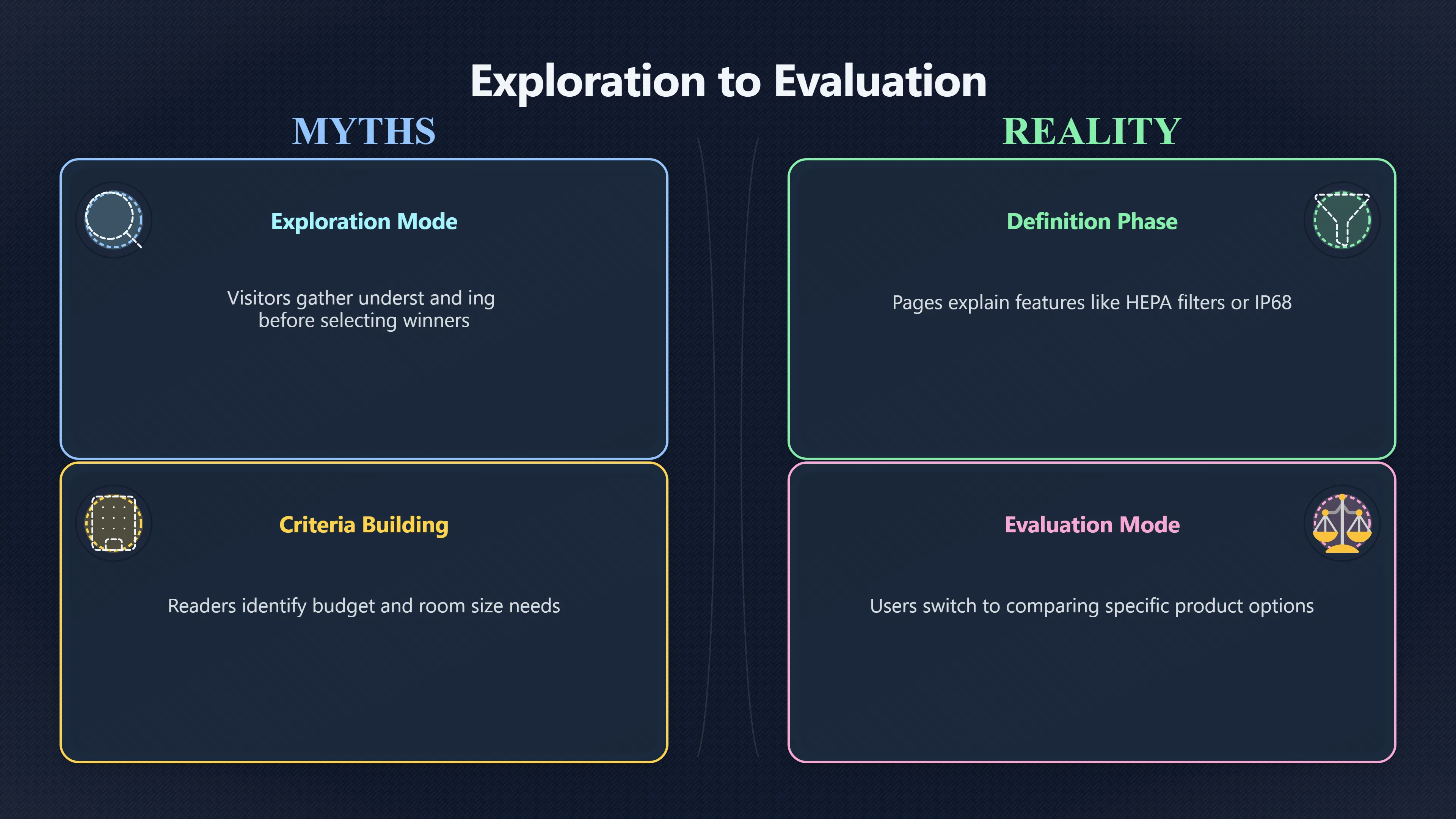
Not every informational page should recommend a product. In affiliate publishing, one of the fastest ways to weaken trust is to turn an explanation page into a sales page before the reader has enough information to make a decision. A visitor asking “what does this feature do?”, “why is this happening?”, or “how do these options differ?” is often still in an exploration phase rather than an evaluation phase. Pushing product recommendations too early can make the content feel biased, incomplete, or commercially motivated rather than genuinely helpful. Research into online buying behaviour consistently shows that people move between exploration and evaluation before purchasing, rather than following a simple linear funnel.[Google Business]business.google.comGoogle BusinessHow people decide what to buy lies in the 'messy middle' of…This equates to two different mental modes in the messy mid…
 For websites that earn through affiliate links, this creates an important structural rule: some pages should explain, diagnose, clarify, or educate without attempting to choose a product for the reader. Their commercial role is not direct conversion. Their role is to increase understanding, build confidence, and create a natural route into comparison pages, reviews, buyer’s guides, or category recommendations when the reader is genuinely ready.
When should information not become a review?
The key distinction is whether the page has enough evidence and context to justify a recommendation.
A review implicitly makes claims about quality, suitability, value, or performance. An informational page often cannot support those claims because it is answering a narrower question.
Consider these examples:
Informational questionShould it recommend products directly?WhyWhat is a HEPA filter?Usually noThe reader may only need a definition.How much moisture should be in a room?Usually noThe page explains a condition, not a purchase.Why is my cordless drill losing power?Usually noThe issue may be battery age, storage, charger faults, or usage habits.Brushless vs brushed motorsSometimes laterThe page can explain differences, then link to buying guides.Best cordless drills for home DIYYesThe user is evaluating products.
The mistake many affiliate sites make is treating every informational keyword as a hidden commercial keyword. The result is content that answers a question for two paragraphs and then suddenly introduces product tables with little justification.
Readers notice this shift immediately. Instead of feeling guided through a decision, they feel pushed towards one.
This is especially damaging because informational pages frequently attract visitors earlier in the buying journey. Google’s research into the “messy middle” describes users repeatedly switching between exploration and evaluation before purchasing. During exploration, users are gathering understanding rather than selecting a winner.[Google Business]business.google.comGoogle BusinessHow people decide what to buy lies in the 'messy middle' of…This equates to two different mental modes in the messy mid…[Google Business]business.google.comGoogle BusinessHow people decide what to buy lies in the 'messy middle' of…This equates to two different mental modes in the messy mid…
A recommendation made before the reader has entered evaluation mode often creates friction rather than conversion.
The line between explanation and recommendation
A useful test is to ask what evidence the page actually contains.
If a page explains:
- what a feature means
- how a technology works
- what causes a problem
- how sizing systems operate
- how terminology differs
then it may not contain enough evidence to justify recommending a specific product.
For example, a page titled “What does IP68 mean?” can explain water-resistance ratings, testing standards, and practical limitations. It does not automatically follow that the page should recommend phones, watches, headphones, or cameras.
The reader’s immediate problem is understanding the rating.
Only after that understanding exists does a buying question emerge.
Similarly, a page explaining “memory foam vs pocket sprung mattresses” can focus on pressure relief, temperature retention, movement transfer, and support characteristics. Recommending a specific mattress inside the explanation can feel premature because the page has not yet established the reader’s budget, sleeping position, weight, preferences, or health concerns.
The informational page clarifies criteria.
The comparison page applies those criteria.
Those are different jobs.
For large affiliate sites, keeping those jobs separate often improves content quality because the system does not need to force recommendations into every page template. Different page types can serve different stages of intent.
Premature product blocks that weaken trust
Many affiliate sites lose credibility through design patterns that reveal commercial intent before they establish informational value.
Common examples include:
Product tables before the answer
A visitor searching for a definition or explanation lands on a page and immediately sees:
- “Top Picks”
- “Best Products”
- affiliate buttons
- star ratings
before the actual answer begins.
The page effectively announces that monetisation is more important than explanation.
This can damage perceived expertise because the recommendation appears disconnected from the question.
Recommendations without comparison criteria
Another trust problem appears when a page suddenly recommends products without showing how those products were selected.
For example:
- page topic: “What size air purifier do I need?”
- recommendation: three specific air purifiers
The missing step is the sizing framework.
Without room-size calculations, airflow requirements, or coverage explanations, the recommendations appear arbitrary.
The reader has no reason to trust them.
Diagnosing problems with a product replacement shortcut
This is common in home, technology, health-adjacent, and appliance niches.
Examples include:
- slow laptop → buy a new laptop
- poor sleep → buy a mattress
- dry air → buy a humidifier
- bad coffee → buy an espresso machine
The informational question is replaced by a sales answer.
Sometimes replacement is correct.
Often it is not.
When every diagnosis ends in a purchase recommendation, users begin to assume the advice is commercially driven.
Recommendation inflation
Large-scale affiliate sites sometimes develop a template problem where every page contains:
- product boxes
- affiliate links
- recommendation widgets
- comparison tables
regardless of intent.
This creates recommendation inflation.
If every page recommends products, recommendations stop carrying meaning.
The strongest review pages lose authority because they look identical to pages that never had enough evidence to recommend anything.
Why forced recommendations can hurt revenue
The short-term temptation is obvious: more affiliate links create more opportunities for clicks.
In practice, the relationship is often weaker.
Users tend to follow links when the next step feels relevant to their current goal. Research from Nielsen Norman Group on information scent shows that people choose links based on cues that suggest useful information lies behind them. Weak or mismatched signals reduce confidence and reduce progression.[Nielsen Norman Group]nngroup.cominformation scentNielsen Norman GroupInformation Scent: How Users Decide Where to Go Next2 Feb 2020 — When deciding which links to click on the web, users…[Nielsen Norman Group]nngroup.cominformation scentNielsen Norman GroupInformation Scent: How Users Decide Where to Go Next2 Feb 2020 — When deciding which links to click on the web, users…
A reader who searches:
- “what does OLED mean?”
- “what is a heat pump dryer?”
- “why does a mattress sag?”
may not yet want a recommendation.
If the page immediately pushes products, many users leave.
By contrast, a page that first solves the informational problem can create a stronger transition:
- understand the concept
- identify relevant buying factors
- recognise personal requirements
- continue into a comparison page
The affiliate click occurs later, but often with higher intent.
From a revenue-system perspective, this means a support page can contribute significant commercial value without containing direct recommendations.
Its value comes from moving qualified readers forward.

Safer paths into reviews and comparison pages
Informational pages do not need to be commercially isolated.
The goal is not to avoid monetisation entirely.
The goal is to delay recommendations until they are justified.
Several transition patterns work particularly well.
Explain the decision before offering the decision
A page about tumble dryer types can explain:
- condenser dryers
- vented dryers
- heat pump dryers
Only after establishing differences should it introduce links such as:
- best heat pump tumble dryers
- condenser vs heat pump comparisons
- cheapest dryers to run
The reader now understands why those pages matter.
Build buying criteria instead of product rankings
An informational page can focus on:
- room size
- budget
- power requirements
- maintenance costs
- durability factors
without naming products.
The buying guide then becomes the page that applies those criteria.
This separation creates a cleaner content architecture and makes internal links feel more useful.
Use decision checkpoints
A useful support-page pattern is:
- Explain the concept.
- Explain when it matters.
- Explain how to identify personal needs.
- Link to the relevant comparison page.
This creates a clear transition from understanding to evaluation.
The recommendation appears at the point where the reader is ready for it.
Link to categories rather than products
If confidence is low, category-level links are often safer than product-level recommendations.
For example:
- “best laptops for students”
- “quiet dehumidifiers”
- “entry-level espresso machines”
rather than a single promoted product.
The reader still receives a useful next step without the informational page pretending to be a review.
The trust advantage of saying less
One overlooked advantage of informational pages is that restraint itself can build credibility.
A page that explains a problem thoroughly and then stops is often more persuasive than a page that immediately tries to monetise the answer.
Readers recognise when a publisher is willing to separate explanation from recommendation.
This becomes especially important in niches where trust drives later conversions:
- home improvement
- technology
- personal finance
- health-adjacent products
- parenting products
- specialist hobbies
In these categories, confidence accumulated across several informational pages can have more commercial value than forcing affiliate links into every article.
The site gradually develops a pattern the reader learns to trust:
- explanation pages explain
- comparison pages compare
- reviews review
When those roles remain clear, product recommendations feel earned rather than inserted.
Designing page systems that respect trust limits
For high-volume affiliate publishing systems, one of the most useful classifications is separating informational pages into two groups:
Information that naturally leads to evaluation
Examples:
- feature comparisons
- sizing questions
- compatibility questions
- cost explanations
- performance trade-offs
These pages should usually connect readers towards reviews and buying guides.
Information that primarily solves understanding problems
Examples:
- definitions
- terminology pages
- troubleshooting explanations
- background concepts
- usage explanations
These pages may deserve no direct product recommendations at all.
Instead, they can link selectively to deeper decision content only when the next step is genuinely relevant.
This distinction prevents a common scaling mistake: assuming every page with traffic should contain affiliate recommendations.
Some pages make money best by increasing trust, clarifying choices, and feeding readers into stronger commercial pages later. In an affiliate system, those pages are not failed monetisation opportunities. They are the pages that make later recommendations believable.
Amazon book picks
Further Reading
Books and field guides related to When should information not become a review?. Use these as the next step if you want deeper reading beyond the article.
Don't Make Me Think, Revisited
Teaches clear information presentation without prematurely pushing products
Content Strategy for the Web
Focuses on structuring informational pages that lead readers effectively without pushing reviews too soon
Everybody Writes
Helps craft educational content that naturally funnels to product pages later
eBay marketplace picks
Marketplace Samples
Example marketplace items related to this page. Use the search link to explore similar finds on eBay.






Endnotes
1.
Source: business.google.com
Link:https://business.google.com/en-all/think/consumer-insights/navigating-purchase-behavior-and-decision-making/
Source snippet
Google BusinessHow people decide what to buy lies in the 'messy middle' of...This equates to two different mental modes in the messy mid...
2.
Source: business.google.com
Link:https://business.google.com/aunz/think/consumer-insights/messy-middle-2023/
Source snippet
Google BusinessBuyer Behaviour in the Messy MiddleUnderstand the buying behaviour of omnichannel shoppers and navigate the Messy Middle o...
3.
Source: business.google.com
Title: messy middle 2023
Link:https://business.google.com/en-all/think/consumer-insights/messy-middle-2023/
Source snippet
Behaviour in the Messy MiddleUnderstand the buying behaviour of omnichannel shoppers and navigate the Messy Middle of e-commerce customer...
4.
Source: thinkwithgoogle.com
Link:https://www.thinkwithgoogle.com/_qs/documents/9998/Decoding_Decisions_The_Messy_Middle_of_Purchase_Behavior.pdf
Source snippet
Decoding DecisionsIn our model, between the twin poles of trigger and purchase, sits the messy middle, in which consumers loop between ex...
5.
Source: nngroup.com
Title: information scent
Link:https://www.nngroup.com/articles/information-scent/
Source snippet
Nielsen Norman GroupInformation Scent: How Users Decide Where to Go Next2 Feb 2020 — When deciding which links to click on the web, users...
6.
Source: nngroup.com
Title: information foraging
Link:https://www.nngroup.com/articles/information-foraging/
Source snippet
Nielsen Norman GroupInformation Foraging: A Theory of How People Navigate on...10 Nov 2019 — Summary: To decide whether to visit a page...
7.
Source: neveralwaysbook.com
Title: messy middle
Link:https://neveralwaysbook.com/learn/messy-middle
Source snippet
Marketing: Google's Consumer Journey Model1 May 2026 — The messy middle is Google's research-backed model describing the complex phase be...
Published: May 2026
Additional References
8.
Source: ipa.co.uk
Link:https://ipa.co.uk/effworks/marketing-marketing/decoding-decisions
Source snippet
Decoding DecisionsThe 'messy middle' of purchase behaviour. How people decide which products and brands to buy is fascinating, but comple...
9.
Source: linkedin.com
Link:https://www.linkedin.com/company/nielsen
Source snippet
NielsenNielsen shapes the world's media and content as a global leader in audience insights, data and analytics. Through our understandin...
10.
Source: medium.com
Link:https://medium.com/astrolabs/understanding-information-scent-95a6554007d4
Source snippet
Understanding Information ScentInformation scent is basically the strength and correlation of the information provided on a site in compa...
11.
Source: federal-lawyer.com
Link:https://federal-lawyer.com/ftc-defense/affiliate-[disclosure
Source snippet
Understanding the FTC's Affiliate Disclosure RulesLearn what affiliate marketers and companies need to know about the FTC's affiliate dis...
12.
Source: uxdesign.cc
Link:https://uxdesign.cc/from-consideration-to-purchase-breaking-down-googles-messy-middle-for-product-managers-8f6252ccca1a
Source snippet
Messy Middle: From consideration to purchase5 Mar 2024 — Google's “Messy Middle” research sheds light on the complex decision-making proc...
13.
Source: consultantlm.com
Link:https://consultantlm.com/consultant-article/ftc-affiliate-disclosure-rules-2025-how-to-avoid-lawsuits-and-legal-penalties-for-your-website
Source snippet
Federal Trade Commission has established comprehensive guidelines to regulate endorsements, testimonials, and influencer marketing...Rea...
14.
Source: affiversemedia.com
Link:https://www.affiversemedia.com/the-complete-guide-to-affiliate-marketing-transparency-building-trust-in-a-performance-driven-industry/
Source snippet
The Complete Guide to Affiliate Marketing TransparencyAug 20, 2025 — Recent ASA rulings mandate that affiliates use clear language to dis...
15.
Source: linkedin.com
Link:https://www.linkedin.com/pulse/google-decodes-messy-middle-buying-process-g-david-dodd
16.
Source: scribd.com
Link:https://www.scribd.com/document/710142097/Decoding-Decisions-Marketing-in-the-Messy-Middle-DclfruV
17.
Source: ftc.gov
Title: s endorsement guides what people are asking
Link:https://www.ftc.gov/business-guidance/resources/ftcs-endorsement-guides-what-people-are-asking
Source snippet
FTC's Endorsement Guides: What People Are AskingJun 29, 2023 — Here are answers to some of the most frequently asked questions from adver...
Topic Tree