Within User Journeys
Avoiding Links That Disrupt the Affiliate User Journey
Understand how excessive or irrelevant links can harm credibility and conversions.
On this page
- Risks of excessive linking
- SEO versus user utility
- Refreshing outdated links
Page outline Jump by section
Introduction
Internal links help affiliate websites move readers from information to evaluation and purchase pages. The problem is that many sites treat every page as a chance to push another click. When links appear too often, point to weakly related pages, or interrupt the flow of reading, they stop feeling helpful and start feeling manipulative.
 For affiliate websites, this is more than a usability issue. Trust is one of the main factors affecting whether a visitor continues reading, clicks a recommendation, or returns later. A reader who feels guided is more likely to explore commercial pages. A reader who feels pushed often leaves. The strongest internal linking systems are therefore designed around relevance and timing rather than maximum link volume. Google’s guidance repeatedly emphasises people-first content and usefulness, reinforcing the idea that links should exist because they help readers, not because a site owner wants another ranking signal.[Google for Developers]developers.google.comGoogle for DevelopersCreating Helpful, Reliable, People-First ContentGoogle's ranking systems are designed to present helpful, reliable i…
Why Forced Internal Links Damage Affiliate Performance
A common mistake on affiliate sites is assuming that more internal links automatically create more opportunities for conversion. In practice, excessive linking often creates the opposite effect.
Readers develop expectations as they move through content. If an article about choosing a budget office chair suddenly links to unrelated pages such as VPN reviews, web hosting offers, or generic “best deals” hubs, the interruption is obvious. The link may technically increase page connectivity, but it weakens the credibility of the page itself.
Several recurring problems appear when links are forced:
- The article becomes harder to read because readers must constantly evaluate whether each link is worth following.
- Commercial intent becomes too visible, making recommendations feel less trustworthy.
- Users become less likely to click genuinely useful links because they learn to ignore them.
- Important conversion links compete against dozens of lower-value links.
- Topical relevance becomes weaker, making the site’s structure look less coherent to both users and search engines.[Semrush]semrush.com9 Common Internal Linking Mistakes (& How to Fix Them)January 25, 2024 — 19 Aug 2025 — Reduced user trust: Users may question the…[outsourcery]outsourcery.ukmaking these internal linking mistakesAre You Making These Internal Linking Mistakes?4 Mar 2024 — When internal links are overused, they can disrupt the flow of content, overw… This is particularly damaging on affiliate websites because trust directly affects revenue per visitor. A visitor does not need to believe every recommendation, but they do need to believe the website is helping them make a better decision. When internal links feel engineered rather than useful, that belief starts to disappear.
The Difference Between Guidance and Manipulation
The easiest way to judge an internal link is to ask a simple question: would the reader naturally want this information at this exact point?
Consider a guide titled “How to Choose a Standing Desk”.
A natural progression might look like:
- Understanding desk height requirements.
- Comparing electric versus manual desks.
- Reviewing recommended standing desk models.
- Comparing prices and features.
Links supporting those transitions feel useful because they match the reader’s likely next question.
By contrast, linking from the same article to unrelated office accessories, productivity software reviews, or general home-office categories simply because those pages generate commissions creates friction. The reader notices the commercial motivation.
Strong affiliate sites tend to use internal links as decision-path tools rather than traffic-routing tools. The goal is not to send users somewhere else. The goal is to send them to the most useful next page.
This distinction matters because affiliate journeys are often built around intent escalation. Informational pages answer questions. Comparison pages evaluate options. Product reviews support final decisions. Internal links work best when they respect that sequence rather than forcing premature commercial jumps.[Geniuslink]geniuslink.comThe Ultimate Guide: Internal Linking for Affiliate WebsitesThe Ultimate Guide: Internal Linking for Affiliate WebsitesMay 1, 2026 — 1 May 2026 — If you're struggling with Internal linkin…[Click Shark]clickshark.co.ukClick Shark Best Internal Linking Strategies for Affiliate SitesBest Internal Linking Strategies for Affiliate Sites - Click SharkDiscover the best internal linking strategies for affiliate sites to im…
SEO Versus User Utility
Many internal-linking mistakes come from treating SEO requirements and user requirements as separate goals.
In reality, search engines increasingly reward pages that satisfy users rather than pages that merely display optimisation signals. Google’s people-first content guidance repeatedly frames usefulness, reader satisfaction, and genuine value as core quality indicators.[Google for Developers]developers.google.comGoogle for DevelopersCreating Helpful, Reliable, People-First ContentGoogle's ranking systems are designed to present helpful, reliable i…[Google for Developers]developers.google.comGoogle for DevelopersCreating Helpful, Reliable, People-First ContentGoogle's ranking systems are designed to present helpful, reliable i…
This creates an important decision rule for affiliate websites:
A link should first justify itself to the reader, then to the search engine.
When a link serves only an SEO purpose, several warning signs appear:
- Anchor text feels unnatural within the sentence.
- The destination page answers a different question than the current page.
- The link exists mainly because the target page is commercially valuable.
- Readers rarely click it despite high visibility.
- The page accumulates dozens of links with little obvious hierarchy.
Many publishers make the mistake of linking every mention of a keyword phrase to the same money page. While this may appear to strengthen internal authority signals, it often creates repetitive reading experiences and reduces editorial credibility.
A better approach is selective linking. Link only when the destination genuinely expands, clarifies, compares, or helps complete the user’s task. Contextual usefulness and commercial value should overlap. When they do not overlap, usefulness should win.[All in One SEO]aioseo.comAll in One SEO9 Internal Linking Best Practices You Can Adopt TodayConsider user experience and think about whether the links are helpful guides or distracting…Read more…[Google for Developers]developers.google.comGoogle for DevelopersCreating Helpful, Reliable, People-First ContentGoogle's ranking systems are designed to present helpful, reliable i…
Risks of Excessive Linking on High-Volume Affiliate Sites
Large affiliate publishing systems face a unique challenge. As content libraries grow, there is pressure to increase cross-linking opportunities across thousands of pages.
Without controls, this often produces predictable problems.
Link inflation
Pages gradually accumulate more links over time because every content update adds new recommendations. Eventually the page contains so many internal destinations that none stand out.
A buyer’s guide with five carefully chosen next-step links often converts better than one containing thirty competing options.
Topic drift
Automated or template-driven linking systems sometimes prioritise keyword overlap rather than user intent.
For example, a page targeting “best camping stoves” might begin linking to survival gear, hiking boots, camping insurance, outdoor watches, and dozens of loosely related categories. Each link may have some semantic relevance, but collectively they weaken the clarity of the buying journey.
Commercial overcrowding
Some affiliate sites attempt to expose every money page from every informational article.
This creates a navigation environment where users constantly encounter commercial choices before they are ready to make them. Instead of creating momentum, the site creates decision fatigue.
High-performing affiliate systems often limit the number of conversion-oriented links within a specific content section and reserve the strongest recommendations for moments where buying intent is most likely to exist.[Geniuslink]geniuslink.comThe Ultimate Guide: Internal Linking for Affiliate WebsitesThe Ultimate Guide: Internal Linking for Affiliate WebsitesMay 1, 2026 — 1 May 2026 — If you're struggling with Internal linkin…[Siteimprove]siteimprove.cominternal linking strategy for seoYour Internal Linking Blueprint For Better SEO30 Sept 2025 — Ready to build an internal linking strategy that boosts SEO? Learn to audit…
Choosing Fewer, Better Links
One useful framework is to classify potential internal links according to reader value.[keywordinsights.ai]keywordinsights.aiinternal links best practicesA Detailed Guide11 Jul 2025 — Internal links best practices: Internal links are one of the most important SEO elements, but they're often…
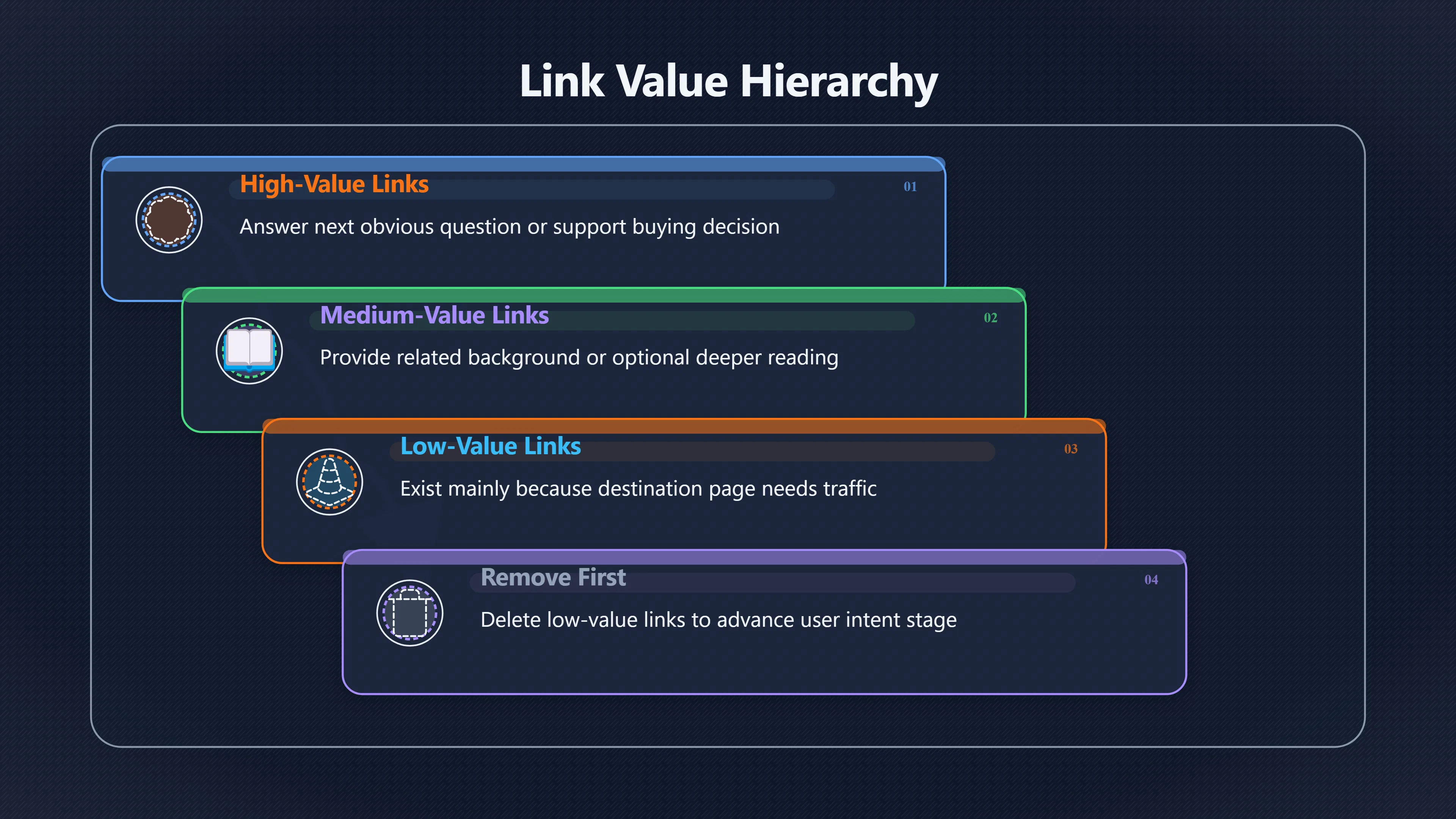
High-value links
- Answer the next obvious question.
- Support a buying decision.
- Expand an explanation already being discussed.
- Help compare alternatives.
Medium-value links
- Provide related background information.
- Cover adjacent but non-essential topics.
- Offer optional deeper reading.
Low-value links
- Exist mainly because the destination page needs traffic.
- Are only loosely related to the current topic.
- Interrupt the user’s progress toward a decision.
When a page contains too many links, low-value links should be removed first.
For affiliate monetisation systems, this principle scales well because it provides a repeatable rule. Rather than maximising internal-link counts, the system prioritises links that advance the user’s current intent stage.
This often leads to fewer total links but higher click-through rates on the links that remain.
Refreshing Outdated Links Before They Erode Trust
Internal links can become harmful even when they were originally useful.[keywordinsights.ai]keywordinsights.aiinternal links best practicesA Detailed Guide11 Jul 2025 — Internal links best practices: Internal links are one of the most important SEO elements, but they're often…
Affiliate sites change constantly. Product recommendations expire. Comparison pages become outdated. Categories evolve. A link that once helped users may eventually create frustration.
Common trust-damaging examples include:
- Links pointing to discontinued products.
- “Best of” pages that have not been updated for years.
- Comparison pages featuring obsolete models.
- Internal recommendations that contradict newer guidance elsewhere on the site.
Readers notice these inconsistencies quickly. A visitor who clicks through to an outdated recommendation may begin questioning the reliability of the entire site.
Regular link audits should therefore focus on more than broken URLs. They should also evaluate whether destination pages still deserve their position in the user journey.
Useful maintenance checks include:
- Reviewing top-linked commercial pages every quarter.
- Replacing links to outdated product reviews with current alternatives.
- Removing links that no longer match search intent.
- Monitoring click-through rates to identify links users consistently ignore.
- Updating anchor text when the destination page’s purpose changes.
This is especially important for affiliate sites because commercial content ages faster than informational content. A tutorial explaining how a product category works may remain useful for years, while the recommended products within that category can become outdated within months.
Building Trust Through Restraint
One of the strongest signals of editorial confidence is restraint.
Readers rarely complain that a page contains too few internal links. They regularly react negatively when links appear excessive, distracting, or self-serving.
The most effective affiliate journeys often feel almost invisible. The reader moves naturally from information to comparison to recommendation because each next step feels logical. Internal links support the decision process instead of competing for attention.
For affiliate websites, trust is not created by adding more pathways. It is created by ensuring that every pathway exists for a clear reason. When links consistently solve the reader’s next problem, they become part of the site’s value. When they exist mainly to manipulate navigation, they become a liability for both conversions and credibility.[Best Marketing]bestmarketing.com.sgBest MarketingInternal vs External Links: SEO Best Practices28 Nov 2025 — Forced or excessive internal linking looks spammy and hurts use…[Google for Developers]developers.google.comGoogle for DevelopersCreating Helpful, Reliable, People-First ContentGoogle's ranking systems are designed to present helpful, reliable i…[Semrush]semrush.com9 Common Internal Linking Mistakes (& How to Fix Them)January 25, 2024 — 19 Aug 2025 — Reduced user trust: Users may question the…
Amazon book picks
Further Reading
Books and field guides related to Avoiding Links That Disrupt the Affiliate User Journey. Use these as the next step if you want deeper reading beyond the article.
Information Architecture for the World Wide Web
Rating: 4.0/5 from 12 Google Books ratings
Directly relevant to organising content hubs, pathways, navigation, and topic relationships.
Building a StoryBrand 2.0
Focuses on building trust and guiding users, reducing friction in affiliate journeys
Trust Agents
Covers credibility and influence in online pathways, aligning with link trust management
eBay marketplace picks
Marketplace Samples
Example marketplace items related to this page. Use the search link to explore similar finds on eBay.







Endnotes
1.
Source: developers.google.com
Link:https://developers.google.com/search/docs/fundamentals/creating-helpful-content
Source snippet
Google for DevelopersCreating Helpful, Reliable, People-First ContentGoogle's ranking systems are designed to present helpful, reliable i...
2.
Source: developers.google.com
Link:https://developers.google.com/search/docs/crawling-indexing/links-crawlable
Source snippet
Google for DevelopersSEO Link Best Practices for Google | Google Search CentralLearn how to make your links crawlable so that Google can...
3.
Source: semrush.com
Link:https://www.semrush.com/blog/internal-linking-mistakes/
Source snippet
9 Common Internal Linking Mistakes (& How to Fix Them)January 25, 2024 — 19 Aug 2025 — Reduced user trust: Users may question the...
Published: January 25, 2024
4.
Source: outsourcery.uk
Title: making these internal linking mistakes
Link:https://outsourcery.uk/2024/03/04/making-these-internal-linking-mistakes/
Source snippet
Are You Making These Internal Linking Mistakes?4 Mar 2024 — When internal links are overused, they can disrupt the flow of content, overw...
5.
Source: geniuslink.com
Title: The Ultimate Guide: Internal Linking for Affiliate Websites
Link:https://geniuslink.com/blog/internal-linking-for-affiliate-websites-guide/
Source snippet
The Ultimate Guide: Internal Linking for Affiliate WebsitesMay 1, 2026 — 1 May 2026 — If you're struggling with Internal linkin...
Published: May 1, 2026
6.
Source: developers.google.com
Link:https://developers.google.com/search/docs/fundamentals/seo-starter-guide
Source snippet
Google for DevelopersSearch Engine Optimization (SEO) Starter GuideHow Google Search works · Creating helpful, reliable, people-first con...
7.
Source: developers.google.com
Link:https://developers.google.com/search/blog/2023/02/google-search-and-ai-content
Source snippet
Google for DevelopersGoogle Search's guidance about AI-generated contentIn this post, we'll share more about how AI-generated content fit...
8.
Source: siteimprove.com
Title: internal linking strategy for seo
Link:https://www.siteimprove.com/blog/internal-linking-strategy-for-seo/
Source snippet
Your Internal Linking Blueprint For Better SEO30 Sept 2025 — Ready to build an internal linking strategy that boosts SEO? Learn to audit...
9.
Source: medium.com
Link:https://medium.com/%40joosep_41274/how-to-structure-content-so-google-ai-can-extract-and-understand-it-bdaa3dda2056
Source snippet
ing whether the content is substantial, clear, useful, and...Read more...
10.
Source: youtube.com
Title: Internal Linking Strategy
Link:https://www.youtube.com/watch?v=q6DyF04neP4
Source snippet
4 How To Use Internal Linking To Massively Boost Your SEO [Including 10 Best Practices]...
11.
Source: bestmarketing.com.sg
Link:https://www.bestmarketing.com.sg/blog/internal-vs-external-links/
Source snippet
Best MarketingInternal vs External Links: SEO Best Practices28 Nov 2025 — Forced or excessive internal linking looks spammy and hurts use...
12.
Source: clickshark.co.uk
Title: Click Shark Best Internal Linking Strategies for Affiliate Sites
Link:https://clickshark.co.uk/internal-linking-for-affiliate-sites/
Source snippet
Best Internal Linking Strategies for Affiliate Sites - Click SharkDiscover the best internal linking strategies for affiliate sites to im...
13.
Source: aioseo.com
Title: All in One SEO9 Internal Linking Best Practices You Can Adopt Today
Link:https://aioseo.com/internal-linking-best-practices/
Source snippet
Consider user experience and think about whether the links are helpful guides or distracting...Read more...
14.
Source: figmentagency.com
Title: internal linking
Link:https://www.figmentagency.com/internal-linking/
Source snippet
Why It Matters and Best Practices18 Oct 2025 — Internal linking is one of the simplest ways to improve how your website performs in searc...
15.
Source: keywordinsights.ai
Title: internal links best practices
Link:https://www.keywordinsights.ai/blog/internal-links-best-practices/
Source snippet
A Detailed Guide11 Jul 2025 — Internal links best practices: Internal links are one of the most important SEO elements, but they're often...
Additional References
16.
Source: linkedin.com
Link:https://www.linkedin.com/pulse/creating-helpful-reliable-people-first-content-guide-googles-bewtf
Source snippet
Creating Helpful, Reliable, and People-First ContentThis guide will walk you through how to self-assess your content, understand Google's...
17.
Source: reflectdigital.co.uk
Link:https://www.reflectdigital.co.uk/blog/guide-to-internal-linking
Source snippet
Guide to Internal LinkingInternal linking helps Google understand which pages on your website are the most valuable and important; helpin...
18.
Source: linkedin.com
Link:https://www.linkedin.com/pulse/internal-linking-strategy-actually-drives-conversions-batterywala-wt4df
Source snippet
Internal Linking for Conversions: Advanced SEO TacticsMaster SEO internal linking with advanced tactics that drive revenue. Learn authori...
19.
Source: seoworks.co.uk
Title: Find out why topic clusters are important and how to create them in this guide
Link:https://www.seoworks.co.uk/topic-clusters-seo-benefits/
Source snippet
SEO Topic Clusters: What they are and how to create them19 Jun 2023 — How can SEO topic clusters improve your website's rankings?...
20.
Source: authoritysolutions.com
Title: google helpful content system a practical guide to people first seo
Link:https://www.authoritysolutions.com/articles/google-helpful-content-system-a-practical-guide-to-people-first-seo/
Source snippet
Complete Guide to People-First SEO1 Aug 2025 — Master the helpful content system! This guide explores people-first SEO, content quality...
21.
Source: midlandmarketing.co.uk
Link:https://midlandmarketing.co.uk/blog/seo/seo-content-best-practices-googles-guidelines/
Source snippet
Create high-quality, search-friendly content that improves rankings and engages readers...
22.
Source: momenticmarketing.com
Link:https://momenticmarketing.com/blog/seo-for-eat-guidelines
Source snippet
EEAT & SEO: How to Make Your Content More Helpful26 Oct 2022 — Use clear and concise language to make sure your website copy is easy to read...
23.
Source: linkedin.com
Link:https://www.linkedin.com/posts/cyrusshepard_googles-helpful-content-system-now-part-activity-7318882316993339392-NduX
Source snippet
ble, and people-first content. To meet Google's standards...Read more...
24.
Source: reddit.com
Link:https://www.reddit.com/r/digital_marketing/comments/1stf0mn/whats_actually_working_in_seo_right_now_to_get/
Source snippet
earning real backlinks still move ranking than tricks.Read more...
25.
Source: thedesignocracy.com
Link:https://thedesignocracy.com/blog/seo-internal-linking
Source snippet
Do not link unrelated pages simply to add more links.Read more...
Topic Tree