Within Trust Rules
Why Every Affiliate Page Needs Its Own Disclosure
Every affiliate page needs its own visible disclosure, especially when visitors land directly from search.
On this page
- Why site wide disclaimers are not enough
- How direct search visits change disclosure placement
- Simple audit rules for high volume affiliate sites
Page outline Jump by section
Introduction
Every affiliate page needs its own disclosure because most visitors do not enter a website through the homepage. They arrive directly on a review, comparison, “best of” list, product roundup, or buying guide from search results, social shares, AI-generated answers, newsletters, or external links. If that page contains affiliate recommendations, the disclosure must be visible on that page rather than hidden behind a site-wide disclaimer or legal page. Regulators in both the US and UK focus on whether a reasonable visitor can understand the commercial relationship before acting on a recommendation, not whether the site technically contains a disclosure somewhere else.[Federal Trade Commission]ftc.govs endorsement guides what people are askingFederal Trade CommissionFTC's Endorsement Guides: What People Are Asking29 Jun 2023 — Here are answers to some of the most frequently ask…[ASA]asa.org.ukaffiliate marketingOnline Affiliate Marketing22 Mar 2023 — Rule 2.1 of the CAP Code requires that marketing communications are obviously identifiable as suc…
 For large affiliate sites, this becomes a governance problem rather than a writing problem. A site with hundreds or thousands of monetised pages can easily develop disclosure gaps through template changes, content imports, expired page formats, or inconsistent publishing workflows. Per-page disclosure checks help protect trust, reduce compliance risk, and create a repeatable standard that can scale across large content inventories.
Why Site-Wide Disclaimers Are Not Enough
Many affiliate publishers start with a single disclosure page linked in the footer. The problem is that users rarely see it.
Regulators consistently focus on visibility and context. The FTC’s guidance emphasises that material connections should be disclosed clearly and conspicuously where consumers encounter the endorsement. Similarly, UK CAP Code guidance requires affiliate marketing communications to be obviously identifiable and commercially transparent.[Federal Trade Commission]ftc.govs endorsement guides what people are askingFederal Trade CommissionFTC's Endorsement Guides: What People Are Asking29 Jun 2023 — Here are answers to some of the most frequently ask…[ASA]asa.org.ukrecognising ads advertisement featuresRecognising ads: Advertisement features23 Mar 2023 — Section 2 of the CAP Code requires that marketing communications are obviously ident…
For a scaled affiliate site, relying on a global disclaimer creates several weaknesses:
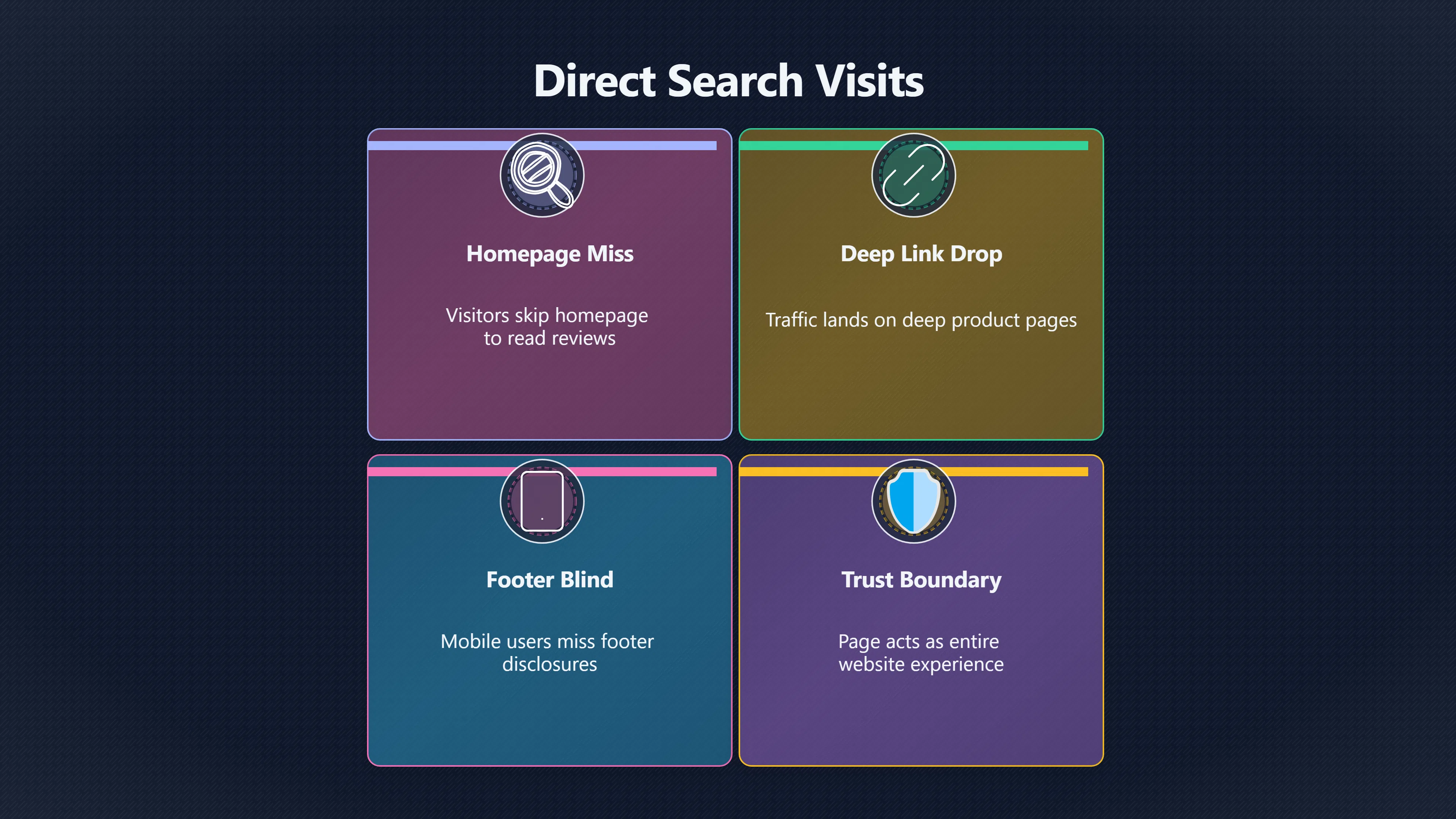
- A visitor can land directly on a monetised article without ever seeing the disclosure page.
- Search engines often send traffic to deep pages rather than category hubs.
- Mobile visitors may never reach the footer.
- Syndicated content, AMP versions, translated pages, or cached versions may display differently from the main site.
- New templates may accidentally remove disclosure elements while preserving affiliate links.
From a governance perspective, a disclosure only works if it travels with the commercial content itself.
A useful rule for large publishers is simple:
If a page contains affiliate links, that page should contain a disclosure visible before or near the first recommendation.
This standard is easier to audit than subjective questions about whether a site-level notice is “good enough”.
How Direct Search Visits Change Disclosure Placement
Affiliate publishers often think about websites as complete experiences. Search visitors do not.
A user searching for:
- “best budget espresso machine”
- “bluehost vs siteground”
- “best standing desk under £300”
- “is product x worth it”
typically lands on a single commercial page and makes a decision within minutes.
The homepage, About page, disclosure page, and brand story may never be viewed.
This changes disclosure strategy in several important ways.
The Page Becomes the Trust Boundary
For search visitors, the page itself is effectively the entire website.
That means the disclosure has to work independently. A reader should not need to navigate elsewhere to understand that commissions may be earned from purchases.
This is particularly important on:
- Product comparison pages
- Buying guides
- Product reviews
- “Best” roundups
- Coupon pages
- Software recommendation pages
These formats are designed to influence purchasing decisions, making commercial transparency more relevant than on informational content.
Search Traffic Creates Disclosure Inconsistency Risk
High-volume affiliate sites often grow through repeated page templates.
A site might contain:
- Legacy articles created before disclosure rules were standardised
- Imported content from acquisitions
- AI-assisted content produced using different prompts
- Multiple page builders or CMS templates
- Separate content teams operating under different standards
As traffic spreads across thousands of URLs, disclosure consistency can deteriorate.
The result is often a mixed estate where some pages have excellent disclosures while others have none.
This inconsistency creates both compliance and trust problems because users judge the entire brand based on the page they land on.
Disclosure Checks as a Scalable Governance System
The most effective affiliate publishers treat disclosure presence as a quality-control requirement rather than an editorial preference.
Instead of asking writers to remember disclosures manually, they create rules that can be checked systematically.
A scalable governance model typically answers four questions:
CheckPurposeDoes the page contain affiliate links?Determines whether disclosure is requiredIs a disclosure present?Verifies basic complianceIs the disclosure visible before or near monetised content?Tests placement qualityIs the disclosure understandable in plain language?Tests reader comprehension
These checks are far easier to standardise than subjective content-quality reviews.
For large sites, disclosure compliance becomes similar to checking whether a page contains a title tag, canonical URL, or structured navigation element.
Simple Audit Rules for High-Volume Affiliate Sites
Large affiliate operations benefit from objective pass-or-fail rules.
Rule 1: Every Affiliate URL Must Trigger a Disclosure Check
The first requirement is identifying pages that contain affiliate monetisation.
Common detection methods include:
- Affiliate network tracking domains
- Affiliate query parameters
- Merchant redirect URLs
- Coupon-tracking links
- Affiliate widgets and product tables
Once a page is classified as monetised, disclosure validation should automatically become part of the publishing workflow.
This prevents disclosure enforcement from depending entirely on editorial memory.
Rule 2: Check Above-the-Fold Visibility
A disclosure hidden far below the first affiliate button is difficult to defend.[termly.io]termly.ioaffiliate disclosureExamples & Writing Guide1 Apr 2026 — We go over what an affiliate link disclosure is, how to write an effective one, a the requirements y…
Many compliance guides recommend disclosures appearing before readers interact with affiliate recommendations.[PartnerCentric]partnercentric.comHow to Properly Disclose FTC Endorsements17 Jun 2024 — On websites, disclosures should be close to the endorsement, such as…[2help.raptive.com]help.raptive.com26147443891483 Guide to Affiliate DisclosuresGuide to Affiliate Disclosures26 Jun 2024 — In each article or post that contains affiliate links, you must state that there are affiliat…
For scaled sites, a practical audit rule is:
- Disclosure appears before the first affiliate link, product table, comparison widget, or call-to-action.
This can often be implemented at template level instead of page level.
Rule 3: Audit Mobile Layouts Separately
A disclosure that appears prominently on desktop can disappear several screens down on mobile.
Because commercial affiliate traffic is frequently mobile-first, disclosure reviews should include:
- Mobile rendering
- Sticky elements
- Product table collapses
- Comparison widgets
- Ad insertions
A page can technically contain a disclosure while still failing the visibility test for many users.
Rule 4: Test Category Templates, Not Just Individual Pages
Many large sites generate hundreds of pages from a single template.
This creates leverage.
Rather than manually checking 5,000 URLs, publishers can review:
- Review template
- Comparison template
- Best-product template
- Coupon template
- Software recommendation template
If disclosure placement is built into the template, compliance scales more reliably across future content.
Rule 5: Flag Pages Where Monetisation Changes
One common failure occurs when informational pages later become commercial.
Examples include:
- Adding affiliate tables to an existing guide
- Inserting product recommendations into an informational article
- Updating old reviews with new affiliate partners
Pages that were originally non-commercial may never receive a disclosure update.
A useful governance rule is that any change introducing affiliate links automatically triggers a disclosure review.
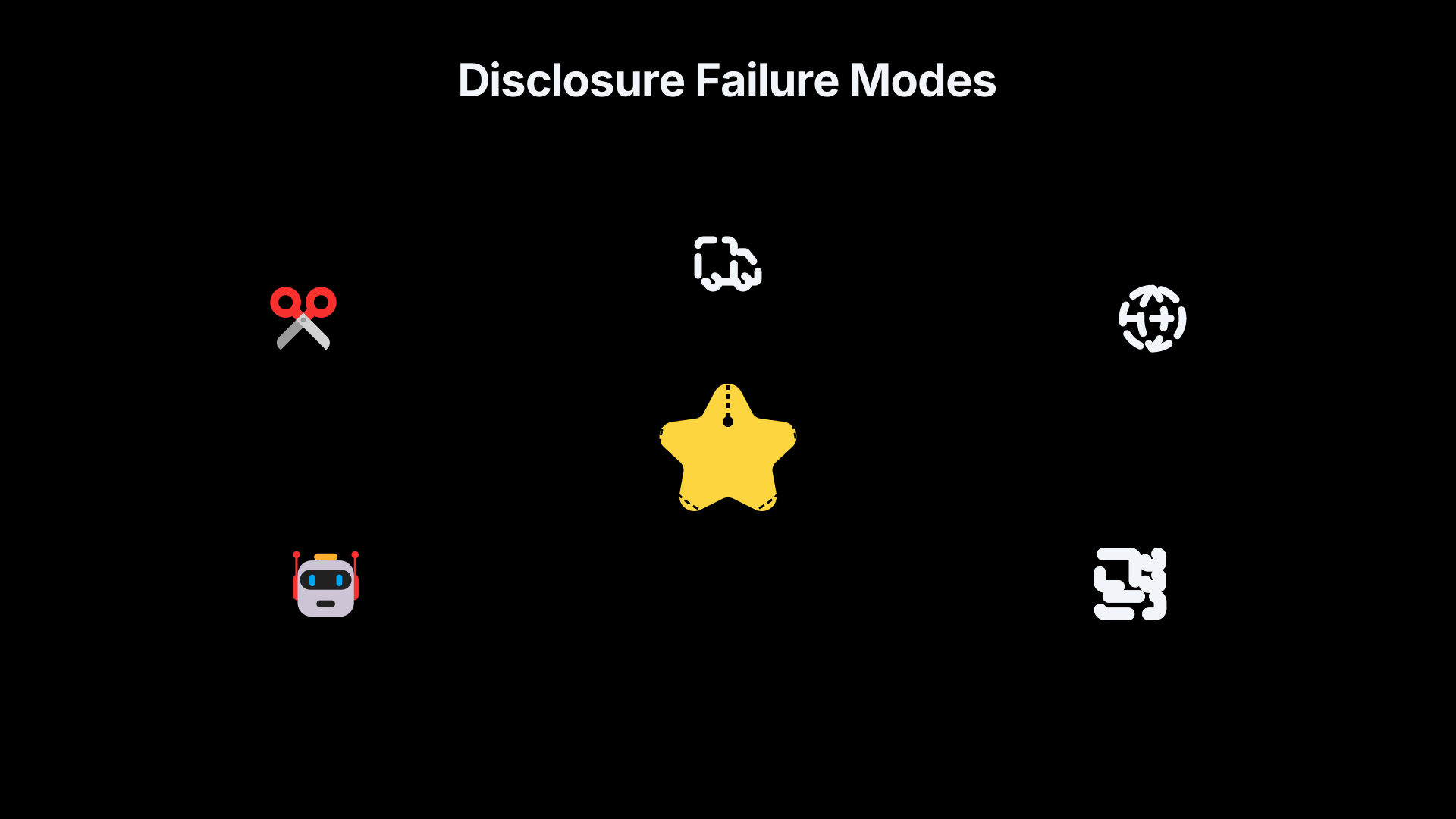
Common Failure Modes on Large Affiliate Sites
The biggest disclosure problems usually come from operational growth rather than deliberate concealment.
Typical examples include:
Template drift
A redesign removes disclosure blocks from one page type while preserving them elsewhere.
Content migrations
Imported articles lose disclosure modules during CMS transitions.
International expansion
Localised versions keep affiliate links but omit translated disclosure text.[termly.io]termly.ioaffiliate disclosureExamples & Writing Guide1 Apr 2026 — We go over what an affiliate link disclosure is, how to write an effective one, a the requirements y…
AI-assisted publishing
Content generation workflows create monetised pages without inserting disclosure components consistently.
Widget-first monetisation
Product comparison tables are embedded through plugins that bypass normal content areas where disclosures appear.
These failures are especially common when sites expand into new topic clusters or launch multiple content formats simultaneously.
Why Disclosure Consistency Supports Revenue
Disclosure checks are often treated as a legal burden, but they also support monetisation.
Visitors increasingly recognise affiliate business models. A clear disclosure removes uncertainty about why products are being recommended and can make the page appear more trustworthy rather than less trustworthy.
Research on affiliate disclosure effectiveness has shown that vague or hidden disclosures are frequently misunderstood, while clearer explanatory disclosures help users recognise the commercial relationship being disclosed.[arXiv]arxiv.orgEndorsements on Social Media: An Empirical Study of Affiliate Marketing Disclosures on YouTube and PinterestSeptember 3, 2018…
For large affiliate sites, trust becomes a repeatable asset.
A visitor who sees:
- transparent disclosures,
- consistent recommendation formats,
- clear review methodology,
- and visible commercial relationships,
is more likely to perceive the site as credible than one that appears to hide monetisation.
This matters because affiliate revenue depends on conversion confidence. The goal is not simply generating clicks but helping visitors feel comfortable acting on recommendations.
The Most Scalable Disclosure Strategy
For high-volume affiliate publishing, the safest approach is usually the simplest:
- Classify pages as affiliate or non-affiliate.
- Attach disclosures automatically to affiliate page templates.
- Position disclosures before major monetisation elements.
- Audit templates regularly rather than relying on manual page reviews.
- Recheck disclosures whenever links, widgets, or monetisation systems change.
The key insight is that disclosure compliance should scale in the same way as navigation, page structure, or internal linking. When disclosures are treated as a template-level governance requirement instead of a writer-level task, consistency becomes easier to maintain across thousands of revenue-generating pages.
Amazon book picks
Further Reading
Books and field guides related to Why Every Affiliate Page Needs Its Own Disclosure. Use these as the next step if you want deeper reading beyond the article.
Don't Make Me Think, Revisited
Direct-entry visitors need disclosures visible on the page they actually land on.
The Art of SEO
Per-page disclosure is a scalable site governance and template issue for affiliate content inventories.
Everybody Writes
Each monetised page needs clear copy that explains affiliate relationships in context.
Content Inc.: How Entrepreneurs Use Content to Build Massive...
Affiliate disclosure standards must scale across repeatable publishing systems.
eBay marketplace picks
Marketplace Samples
Example marketplace items related to this page. Use the search link to explore similar finds on eBay.








Endnotes
1.
Source: ftc.gov
Title: s endorsement guides what people are asking
Link:https://www.ftc.gov/business-guidance/resources/ftcs-endorsement-guides-what-people-are-asking
Source snippet
Federal Trade CommissionFTC's Endorsement Guides: What People Are Asking29 Jun 2023 — Here are answers to some of the most frequently ask...
2.
Source: asa.org.uk
Title: affiliate marketing
Link:https://www.asa.org.uk/advice-online/affiliate-marketing.html
Source snippet
Online Affiliate Marketing22 Mar 2023 — Rule 2.1 of the CAP Code requires that marketing communications are obviously identifiable as suc...
3.
Source: asa.org.uk
Title: recognising ads advertisement features
Link:https://www.asa.org.uk/advice-online/recognising-ads-advertisement-features.html
Source snippet
Recognising ads: Advertisement features23 Mar 2023 — Section 2 of the CAP Code requires that marketing communications are obviously ident...
4.
Source: asa.org.uk
Title: get yourself affiliated with the rules on affiliate marketing
Link:https://www.asa.org.uk/news/get-yourself-affiliated-with-the-rules-on-affiliate-marketing.html
Source snippet
10 Oct 2024 — This CAP Advice explains the circumstances under which different aspects of content which includes affiliate links will nee...
5.
Source: partnercentric.com
Link:https://partnercentric.com/blog/how-to-properly-disclose-ftc-endorsements/
Source snippet
How to Properly Disclose FTC Endorsements17 Jun 2024 — On websites, disclosures should be close to the endorsement, such as...
6.
Source: help.raptive.com
Title: 26147443891483 Guide to Affiliate Disclosures
Link:https://help.raptive.com/hc/en-us/articles/26147443891483-Guide-to-Affiliate-Disclosures
Source snippet
Guide to Affiliate Disclosures26 Jun 2024 — In each article or post that contains affiliate links, you must state that there are affiliat...
7.
Source: arxiv.org
Link:https://arxiv.org/abs/1809.00620
Source snippet
Endorsements on Social Media: An Empirical Study of Affiliate Marketing Disclosures on YouTube and PinterestSeptember 3, 2018...
Published: September 3, 2018
8.
Source: ftc.gov
Link:https://www.ftc.gov/system/files/ftc_gov/pdf/P204500%20Guides%20Concerning%20Endors%20and%20Testimonials.pdf
Source snippet
at an endorser's experience is representative of what consumers will.Read more...
9.
Source: youtube.com
Title: Compliance in Affiliate Marketing, The 6 Blind Spots
Link:https://www.youtube.com/watch?v=Or2vR78M6KA
Source snippet
How to do an SEO Audit — 7 Steps for Beginners (Free Tools)...
10.
Source: youtube.com
Title: How to do an SEO Audit — 7 Steps for Beginners (Free Tools)
Link:https://www.youtube.com/watch?v=0nCoeDTbo_Y
Source snippet
Comprehensive SEO Audit Guide: Perfect for Beginners...
11.
Source: youtube.com
Title: Comprehensive SEO Audit Guide: Perfect for Beginners!
Link:https://www.youtube.com/watch?v=SIR4Kn62bLQ
Source snippet
EP 118. Disclosures 101: FTC Guidelines for Social Media Influencers...
12.
Source: youtube.com
Title: EP 118. Disclosures 101: FTC Guidelines for Social Media Influencers
Link:https://www.youtube.com/watch?v=Q1D_dZdExHA
Source snippet
sharing amazon affiliate links - the right way...
13.
Source: youtube.com
Title: sharing amazon affiliate links
Link:https://www.youtube.com/watch?v=COaie368nNo
Source snippet
How to check affiliate disclosures automated audit scaled site What They DON'T Tell You About The Amazon Affiliate Program...
14.
Source: asa.org.uk
Link:https://www.asa.org.uk/
Source snippet
CAPThe Advertising Standards Authority (ASA) is the UK's independent regulator of advertising across all media...
15.
Source: termly.io
Title: affiliate disclosure
Link:https://termly.io/resources/articles/affiliate-disclosure/
Source snippet
Examples & Writing Guide1 Apr 2026 — We go over what an affiliate link disclosure is, how to write an effective one, a the requirements y...
16.
Source: termsfeed.com
Title: affiliate disclosure
Link:https://www.termsfeed.com/blog/affiliate-disclosure/
Source snippet
Disclosures for Affiliate Links21 Apr 2026 — This article will break down affiliate disclosure requirements, how to create your own and h...
17.
Source: youtube.com
Title: “Advertising Standards Authority (ASA)”
Link:https://www.youtube.com/watch?v=FnQymLaL7yo
Source snippet
Legal DefinitionASA is an independent non-government body that regulates UK advertisements to ensure they are truthful and socially respo...
Additional References
18.
Source: x.com
Link:https://x.com/ASA_UK?lang=en
Source snippet
ASA (@ASA_UK) / Posts / XWe're the Advertising Standards Authority, the UK's independent regulator for advertising across all media, incl...
19.
Source: lyricalhost.com
Link:https://www.lyricalhost.com/blog/how-to-disclose-affiliate-links/
Source snippet
How To Disclose Affiliate LinksConspicuous: The disclosure must be clear and easy to see, with no scrolling required. It should begin wit...
20.
Source: iubenda.com
Link:https://www.iubenda.com/en/blog/affiliate-disclosure/
Source snippet
How to Write an Effective Affiliate DisclosureAccording to the FTC, endorsements must reflect the honest opinions and experience of the e...
21.
Source: myroomismyoffice.com
Link:https://myroomismyoffice.com/uk-affiliate-link-disclosures/
Source snippet
UK Affiliate Link Disclosures: Where to Put Them (and...This guide shows you exactly where to put disclosures and what to say across blo...
22.
Source: federal-lawyer.com
Link:https://federal-lawyer.com/ftc-defense/affiliate-disclosure/
Source snippet
Understanding the FTC's Affiliate Disclosure RulesLearn what affiliate marketers and companies need to know about the FTC's affiliate dis...
23.
Source: rpclegal.com
Link:https://www.rpclegal.com/snapshots/advertising-and-marketing/spring-2023/the-asas-strict-approach-to-affiliate-marketing-links-and-the-need-for-advertising-disclosures/
Source snippet
The ASA's strict approach to affiliate marketing links and...31 Mar 2023 — Both affiliate marketers and the brands they promote hold joi...
24.
Source: adamigo.ai
Link:https://www.adamigo.ai/blog/ultimate-guide-to-ftc-ad-disclosures
25.
Source: dglaw.com
Link:https://www.dglaw.com/the-deep-dive-ftc-updates-endorsement-guides-for-modern-marketing-and-advertising/
Source snippet
The Deep Dive: FTC Updates Endorsement Guides...11 Jul 2023 — On June 29, the FTC announced new Endorsement Guides (Endorsement Guides)...
26.
Source: fastcomet.com
Link:https://www.fastcomet.com/blog/affiliate-disclosure
Source snippet
Affiliate Link Disclosures: Examples and Best Practices9 Jun 2022 — Affiliate link disclosures are an FTC-mandated practice...
27.
Source: jmw.co.uk
Link:https://www.jmw.co.uk/services-for-you/business-crime/advertising-standards-authority
Source snippet
As such, it may respond to concerns about misleading or unlawful advertising (like financial or...Read more...
Topic Tree