Within Support Pages
Can a problem page lead to revenue?
Troubleshooting pages can become valuable when each likely cause points to a different product category or replacement decision.
On this page
- Mapping causes to product categories
- When troubleshooting should not sell yet
- Examples from damp, sleep and appliance problems
Page outline Jump by section
Introduction
Yes, a problem page can lead to revenue, but only when it helps the reader identify the cause of a problem before pushing a solution. In many affiliate-driven website systems, some of the highest-value visitors arrive with symptoms rather than product intent. They search for things like “why does my bedroom smell damp?”, “why am I waking up with shoulder pain?”, or “why is my tumble dryer taking so long to dry clothes?” They do not yet know whether they need a dehumidifier, a new mattress, a pillow, a replacement appliance, a repair part, or no purchase at all.
 That makes diagnosis pages commercially important. They sit between pure information and buying intent. Instead of immediately recommending products, they narrow possibilities, separate causes, and direct readers into the most relevant solution path. This mirrors Google’s research on the “messy middle” of purchasing, where people move repeatedly between exploration and evaluation before deciding what to buy.[Google Business]business.google.comAs people explore and evaluate in the messy middle, cognitive biases shape their shopping behavior and…
For affiliate websites, diagnosis pages often outperform generic informational content because they create structured routes into different solution categories. The page does not earn because it attracts traffic alone. It earns because each diagnosis outcome can lead to a different buying guide, comparison page, service recommendation, or replacement decision.
Mapping causes to product categories
The strongest diagnosis pages are built around branching outcomes rather than single answers.
A common mistake is treating troubleshooting as a content dead end. A better approach is to treat the page as a decision framework.
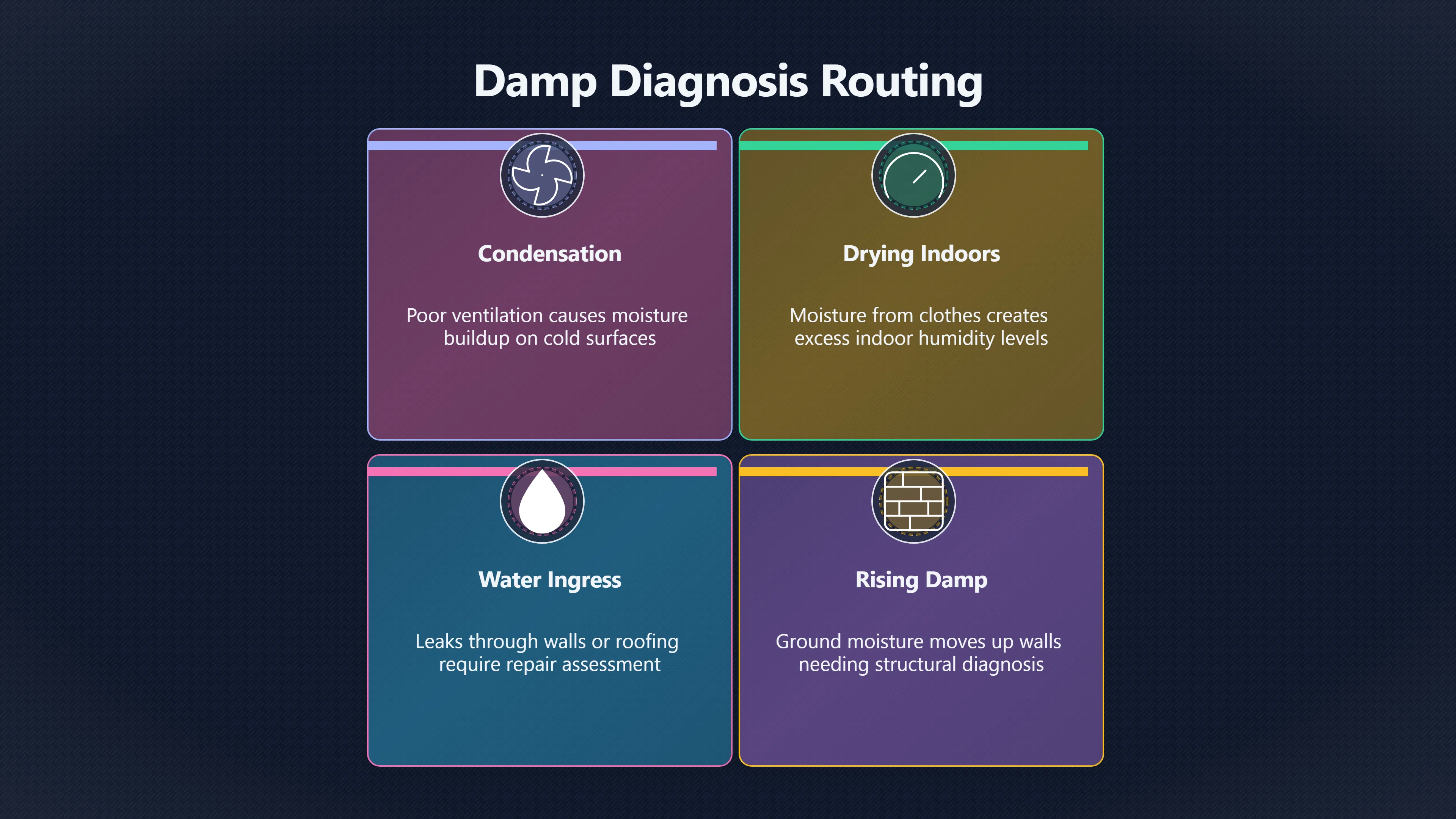
Consider a query such as “why is my bedroom damp?” The visitor may assume they need a dehumidifier. In reality, the cause could be:
- Condensation from poor ventilation
- Water ingress through walls or roofing
- Rising damp
- Excess indoor moisture from drying clothes
- Insufficient heating
Each cause points towards a different solution path:
Likely causeNext page typeCommercial categoryCondensationVentilation guideExtractor fans, window ventsDrying clothes indoorsMoisture-control guideDehumidifiersCold room surfacesHeating comparisonElectric heaters, insulation productsWater ingressRepair assessmentProfessional services rather than productsRising dampStructural diagnosis guideSpecialist contractors
The diagnosis page therefore becomes a routing layer. It helps the user avoid the wrong purchase while increasing the chance that readers who do need products reach the correct buying page.
This structure is valuable for large-scale affiliate publishing because the same template can be reused across many problem categories:
- Symptom
- Likely causes
- Tests or checks
- Cause identification
- Relevant solution category
- Product or service guide
The monetisation opportunity appears after classification, not before.
Why diagnosis pages often convert better than broad guides
A visitor searching for a product category may still be comparing options. A visitor searching for a symptom is often trying to solve an immediate problem.
That creates stronger motivation.
Someone searching “best dehumidifier” is evaluating products. Someone searching “why are my windows covered in water every morning?” is trying to stop a specific problem. Once they discover condensation is the likely cause, a dehumidifier guide becomes highly relevant.
The commercial advantage comes from matching the solution to the diagnosed cause.
Google’s research describes shoppers moving between exploration and evaluation stages before purchase. Diagnosis pages work because they help readers move from confusion into a narrower set of options.[Google Business]business.google.comAs people explore and evaluate in the messy middle, cognitive biases shape their shopping behavior and…
In practice, this means:
- Higher relevance between page and recommendation
- Better user trust
- Fewer wasted clicks
- Higher likelihood of reaching the correct buying guide
Instead of forcing readers into a product category, the page earns the transition.
When troubleshooting should not sell yet
Not every diagnosis outcome should trigger a commercial recommendation.
This is one of the main quality distinctions between useful troubleshooting content and thin affiliate content.
If a page about back pain immediately recommends mattresses without discussing posture, sleeping position, injuries, or pillow support, readers often recognise the commercial bias.
A better structure is:
- Identify common causes.
- Eliminate obvious non-product causes.
- Explain when a product is likely to help.
- Explain when a professional assessment may be more appropriate.
- Only then route readers towards relevant buying guides.
This matters because trust is part of the conversion path.
Users decide whether to follow links based on what usability researchers call “information scent” — the clues that indicate where a link will lead and whether it will help solve the current problem. Weak or misleading transitions reduce engagement and increase abandonment.[Nielsen Norman Group]nngroup.cominformation scentNielsen Norman GroupInformation Scent: How Users Decide Where to Go NextFeb 2, 2020 — Summary: When deciding which links to click on the…[Nielsen Norman Group]nngroup.cominformation scentNielsen Norman GroupInformation Scent: How Users Decide Where to Go NextFeb 2, 2020 — Summary: When deciding which links to click on the…
A page titled:
- “Signs your mattress is causing back pain”
creates stronger information scent for a diagnosed mattress issue than:
- “Best mattresses 2026”
because the second link assumes the reader has already accepted the diagnosis.
The troubleshooting page should therefore delay monetisation until sufficient certainty exists.
Sleep problems: one symptom, multiple affiliate paths
Sleep-related diagnosis content demonstrates how one symptom can feed several monetisation routes.
Consider a page answering:
“Why do I wake up with shoulder pain?”
Potential causes include:
- Mattress firmness issues
- Pillow height problems
- Sleeping position
- Old mattress deterioration
- Underlying medical conditions
Each branch can lead somewhere different:
- Mattress firmness guide
- Side-sleeeper mattress comparisons
- Pillow buying guide
- Mattress replacement signs
- Non-commercial medical advice page
This creates a cluster structure rather than a single affiliate funnel.
A website generation system can scale this pattern because many symptoms share the same architecture:
- Symptom page
- Cause identification section
- Decision tree
- Cause-specific solution guide
- Product comparison page
The symptom becomes the entry point into several monetised content branches.
Damp problems: a high-value diagnostic content model
Damp-related content is particularly useful because users often misdiagnose the problem.
A search such as:
- “Why does my room smell musty?”
- “Why are my walls wet?”
- “Why is mould coming back?”
often precedes any product search.
A diagnosis page can separate:
- Condensation
- Penetrating damp
- Rising damp
- Temporary moisture issues
The monetisation paths are different:
- Condensation → dehumidifiers
- Ventilation issues → extractor fans
- Humidity monitoring → hygrometers
- Structural damp → contractor referral content
Importantly, the page should explain when a dehumidifier is unlikely to solve the underlying issue.
Paradoxically, this can improve revenue.
A reader who trusts the diagnosis is more likely to follow solution guides later than a reader who feels pushed towards an inappropriate purchase.
Appliance problems and replacement decisions
Appliance troubleshooting pages often sit very close to commercial intent.
Queries such as:
- “Why is my tumble dryer taking three cycles?”
- “Why is my vacuum losing suction?”
- “Why is my washing machine leaking?”
usually indicate a reader deciding between repair and replacement.
The diagnosis page can separate:

Simple fixes
Examples include:
- Blocked filters
- Full water containers
- Incorrect settings
- Obstructed vents
These outcomes may not produce immediate affiliate revenue, but they increase trust and return visits.
Replaceable components
Examples include:
- Filters
- Belts
- Hoses
- Attachments
These can feed parts guides and accessory pages.
End-of-life indicators
Examples include:
- Repeated breakdowns
- Poor energy efficiency
- Expensive repair costs
- Obsolete parts
These outcomes naturally lead into replacement guides.
A page explaining when a fault is likely to indicate appliance replacement often converts better than a generic “best washing machines” page because the reader has already reached the replacement decision.
Designing diagnosis pages for scalable affiliate systems
For high-volume website production, diagnosis content works best when it follows predictable structures.
Useful repeatable elements include:
- Symptom definition
- Common causes ranked by likelihood
- Quick self-checks
- Signs that distinguish one cause from another
- Cause-specific solution routes
- Internal links to relevant buying guides
- Non-commercial outcomes where appropriate
The key classification variable is not the product category.
It is the symptom.
A site that organises around symptoms can often reach visitors earlier than a site organised entirely around products.
For example:
Symptom pageSolution guides generatedWhy is my room damp?Dehumidifiers, ventilation, heatingWhy does my back hurt after sleeping?Mattresses, pillows, bed framesWhy are my clothes still wet after drying?Tumble dryers, drying racks, moisture controlWhy is my vacuum losing suction?Filters, replacement parts, new vacuums
This creates a scalable publishing pattern where one diagnosis page can feed several monetised content paths.
The most valuable outcome is often category discovery
The strongest diagnosis pages do something that conventional buying guides cannot.
They reveal the product category itself.
Many readers arrive knowing only that they have a problem. They do not know which category of product might solve it.
A diagnosis page bridges that gap.
Instead of asking readers to choose between products, it helps them discover whether they need a product at all, and if so, which type. That makes the page valuable both to users and to affiliate-driven website systems. The content captures earlier intent, improves solution matching, and creates cleaner transitions into buying guides that feel like the natural next step rather than an interruption.
Amazon book picks
Further Reading
Books and field guides related to Can a problem page lead to revenue?. Use these as the next step if you want deeper reading beyond the article.
Troubleshooting and Maintaining Your PC All-in-One For Dummies
Shows how to identify causes before recommending solutions, mirroring affiliate diagnosis flow
Problem Solving 101
Supports the concept of structured diagnosis that leads into solution pathways

The Art of Problem Solving
Teaches systematic approaches to identifying problem causes, useful for shaping diagnosis content
The Art of Problem Solving, Volume 1
Teaches systematic approaches to identifying problem causes, useful for shaping diagnosis content
eBay marketplace picks
Marketplace Samples
Example marketplace items related to this page. Use the search link to explore similar finds on eBay.






Endnotes
1.
Source: business.google.com
Link:https://business.google.com/aunz/think/consumer-insights/navigating-purchase-behavior-and-decision-making/
Source snippet
As people explore and evaluate in the messy middle, cognitive biases shape their shopping behavior and...
2.
Source: business.google.com
Title: messy middle 2023
Link:https://business.google.com/aunz/think/consumer-insights/messy-middle-2023/
Source snippet
Behaviour in the Messy MiddleUnderstand the buying behaviour of omnichannel shoppers and navigate the Messy Middle of e-commerce customer...
3.
Source: thinkwithgoogle.com
Link:https://www.thinkwithgoogle.com/_qs/documents/9998/Decoding_Decisions_The_Messy_Middle_of_Purchase_Behavior.pdf
Source snippet
Google BusinessDecoding DecisionsAnd while there's still plenty of tactical value in both of these approaches, the exploration and evalua...
4.
Source: nngroup.com
Title: information scent
Link:https://www.nngroup.com/articles/information-scent/
Source snippet
Nielsen Norman GroupInformation Scent: How Users Decide Where to Go NextFeb 2, 2020 — Summary: When deciding which links to click on the...
5.
Source: nngroup.com
Link:https://www.nngroup.com/articles/information-foraging/
Source snippet
Nielsen Norman GroupInformation Foraging: A Theory of How People Navigate on...Nov 10, 2019 — Each source of information thus emits a “s...
6.
Source: Wikipedia
Link:https://en.wikipedia.org/wiki/Information
Source snippet
InformationInformation is an abstract concept that refers to something which has the power to inform. At the most fundamental level, i...
7.
Source: nngroup.com
Title: information scent
Link:https://www.nngroup.com/videos/information-scent/
Source snippet
(Video)Nov 27, 2020 — Information scent can be used to analyze how people assess a link and the page context surrounding the link to judg...
8.
Source: dictionary.cambridge.org
Link:https://dictionary.cambridge.org/dictionary/english/information
Source snippet
English meaning - Cambridge Dictionary3 days ago — Information is an uncountable noun meaning 'facts about someone or something'. It is...
9.
Source: neveralwaysbook.com
Title: messy middle
Link:https://neveralwaysbook.com/learn/messy-middle
Source snippet
Marketing: Google's Consumer Journey Model1 May 2026 — The messy middle is Google's research-backed model describing the complex phase be...
Published: May 2026
10.
Source: linkedin.com
Link:https://www.linkedin.com/pulse/contextual-menus-clean-ui-costly-ux-aleksandra-smith-cirqe
Source snippet
Nielsen Norman Group: "In studies on icon...Read more...
11.
Source: uxtigers.com
Title: information scent
Link:https://www.uxtigers.com/post/information-scent
Source snippet
How Users Decide Where to ClickJul 26, 2024 — Information scent determines users' ability to predict what they will find if they pursue a...
Additional References
12.
Source: ipa.co.uk
Link:https://ipa.co.uk/effworks/marketing-marketing/decoding-decisions
Source snippet
Decoding DecisionsThe 'messy middle' of purchase behaviour. How people decide which products and brands to buy is fascinating, but comple...
13.
Source: merriam-webster.com
Link:https://www.merriam-webster.com/dictionary/information
Source snippet
INFORMATION Definition & MeaningThe meaning of INFORMATION is knowledge gained from investigation, study, or instruction. How to use info...
14.
Source: mrs.org.uk
Link:https://www.mrs.org.uk/pdf/NCI5%20-%20Google%20%26%20The%20Behavioural%20Architects.pdf
Source snippet
Surpassing Expectations in the Messy MiddleWe explore strategies for success in the "messy middle" – where consumers actively explore and...
15.
Source: impact.com
Link:https://impact.com/affiliate/affiliate-onboarding-challenges-and-solutions/
Source snippet
Troubleshooting affiliate onboarding: Top 4 issuesFacing affiliate onboarding issues? Learn 4 common challenges and how to fix them for f...
16.
Source: linkedin.com
Link:https://www.linkedin.com/pulse/google-decodes-messy-middle-buying-process-g-david-dodd
17.
Source: scribd.com
Link:https://www.scribd.com/document/710142097/Decoding-Decisions-Marketing-in-the-Messy-Middle-DclfruV
Source snippet
and evaluate in the messy middle. Marketers can influence consumer decision-making by responsibly...Read more...
18.
Source: sarahwithanh-xo.medium.com
Title: com5 problems with Affiliate Marketing and how you can fix them1
Link:https://sarahwithanh-xo.medium.com/5-problems-with-affiliate-marketing-and-how-you-can-fix-them-4d255c734d0a
Source snippet
Difficulty attracting traffic. Affiliate marketers rely heavily on web traffic to generate sales. · 2. Low conversion rates · 3. Limited...
19.
Source: articles.data.blog
Title: Articles of Interest The “messy middle” of the purchase journey
Link:https://articles.data.blog/2020/07/19/the-messy-middle-of-the-purchase-journey/
Source snippet
Articles of InterestThe “messy middle” of the purchase journey - Articles of Interest19 Jul 2020 — This equates to two different mental m...
20.
Source: iabeurope.eu
Link:https://iabeurope.eu/knowledge_hub/insights-from-think-with-google-how-people-decide-what-to-buy-lies-in-the-messy-middle-of-the-purchase-journey/
Source snippet
wing how brands can win and retain customers in the “messy middle” of the purchase...Read more...
21.
Source: ux.stackexchange.com
Title: can navigation same content be repeated in different sections of a website wh
Link:https://ux.stackexchange.com/questions/54128/can-navigation-same-content-be-repeated-in-different-sections-of-a-website-wh
Source snippet
It could be reflective of content-strategy problem, a navigation organization problem, or an audience...Read more...
Topic Tree