Within Support Pages
Which questions create buying momentum?
Early questions earn more when the answer turns uncertainty into clear criteria for a later product choice.
On this page
- How early stage questions expose commercial criteria
- Examples where answers change the next page
- Signals that a question is too broad to monetise
Page outline Jump by section
Introduction
The most valuable informational affiliate pages often answer questions that appear before a product search. Their purpose is not to recommend products immediately. Their purpose is to help the reader discover what actually matters in the decision.
 A question such as “What size dehumidifier do I need?” does more than attract traffic. It reveals buying criteria: room size, extraction rate, noise level, drainage options and running costs. Once those criteria become clear, the reader is much more likely to engage with a comparison page, buying guide or review because they now understand what they are evaluating.
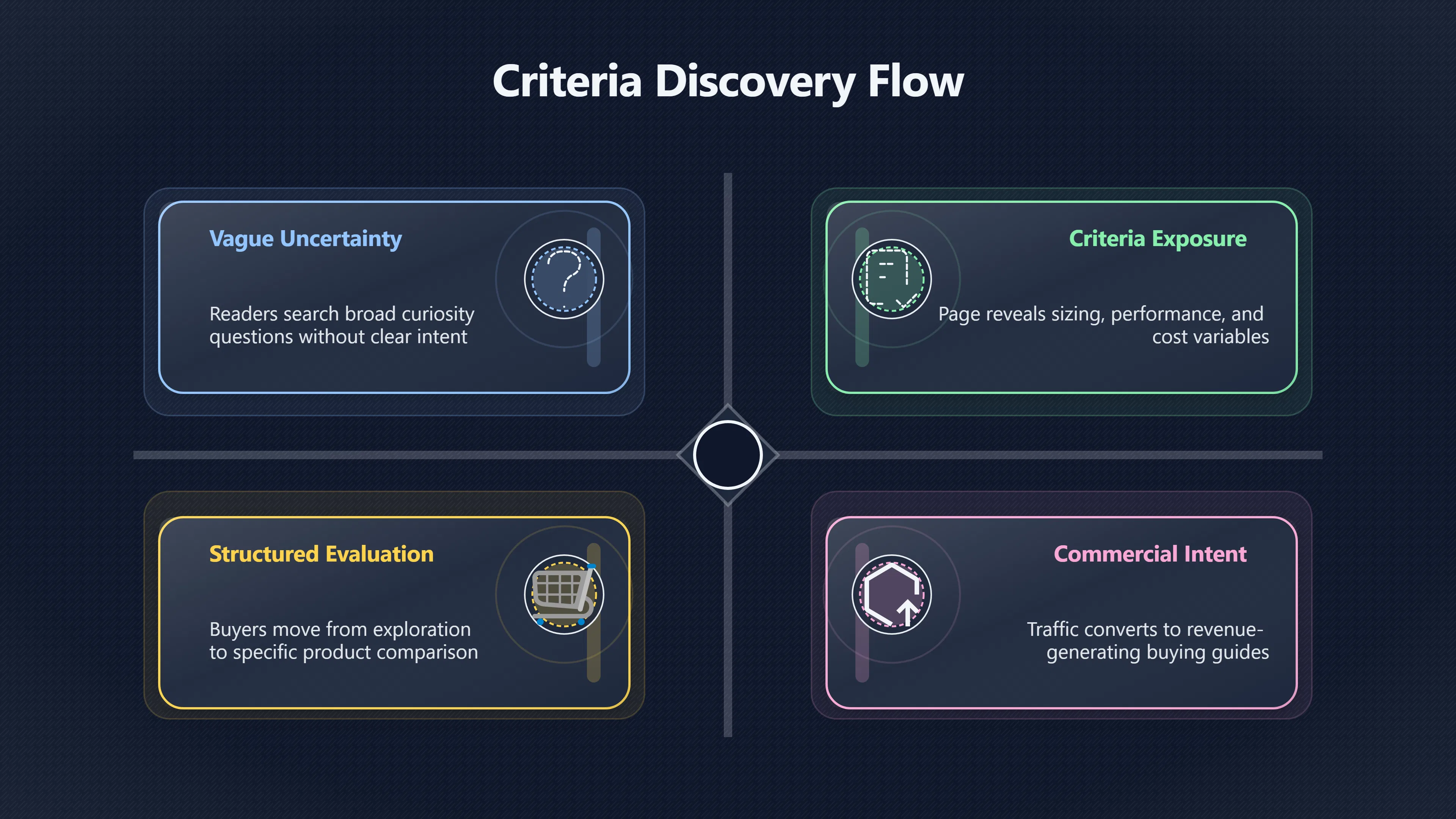
This is where many affiliate sites either create buying momentum or lose it. Pages that expose decision criteria help readers move from vague uncertainty to structured evaluation. Pages that merely answer broad curiosity questions often generate pageviews without creating a meaningful route towards commercial intent. Google’s research on the “messy middle” of purchasing describes how buyers repeatedly move between exploration and evaluation before choosing a product. Question pages are most valuable when they help readers exit exploration with clearer evaluation criteria.[Google Business]business.google.comAs people explore and evaluate in the messy middle, cognitive biases shape their shopping behavior and…Read more…[Google Business]business.google.comAs people explore and evaluate in the messy middle, cognitive biases shape their shopping behavior and…Read more…
How early-stage questions expose commercial criteria
The strongest question pages reveal variables that affect the eventual purchase.
A reader who searches “Do I need a 4K monitor?” is rarely asking for a definition of 4K. They are usually trying to determine whether resolution matters for their work, gaming habits, screen size or budget. The useful answer therefore identifies the criteria behind the purchase rather than simply defining the term.
This changes the structure of the page. Instead of treating the query as an informational endpoint, the page becomes a decision-discovery tool.
For affiliate websites, high-value question pages usually uncover one or more of the following:
- Sizing criteria: capacity, dimensions, household size, room size, storage needs.
- Performance criteria: power, speed, durability, battery life, efficiency.
- Compatibility criteria: operating systems, fittings, vehicle models, ecosystems.
- Cost criteria: upfront price, running costs, maintenance costs.
- Use-case criteria: beginner versus professional use, travel versus home use, occasional versus heavy usage.
- Risk criteria: reliability, safety, warranty support, replacement frequency.
The page earns value because the answer transforms a vague question into a checklist.
A person searching “How much suction do I need in a cordless vacuum?” may arrive without knowing that battery runtime, floor type and pet ownership are more important than headline suction figures. Once those factors become clear, links to “best cordless vacuums for pet hair” or “best cordless vacuums for thick carpets” feel like logical next steps rather than sales pitches.
Questions that naturally create buying momentum
Not every informational query contributes equally to revenue generation.
The strongest questions create a gap between the reader’s current understanding and a future purchase decision. They reveal information that will directly influence which products should be considered.
Common patterns include:
“What size do I need?”
Examples:
- What size air purifier do I need?
- What size TV should I buy for my room?
- What capacity power bank do I need?
These questions uncover measurable selection criteria. Once the answer is known, a product shortlist becomes relevant.
“Is feature X worth paying for?”
Examples:
- Is OLED worth it?
- Is brushless worth it on a drill?
- Is active noise cancellation worth it?
These questions expose willingness-to-pay thresholds. The answer often divides readers into budget and premium segments.
“Which type should I choose?”
Examples:
- Heat pump or condenser dryer?
- Foam or hybrid mattress?
- Mechanical or membrane keyboard?
The question itself signals that the reader has already narrowed the category and is evaluating trade-offs.
“What matters most for my situation?”
Examples:
- What matters most in a travel camera?
- What should I look for in a gaming monitor?
- What makes a good beginner telescope?
These pages reveal prioritisation criteria and naturally lead into filtered buying guides.
Research into consumer decision-making consistently shows that buyers move from problem recognition into information gathering before evaluating alternatives. Questions that clarify evaluation criteria sit directly between those stages.[Involve.me]involve.me5 stages of the consumer decision making processStages of the Consumer Decision-Making Process.5 Jun 2025 — 1. Problem or Need Recognition · 2. Information Search · 3. Evaluation of Alt…[HubSpot]blog.hubspot.com16 ways to simplify your prospects decision making process.aspxHubSpot BlogThe five stages of the consumer decision-making process…25 Feb 2026 — Discover the five stages of the consumer decision-ma…
Examples where the answer changes the next page
The clearest sign of a valuable question page is that different answers should lead readers to different commercial destinations.
Dehumidifier sizing
A visitor asks:
What size dehumidifier do I need?
The page determines:
- Small bedroom
- Large living area
- Severe damp problem
- Mild seasonal moisture
Each outcome should lead to a different buying guide.
The answer is not the end product recommendation. The answer is a sorting mechanism that determines which recommendation page becomes relevant.
Mattress firmness
A visitor asks:
What mattress firmness is best for side sleepers?
The answer may depend on:
- Body weight
- Sleeping position
- Existing back pain
- Preference for softer or firmer surfaces
A lightweight side sleeper and a heavier side sleeper may need entirely different products. The informational page exposes the variables before the buying guide appears.
Laptop RAM requirements
A visitor asks:
How much RAM do I need?
The answer separates:
- Basic web browsing
- Office work
- Creative software
- Gaming
- Virtual machines
The buying path changes dramatically depending on which use case applies. A successful affiliate page identifies the correct branch before introducing products.
Coffee machine questions
A visitor asks:
Do I need a bean-to-cup machine?
The answer may reveal:
- Convenience priorities
- Cleaning tolerance
- Drink frequency
- Budget range
Readers effectively segment themselves. The site can then route them into highly relevant comparison pages.
This branching structure is particularly useful for scalable website systems because the same pattern can be reused across hundreds of product categories. The question page acts as a classification layer that improves offer matching and increases the likelihood that later product recommendations align with actual needs.
Why broad informational questions often monetise poorly
Some questions attract large search volumes but reveal almost nothing about purchase intent.
Examples include:
- Who invented vacuum cleaners?
- History of gaming keyboards
- Why are televisions rectangular?
- When were microwaves invented?
These pages may attract visitors, but the answers rarely uncover meaningful buying criteria.
The problem is not that informational traffic is inherently bad. The problem is that the answer does not change the next decision.
After reading about the history of air fryers, the visitor may still know nothing about basket size, wattage, cooking capacity or cleaning requirements. The page generates awareness without creating evaluation criteria.
By contrast:
- How many litres should an air fryer be for a family of four?
- Is dual-zone worth it on an air fryer?
- What wattage air fryer do I need?
These questions reveal criteria that directly influence product selection.
A useful internal rule is:
If two readers receive the same answer and still need completely different products, the page may be exposing useful buying criteria.
If every reader receives essentially the same answer and no meaningful purchasing variables emerge, monetisation opportunities tend to be weaker.

Signals that a question is too broad to monetise
Broad questions are not automatically worthless, but they often fail to create a clear transition into buying content.
Common warning signs include:
The answer does not affect product choice
If learning the answer leaves product selection unchanged, buying momentum is weak.
The question attracts mixed audiences
A query such as “How do headphones work?” may attract students, hobbyists, researchers and shoppers simultaneously. Commercial intent becomes diluted.
No clear next-step page exists
If there is no obvious buying guide that logically follows the answer, the traffic may be difficult to monetise.
The answer is universal
Questions with a single generic answer often create fewer segmentation opportunities.
The query centres on trivia rather than decisions
Historical, cultural and curiosity-driven searches can produce traffic without creating commercial movement.
This does not mean such pages should never exist. They simply belong lower in a monetisation priority system than pages that reveal purchasing variables.
The role of information scent in buying progression
A question page only creates revenue potential if readers can see why the next page matters.
Nielsen Norman Group’s work on information scent shows that users follow links when the surrounding cues suggest that the destination contains the information they need. Poorly matched links weaken progression and increase abandonment.[Nielsen Norman Group]nngroup.cominformation scentNielsen Norman GroupInformation Scent: How Users Decide Where to Go Next2 Feb 2020 — When deciding which links to click on the web, users…[Nielsen Norman Group]nngroup.cominformation scentNielsen Norman GroupInformation Scent: How Users Decide Where to Go Next2 Feb 2020 — When deciding which links to click on the web, users…
For affiliate sites, this means the transition should reflect the criteria the reader just discovered.
Weak progression:
- Learn about monitor resolution
- Link: “Best monitors”
Strong progression:
- Learn that screen size and desk distance determine whether 4K matters
- Link: “Best 27-inch 4K monitors for desk-based work”
The second link preserves information scent because it directly reflects the decision framework the reader has just learned.
This is particularly important for large-scale affiliate publishing systems. The more precisely question pages reveal criteria, the easier it becomes to generate matching downstream pages, internal links and offer placements automatically.
Question pages as qualification engines
The highest-value question pages function as qualification engines.
They do not persuade readers to buy. They help readers understand what they need before buying.
This distinction matters because qualification often increases the value of later commercial pages. A visitor who understands the relevant criteria is more likely to engage with comparisons, trust recommendations and click through to products that genuinely fit their situation.
From a website monetisation perspective, the best question pages are therefore not broad educational resources or disguised sales pages. They are pages that convert uncertainty into criteria. Once the criteria become visible, the next commercial step becomes obvious, and the buying path feels useful rather than forced. The strongest affiliate content systems repeatedly build around this mechanism because it scales across categories, improves internal linking logic and creates clearer paths from informational traffic to revenue-generating decisions.
Amazon book picks
Further Reading
Books and field guides related to Which questions create buying momentum?. Use these as the next step if you want deeper reading beyond the article.
eBay marketplace picks
Marketplace Samples
Example marketplace items related to this page. Use the search link to explore similar finds on eBay.


Endnotes
1.
Source: business.google.com
Link:https://business.google.com/uk/think/consumer-insights/navigating-purchase-behavior-and-decision-making/
Source snippet
As people explore and evaluate in the messy middle, cognitive biases shape their shopping behavior and...Read more...
2.
Source: involve.me
Title: 5 stages of the consumer decision making process
Link:https://www.involve.me/blog/5-stages-of-the-consumer-decision-making-process
Source snippet
Stages of the Consumer Decision-Making Process.5 Jun 2025 — 1. Problem or Need Recognition · 2. Information Search · 3. Evaluation of Alt...
3.
Source: blog.hubspot.com
Title: 16 ways to simplify your prospects decision making process.aspx
Link:https://blog.hubspot.com/blog/tabid/6307/bid/33375/16-ways-to-simplify-your-prospects-decision-making-process.aspx
Source snippet
HubSpot BlogThe five stages of the consumer decision-making process...25 Feb 2026 — Discover the five stages of the consumer decision-ma...
4.
Source: business.google.com
Title: messy middle 2023
Link:https://business.google.com/en-all/think/consumer-insights/messy-middle-2023/
Source snippet
Behaviour in the Messy MiddleUnderstand the buying behaviour of omnichannel shoppers and navigate the Messy Middle of e-commerce customer...
5.
Source: thinkwithgoogle.com
Link:https://www.thinkwithgoogle.com/_qs/documents/18366/Decoding_Decisions_Marketing_in_the_Messy_Middle.pdf
Source snippet
Marketing in the messy middleWe also upgraded the buying guide to provide shoppers with even more accessible information to aid their dec...
6.
Source: shopify.com
Title: purchase decision
Link:https://www.shopify.com/uk/blog/purchase-decision
Source snippet
5 Stages of the Consumer Purchase-Decision Process12 Nov 2025 — Customer-need recognition. The first step of the consumer decision-making...
7.
Source: nngroup.com
Title: information scent
Link:https://www.nngroup.com/articles/information-scent/
Source snippet
Nielsen Norman GroupInformation Scent: How Users Decide Where to Go Next2 Feb 2020 — When deciding which links to click on the web, users...
8.
Source: nngroup.com
Title: information foraging
Link:https://www.nngroup.com/articles/information-foraging/
Source snippet
Nielsen Norman GroupInformation Foraging: A Theory of How People Navigate on...10 Nov 2019 — The estimate is based the on cues that they...
9.
Source: nngroup.com
Title: wrong information scent costs sales
Link:https://www.nngroup.com/articles/wrong-information-scent-costs-sales/
Source snippet
Nielsen Norman GroupDeceivingly Strong Information Scent Costs Sales1 Aug 2004 — Information scent refers to the extent to which users ca...
10.
Source: uxtigers.com
Title: information scent
Link:https://www.uxtigers.com/post/information-scent
Source snippet
How Users Decide Where to Click26 Jul 2024 — Good information scent happens when link labels and other navigational cues accurately repre...
Additional References
11.
Source: researchgate.net
Link:https://www.researchgate.net/publication/376046363_Consumer_Decision-Making_in_E-Commerce_A_Literature_Review_of_Factors_Influencing_Online_Purchases-0008-3924-202X
Source snippet
Consumer Decision-Making in E-Commerce: A Literature...30 Nov 2023 — The purpose of this research paper is to conduct a comprehensive li...
12.
Source: steptwo.com.au
Link:https://www.steptwo.com.au/papers/kmc_informationscent/
Source snippet
Information scent: helping people find the content they wantThis article introduces the concept of information scent and explains how cre...
13.
Source: reddit.com
Link:https://www.reddit.com/r/UXDesign/comments/th1uo7/notes_on_information_foraging/
Source snippet
Notes on Information Foraging: r/UXDesignHow do users decide which link to click, and which ones to ignore? This happens through informa...
14.
Source: nngroup.com
Link:https://www.nngroup.com/topic/psychology-and-ux/?page=4
15.
Source: medium.com
Link:https://medium.com/astrolabs/understanding-information-scent-95a6554007d4
Source snippet
Understanding Information ScentInformation scent is basically the strength and correlation of the information provided on a site in compa...
16.
Source: iabeurope.eu
Link:https://iabeurope.eu/knowledge_hub/insights-from-think-with-google-how-people-decide-what-to-buy-lies-in-the-messy-middle-of-the-purchase-journey/
Source snippet
How people decide what to buy lies in the “messy middle”...3 Aug 2020 — Google's Alistair Rennie and Jonny Protheroe share their latest...
17.
Source: thebearchitects.com
Link:https://thebearchitects.com/behavioural-science/our-articles/decoding-decisions-why-marketers-need-to-master-the-messy-middle
Source snippet
It illustrates how people can loop back and forth and can repeat the cycle many times before making a...Read more...
18.
Source: youtube.com
Link:https://www.youtube.com/watch?v=-c9AUhXAFD8
Source snippet
Information ScentInformation foraging explains how users behave on the web and why they click certain links and not others. Information s...
19.
Source: directiveconsulting.com
Title: 5 stages of the consumer decision making process and how its different
Link:https://directiveconsulting.com/blog/5-stages-of-the-consumer-decision-making-process-and-how-its-different/
Source snippet
early. At this stage, the core questions for marketers are: “What problem does our product or service solve?” and “Is our brand discoverable...
20.
Source: junction.cj.com
Title: making the most of affiliate in googles messy middle
Link:https://junction.cj.com/article/making-the-most-of-affiliate-in-googles-messy-middle
Source snippet
the Most of Affiliate in Google's Messy Middle10 Sept 2020 — As shoppers explore and evaluate, Google noted six cognitive biases that inf...
Topic Tree