Within Affiliate Engines
Which Affiliate Topics Are Worth Building?
Affiliate pages earn more when the topic attracts readers who are already comparing, replacing, choosing, or buying.
On this page
- Buyer closeness and search intent
- Offer availability and commission economics
- Repeatable topic scoring for scaled sites
Page outline Jump by section
Introduction
Affiliate topics are worth building when they attract people who are already close to a commercial decision: comparing options, replacing something, checking whether a product is suitable, looking for alternatives, or preparing to buy. That is the difference between traffic that merely looks impressive and traffic that can realistically earn. A large informational page may bring visitors who are curious; a smaller “best X for Y”, “X vs Y”, “X alternatives”, or “is X worth it?” page may bring readers who are actively deciding where their money should go.
For affiliate websites, commercial intent is the bridge between search demand and revenue. The page must match a decision moment, show useful differences between options, and connect the reader to relevant merchants or programmes. Google’s own guidance acknowledges that reviews often use affiliate links, but it also stresses that good reviews should provide useful evidence, comparisons, and decision help rather than thin summaries of other people’s product listings.[Google for Developers]developers.google.comGoogle for DevelopersWrite high quality reviewsReviews often use affiliate links, so that if someone finds a review useful and follows th…
Buyer closeness is the first filter
A topic earns more when the reader is nearer to action. “How does an air purifier work?” may be useful, but it usually captures early research. “Best air purifier for allergies in a small bedroom” is closer to purchase because the reader has a problem, a use case, and a product category in mind. “Dyson Purifier Cool vs Levoit Core 400S” is closer still because the reader has narrowed the field and needs help choosing.
This buyer closeness is why commercial intent cannot be judged by search volume alone. A high-volume definition keyword can sit far from revenue, while a lower-volume comparison keyword can send better-qualified visitors to affiliate offers. Commercial intent keywords are commonly associated with readers researching a brand, product, or service before buying, and third-party comparison content often appears because searchers want information that feels less partial than a brand’s own sales page.[Semrush]semrush.comcommercial intent keywordsCommercial Intent Keywords: The Complete Guide for…3 Dec 2025 — Commercial intent keywords are search terms used to research a…
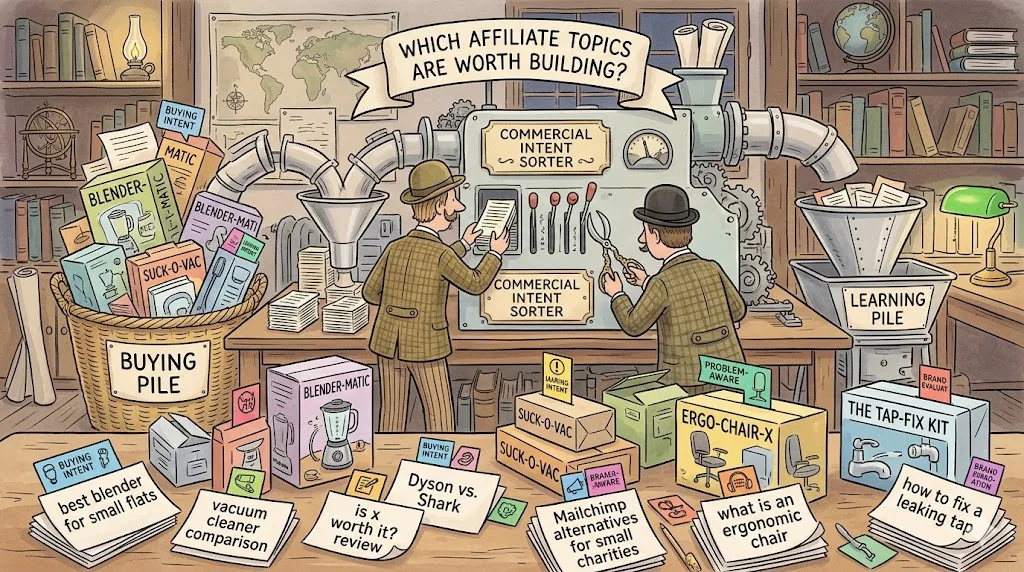
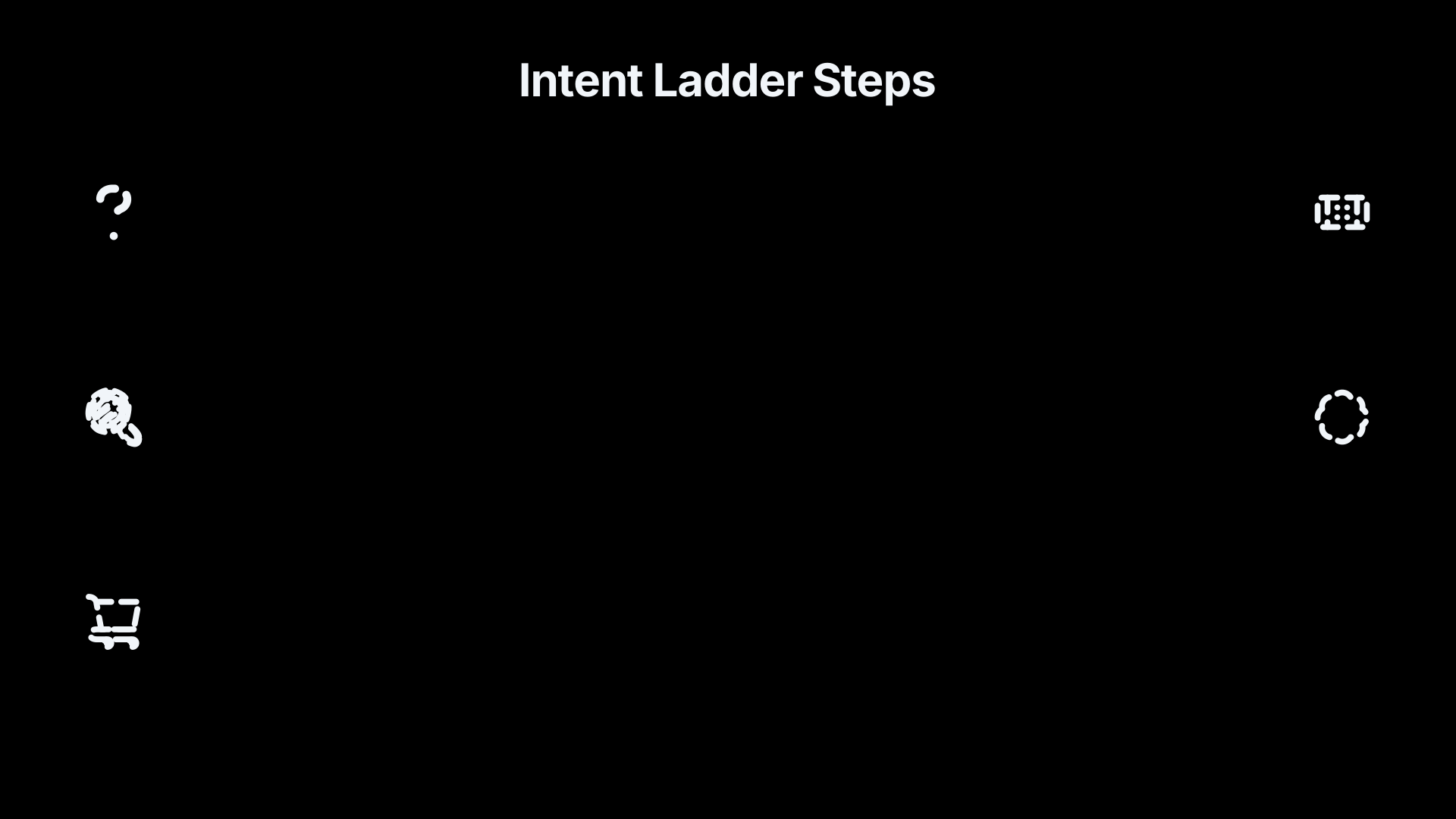
For a scalable affiliate site, the practical intent ladder looks like this:
- General learning: “what is an ergonomic chair” or “how air fryers work”. Useful for support content, but usually weak as a direct revenue page.
- Problem-aware research: “best chair for lower back pain” or “air fryer for one person”. Stronger because the reader has a need.
- Category comparison: “best ergonomic chairs under £300” or “best dual-zone air fryers”. Strong affiliate territory because the page can compare options.
- Brand or product evaluation: “Secretlab Titan review” or “Ninja Foodi vs Instant Vortex”. High intent because the reader is near a decision.
- Transaction modifiers: “discount code”, “price”, “deal”, “where to buy”, “free trial”, or “near me”. Often very close to purchase, but sometimes competitive, low-trust, or dependent on frequently changing offers.
The key mechanism is not simply that commercial keywords convert better. It is that they reveal a job the page can perform. A comparison page helps someone choose between named options. A “best for” page narrows a crowded market around a use case. An alternatives page catches dissatisfaction with a known product. A review page answers risk questions before a purchase. Each page type should exist because the reader’s intent gives it a clear conversion path.
Search intent should dictate the page type
A common mistake in affiliate publishing is to choose a keyword, then force it into a standard article format. Commercial intent topics work better when the page type follows the decision being made.
A “best” page suits a reader who wants a shortlist. It should explain selection criteria, separate use cases, and give quick routes to the right offer. A “versus” page suits a reader choosing between two or more named products. It should make the differences obvious, ideally with a comparison table that uses attributes readers genuinely care about. Nielsen Norman Group defines comparison tables as a structure where products or services appear in columns and attributes appear in rows, allowing people to compare features quickly.[Nielsen Norman Group]nngroup.comNielsen Norman GroupComparison Tables for Products, Services, and FeaturesFebruary 9, 2024 — 9 Feb 2024 — A table that uses columns for p…
A review page suits a reader asking whether one product is good enough, safe enough, durable enough, or worth the price. Google’s guidance on high-quality reviews asks publishers to show what a product is like physically, explain how it performs, compare it with competitors, discuss benefits and drawbacks, and help readers choose among alternatives. Those are not decorative details; they are the trust material that turns a commercial page from a thin affiliate bridge into a useful decision page.[Google for Developers]developers.google.comGoogle for DevelopersWrite high quality reviewsReviews often use affiliate links, so that if someone finds a review useful and follows th…
An alternatives page suits a reader who already knows a product but is dissatisfied with price, features, availability, complexity, reputation, or suitability. For example, “Mailchimp alternatives for small charities” can support affiliate software offers because the reader is not merely learning about email marketing; they are looking for a replacement. A “best X for Y” page can then link naturally to individual reviews, comparison pages, and related use-case pages, creating a structured commercial cluster rather than a set of isolated posts.
The page type should also control the internal linking. A broad guide can send readers to “best” pages. A “best” page can send readers to reviews and “versus” pages. A review can send readers to alternatives if the product is not the right fit. The goal is to move the reader along a decision path without pretending every page has the same earning role.
Offer availability decides whether intent can become revenue
Commercial intent is necessary, but it is not enough. A topic can be full of buyers and still be poor for affiliate revenue if there are no suitable offers, commissions are too low, merchants do not convert, or the programme terms are restrictive. Affiliate marketing is performance-based: the publisher is rewarded for tracked actions such as clicks, leads, or sales, usually under programme-specific rules.[asa.org.uk]asa.org.ukaffiliate marketingaffiliate marketing
This is why topic selection should check offer availability before content production. A promising topic needs reputable merchants, working affiliate programmes, stock or service availability in the target market, clear commission rules, and an offer that matches the reader’s intent. A page about “best garden sheds UK” is not automatically strong if the available merchants have poor delivery coverage, low stock, weak commission, or high return rates. A page about “best accounting software for landlords” may be stronger with fewer searches if software programmes pay recurring or higher lead commissions and the reader’s decision value is high.
Amazon Associates illustrates why commission economics matter at topic level. In the UK programme, commission rates vary sharply by category, with some categories at 0%, some low single-digit rates, and others higher. The official Amazon UK commission statement lists examples such as 4% for Beauty, Luggage, Personal Care Appliances, and Sports & Fitness; 2.5% for Appliances, Fire TV Devices, and Mobile Electronics; 1% for categories including Grocery and Video Game Consoles; and 0% for several gift-card-related categories.[Amazon Associates]affiliate-program.amazon.co.ukSource details in endnotes.
That does not mean low-commission topics should always be avoided. A low-rate product category can still earn if order values are high, conversion rates are strong, or the page captures buyers at scale. But it does mean a scalable affiliate system should not treat a £20 accessory at 3% and a £400 subscription product with recurring commission as equivalent opportunities. The correct comparison is revenue per visitor, not traffic alone.
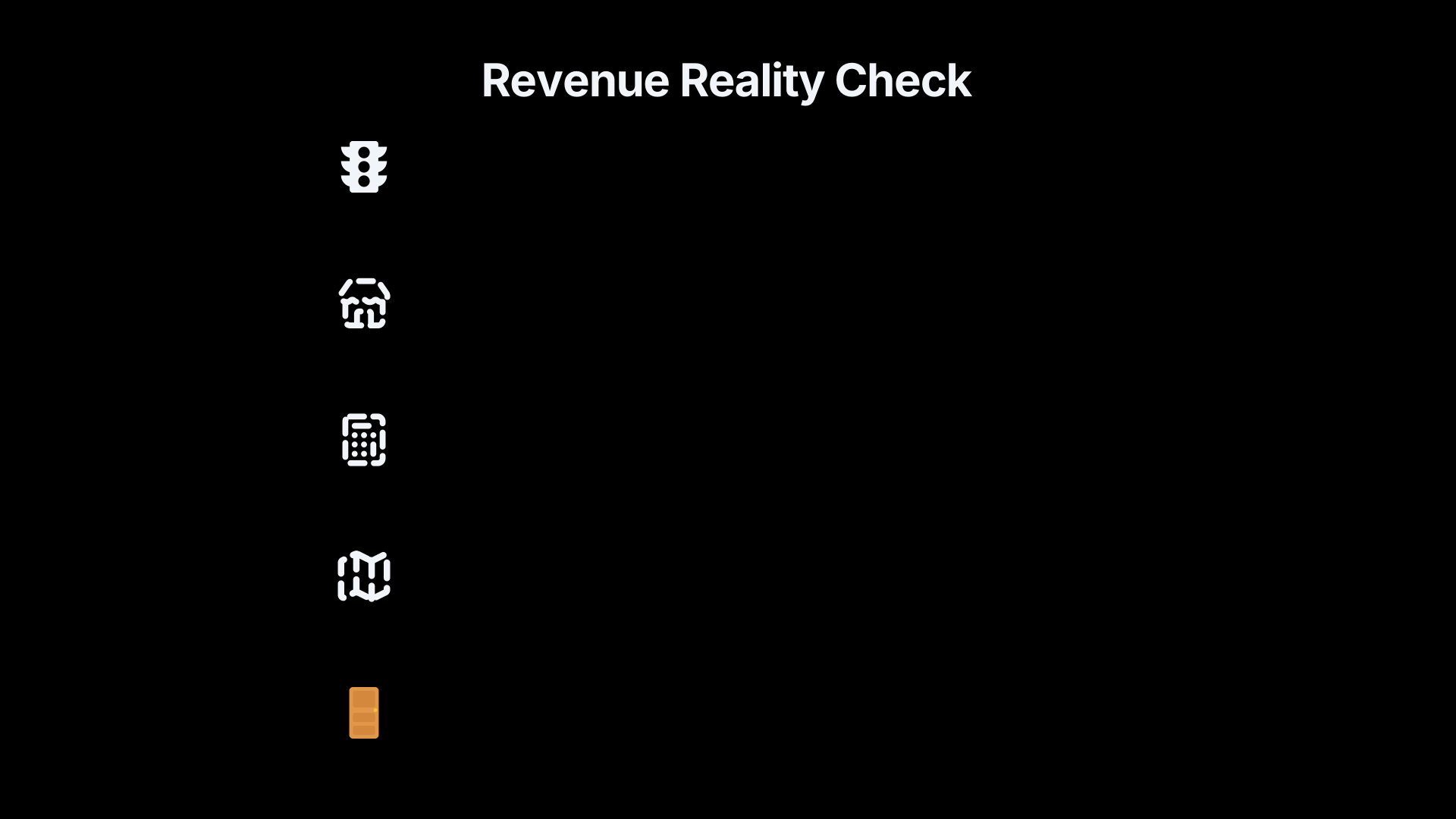
A simple commercial check before building a topic is:
QuestionWhy it mattersAre there reputable merchants or networks for the topic?Without credible offers, the page may attract buyers but fail to monetise.Does the commission justify the content cost and maintenance?Low rates need high volume, high conversion, or strong basket size.Is the offer available in the reader’s market?UK search intent needs UK-relevant prices, stock, delivery, and compliance.Does the merchant’s page convert well?A good affiliate page loses value if the merchant page is confusing or untrusted.Are returns, cancellations, or approval rules harsh?Some apparent earnings disappear through reversals or programme terms.Can the topic be refreshed efficiently?Price-led and fast-changing categories need more maintenance than evergreen comparison logic.
Commission economics should shape the topic mix
Affiliate sites often fail by overvaluing easy product lists and undervaluing economics. A topic with a high-intent keyword is not necessarily a high-value topic. The revenue potential depends on order value, commission rate, conversion rate, cookie window, lead approval rules, refund likelihood, and repeat purchases.
Retail topics can be attractive because they are familiar, easy to understand, and often have strong consumer demand. But many retail programmes pay modest commissions, and products can go out of stock or change quickly. Software, finance, education, web services, travel, and business tools can offer stronger economics, but they may involve longer buying cycles, higher trust requirements, stricter claims, and more competition. Awin’s 2026 guidance for advertisers notes that commission strategy depends on factors such as business objectives, margins, customer lifetime value, and competitive positioning, which is a useful reminder that affiliate payouts vary because the underlying economics vary.[help.awin.com]help.awin.combest practices for setting commission ratesbest practices for setting commission rates
The strongest topics often combine several advantages:
- High decision value: The reader cares about choosing correctly because the purchase is expensive, recurring, risky, or inconvenient to reverse.
- Clear comparison criteria: Products differ in visible ways, such as price, features, compatibility, durability, service level, or suitability for a use case.
- Available affiliate offers: There are merchants or networks with credible programmes.
- Enough choice to justify a page: The reader genuinely benefits from comparison, not just a single obvious recommendation.
- Repeatable page pattern: The same structure can be reused across adjacent topics without becoming thin or duplicated.
For example, “best website builders for photographers” has more earning logic than “what is a website builder”. It has a defined buyer, a software category, a likely subscription model, many competing offers, and a reason to compare features such as gallery templates, booking tools, storage, ecommerce, speed, support, and pricing. The page can then link to “Squarespace vs Wix for photographers”, “best portfolio website builders”, and individual reviews. The commercial topic becomes a cluster, not a one-off article.
The best topics solve decision friction
Commercial intent pages earn when they reduce friction in a buying decision. That friction may be confusion, risk, time pressure, distrust, budget uncertainty, feature overload, or fear of buying the wrong thing. A good affiliate topic therefore asks: “What is stopping this reader from clicking through?”
For physical products, friction often involves fit, quality, durability, compatibility, delivery, returns, and real-world use. For software, it often involves pricing tiers, integrations, migration effort, hidden limits, trial length, data ownership, and support. For financial or regulated products, friction includes eligibility, risk, fees, suitability, and trust. For travel, it includes location, cancellation rules, timing, family suitability, and total cost.
This is where affiliate content can add value beyond a merchant page. Merchant pages are usually built to sell one offer. Affiliate pages can compare several options against the reader’s situation. Google’s review guidance explicitly encourages content that explains advantages and disadvantages, shows how products differ from competitors, and discusses important decision factors.[Google for Developers]developers.google.comGoogle for DevelopersWrite high quality reviewsReviews often use affiliate links, so that if someone finds a review useful and follows th…
Commercial intent topics that solve decision friction include:[semrush.com]semrush.comcommercial intent keywordsCommercial Intent Keywords: The Complete Guide for…3 Dec 2025 — Commercial intent keywords are search terms used to research a…
- “Best X for Y” where Y is a real use case, such as “best standing desk for a small flat”.
- “X vs Y” where the products are plausible substitutes.
- “X alternatives” where the reader is switching from a known option.
- “Is X worth it?” where price or reputation creates hesitation.
- “X for beginners” where the reader wants a safe first choice.
- “X under £Y” where budget is the main constraint.
- “X compatible with Y” where a wrong choice would waste money.
- “X problems” or “X complaints” where the reader is checking risk before purchase.
These topics can earn because they are not just content themes. They are decision points with natural affiliate placements.

Thin commercial pages are a long-term risk
A site-generation system can scale topic production, but commercial intent topics are vulnerable to thin-page patterns. A page that merely repeats merchant descriptions, swaps product names into a template, or lists products without useful comparison may target buyer keywords but fail the usefulness test. Google has warned for years about affiliate programmes that add little value, especially when pages contain thin or copied material.[Google for Developers]developers.google.comGoogle for DevelopersWrite high quality reviewsReviews often use affiliate links, so that if someone finds a review useful and follows th…
The risk is not only search visibility. Thin commercial pages also convert poorly because readers can sense when a page has not helped them decide. If a “best” page gives every product the same vague praise, the reader has no reason to trust the recommendation or click. If a “versus” page hides the actual trade-off, it fails at the exact job that brought the visitor there.
A scalable affiliate site should therefore standardise quality, not just format. The repeatable pattern should require decision-useful fields, such as:
- Who the option is best for.
- Who should avoid it.
- The main trade-off.
- The strongest alternative.
- Key buying criteria.
- Price or value positioning where stable enough to discuss.
- Relevant drawbacks.
- Evidence of use, testing, specification analysis, or credible third-party information.
- Clear affiliate disclosure.[asa.org.uk]asa.org.ukSource details in endnotes.
This is especially important because search behaviour is increasingly selective. SparkToro’s 2024 zero-click study found that for every 1,000 Google searches, only a minority of resulting clicks went to the open web in the US and EU, which raises the value of visits that do arrive with clear commercial intent.[SparkToro]sparktoro.comSource details in endnotes.
Disclosure and trust affect earning potential
Commercial intent pages should not hide the commercial relationship. In the UK, the Advertising Standards Authority explains that affiliate marketing is performance-based marketing where an affiliate is rewarded for new customers, clicks, or sales, and that content containing affiliate links may need to be identified as advertising depending on the arrangement.[asa.org.uk]asa.org.ukget yourself affiliated with the rules on affiliate marketingget yourself affiliated with the rules on affiliate marketing
The UK government’s guidance on social media endorsements says promotional content should be labelled as advertising and that this should be obvious as soon as someone engages with it. Although that guidance is framed around social content, the underlying principle is relevant to public-facing affiliate publishing: readers should understand when commercial links may generate payment.[GOV.UK]GOV.UKSocial media endorsements: guidance for content creatorsSocial media endorsements: guidance for content creators
For affiliate websites, disclosure is not only a compliance issue. It is also part of trust design. A clear disclosure near the relevant content is less damaging than a hidden or evasive disclosure because it lets the reader understand the relationship while still judging the usefulness of the page. FTC guidance similarly states that endorsements must be honest and not misleading, and that material connections should be disclosed clearly.[Federal Trade Commission]ftc.govSource details in endnotes.
Trust matters more in high-intent topics because the reader is close to action. A reader comparing two expensive products is likely to notice whether the page is fair, whether drawbacks are real, and whether the recommendations suspiciously follow the highest payout. A monetisation system should therefore treat disclosure, balanced comparison, and credible selection logic as conversion assets, not as legal clutter.
A repeatable topic scoring model for scaled sites
Commercial intent topics can be scored before production. The purpose is not to predict revenue perfectly, but to avoid building large numbers of pages that have traffic potential but weak earning logic.
A practical scoring model can use five dimensions:
1. Intent strength
Does the query show that the reader is choosing, comparing, replacing, buying, checking price, or validating a product? “Best”, “review”, “vs”, “alternatives”, “discount”, “pricing”, “for”, “under”, “compatible with”, and “worth it” often indicate stronger intent than “what is” or “how to”.
2. Offer strength
Are there credible affiliate offers that match the reader’s market and intent? A topic should be downgraded if offers are unavailable, low-quality, geographically wrong, or disconnected from what the reader needs.
3. Commission value
Does the category pay enough to matter? This should consider both percentage and order value. A 3% commission on a large basket may beat a 10% commission on a small accessory. Recurring software commissions may justify more competitive topics if conversion and retention are plausible.
4. Decision complexity
Does the reader need help? The best affiliate pages often sit in markets where options differ meaningfully. If all options are nearly identical, a page may struggle to add value. If options vary by use case, budget, features, quality, risk, and compatibility, the page has a stronger reason to exist.
5. Pattern repeatability
Can the topic support a cluster? “Best CRM for estate agents” can connect to “best CRM for letting agents”, “HubSpot vs Pipedrive for estate agents”, and “estate agency email marketing software”. Repeatability matters because scaled sites need internal linking logic and reusable decision frameworks.
A simple score might rate each dimension from 1 to 5. Topics scoring high on intent, offers, economics, and repeatability deserve priority. Topics high in traffic but low in commercial fit can still be useful as support pages, but they should not be treated as primary earning pages.
Examples of topics that can earn
The following examples show how commercial intent changes the earning mechanism.[semrush.com]semrush.comcommercial intent keywordsCommercial Intent Keywords: The Complete Guide for…3 Dec 2025 — Commercial intent keywords are search terms used to research a…
“Best meal delivery services for one person UK”
This has clear buyer intent, a defined audience, recurring purchase potential, and a comparison need around price, portions, dietary options, delivery area, and flexibility. It can link to individual service reviews and discount pages, but it must stay current because offers and menus change.
“Squarespace vs Wix for photographers”
This is a strong comparison query. The reader has narrowed the choice and needs a recommendation based on templates, galleries, booking features, ecommerce, price, ease of use, and SEO basics. It can monetise through website-builder affiliate programmes and link into a broader website-builder cluster.
“Best cordless vacuum for pet hair under £250”
This combines problem, product category, and budget. It is commercially attractive because the reader has an immediate need and a buying constraint. The page should compare suction, filtration, battery life, attachments, bin size, weight, and replacement parts.
“Mailchimp alternatives for charities”
This catches replacement intent. The reader may be unhappy with cost, complexity, deliverability, list limits, or charity-specific needs. It can monetise through email software programmes, but the page must be careful not to make unsupported claims about deliverability or compliance.
“Is refurbished iPhone worth it?”
This is risk-resolution intent. The reader is interested but hesitant. The page can earn through refurbished electronics merchants, but it must address warranty, battery health, grading, returns, seller reputation, and total cost against buying new.
Each example has a conversion path because the reader is not merely browsing information. They are deciding.
What to avoid when choosing commercial topics
Some topics look commercial but are weak once inspected. “Cheap laptops” may have huge demand, but it can be brutally competitive, price-sensitive, and difficult to keep current. “Best supplements for anxiety” may have affiliate offers, but it carries a high trust and safety burden, and unsupported health claims can create serious legal, ethical, and platform risk. “Amazon gift card deals” may sound transactional, but commission structures can make some gift-card categories worthless; Amazon UK lists some gift-card-related categories at 0%.[Amazon Associates]affiliate-program.amazon.co.ukSource details in endnotes.
Also avoid topics where the affiliate offer conflicts with the reader’s best outcome. If the best answer is often “do not buy this”, “speak to a professional”, “check safety certification”, or “use the free option”, the page may still be useful, but it should not be forced into a hard-selling affiliate format. Commercial intent is valuable only when the page can help the reader make a good decision and then provide a relevant next step.
A healthy commercial topic set should include a mix of direct earning pages and supporting pages. Direct earning pages target “best”, “review”, “vs”, “alternatives”, and “deals” intent. Supporting pages answer questions that feed those pages, such as “what size dehumidifier do I need?” or “how much storage does a photographer’s website need?” The support content builds topical coverage and moves readers towards the right commercial page, rather than pretending every informational query deserves affiliate buttons.
Turning topic choice into a scalable revenue system
The most useful way to think about commercial intent topics is as repeatable decision templates. A website-generation system should not merely produce articles; it should classify the decision, choose the page type, select offers, place internal links, and define what evidence the page must contain.
For a “best” page, the system should expect use-case segmentation, selection criteria, product cards, comparison tables, and links to deeper reviews. For a “versus” page, it should expect a direct recommendation, a comparison table, trade-offs, and links to alternatives. For a review, it should expect who it is for, who should avoid it, evidence of performance, drawbacks, and competing options. For an alternatives page, it should expect the reason for switching and a mapped set of substitutes.
This makes commercial intent topic selection both an SEO decision and a monetisation decision. The best topics are not simply those with buyer keywords. They are topics where the page can perform a clear commercial job, the offer can satisfy the intent, the commission economics justify the work, and the pattern can be repeated across a cluster without becoming thin. Done well, affiliate publishing becomes a structured system for matching readers’ decision moments with useful recommendations and relevant offers.
Amazon book picks
Further Reading
Books and field guides related to Which Affiliate Topics Are Worth Building?. Use these as the next step if you want deeper reading beyond the article.
The Long Tail
Affiliate topic selection often depends on profitable niches, long-tail demand, and commercial specificity.
Building a StoryBrand 2.0
Commercial topics perform better when the buyer problem and offer promise are sharply framed.
Traction
Helps evaluate channels, audiences, and repeatable acquisition opportunities before building pages.
They Ask, You Answer
Supports choosing topics around real buyer questions, comparisons, pricing, and objections.
eBay marketplace picks
Marketplace Samples
Example marketplace items related to this page. Use the search link to explore similar finds on eBay.








Endnotes
1.
Source: developers.google.com
Link:https://developers.google.com/search/docs/specialty/ecommerce/write-high-quality-reviews
Source snippet
Google for DevelopersWrite high quality reviewsReviews often use affiliate links, so that if someone finds a review useful and follows th...
2.
Source: developers.google.com
Link:https://developers.google.com/search/docs/fundamentals/creating-helpful-content
Source snippet
Google for DevelopersCreating Helpful, Reliable, People-First ContentGoogle's ranking systems are designed to present helpful, reliable i...
3.
Source: semrush.com
Title: commercial intent keywords
Link:https://www.semrush.com/blog/commercial-intent-keywords/
Source snippet
Commercial Intent Keywords: The Complete Guide for...3 Dec 2025 — Commercial intent keywords are search terms used to research a...
4.
Source: asa.org.uk
Title: affiliate marketing
Link:https://www.asa.org.uk/advice-online/affiliate-marketing.html
5.
Source: help.awin.com
Title: best practices for setting commission rates
Link:https://help.awin.com/docs/best-practices-for-setting-commission-rates
6.
Source: developers.google.com
Title: affiliate programs and added value
Link:https://developers.google.com/search/blog/2014/01/affiliate-programs-and-added-value
7.
Source: sparktoro.com
Link:https://sparktoro.com/blog/2024-zero-click-search-study-for-every-1000-us-google-searches-only-374-clicks-go-to-the-open-web-in-the-eu-its-360/
8.
Source: asa.org.uk
Title: get yourself affiliated with the rules on affiliate marketing
Link:https://www.asa.org.uk/news/get-yourself-affiliated-with-the-rules-on-affiliate-marketing.html
9.
Source: GOV.UK
Title: Social media endorsements: guidance for content creators
Link:https://www.gov.uk/government/publications/social-media-endorsements-guidance-for-content-creators/social-media-endorsements-being-transparent-with-your-followers
10.
Source: ftc.gov
Title: Federal Trade Commission FTC’s Endorsement Guides: What People Are Asking
Link:https://www.ftc.gov/business-guidance/resources/ftcs-endorsement-guides-what-people-are-asking
11.
Source: ftc.gov
Title: [disclosures]({{ ‘disclosures/’ | relative_url }}) 101 social media influencers
Link:https://www.ftc.gov/business-guidance/resources/disclosures-101-social-media-influencers
12.
Source: awin.com
Title: affiliate marketing trends 2026
Link:https://www.awin.com/gb/sector-insights/affiliate-marketing-trends-2026
13.
Source: awin.com
Title: affiliate marketing global views
Link:https://www.awin.com/gb/sector-insights/affiliate-marketing-global-views
14.
Source: awin.com
Link:https://www.awin.com/gb/pricing/affiliate-partners
15.
Source: awin.com
Link:https://www.awin.com/gb/market-insights
16.
Source: awin.com
Link:https://www.awin.com/gb/
17.
Source: asa.org.uk
Link:https://www.asa.org.uk/static/uploaded/3af39c72-76e1-4a59-b2b47e81a034cd1d.pdf
18.
Source: asa.org.uk
Title: recognising ads social media
Link:https://www.asa.org.uk/advice-online/recognising-ads-social-media.html
19.
Source: asa.org.uk
Link:https://www.asa.org.uk/static/790d2e01-e3f8-4fea-b3c99ef91a9f04dc/Influencerguidance2023v4-FINAL.pdf
20.
Source: asa.org.uk
Link:https://www.asa.org.uk/static/9cc1fb3f-1288-405d-af3468ff18277299/INFLUENCERGuidanceupdatev6HR.pdf
21.
Source: asa.org.uk
Title: like follow and subscribe to our influencer marketing advice
Link:https://www.asa.org.uk/news/like-follow-and-subscribe-to-our-influencer-marketing-advice.html
22.
Source: asa.org.uk
Title: updated guidance for influencer marketing
Link:https://www.asa.org.uk/news/updated-guidance-for-influencer-marketing.html
23.
Source: asa.org.uk
Title: Influencing Responsibly
Link:https://www.asa.org.uk/news/influencingresponsibly-make-clear-upfront-when-ads-are-ads.html
24.
Source: asa.org.uk
Title: Influencer Marketing
Link:https://www.asa.org.uk/advice-and-resources/resource-library/influencer-marketing-key-advice-resources.html
25.
Source: support.google.com
Title: low traffic affiliate site what can i do better
Link:https://support.google.com/webmasters/thread/112211009/low-traffic-affiliate-site-what-can-i-do-better?hl=en
26.
Source: support.google.com
Link:https://support.google.com/webmasters/thread/180636419/does-the-ratio-of-commercial-content-on-the-site-vs-informative-matter-for-product-reviews-sites?hl=en
27.
Source: support.google.com
Link:https://support.google.com/webmasters/thread/302446608/provide-details-about-the-affiliate-products-review-guidelines-and-can-we-used-more-than-ads-network?hl=en
28.
Source: support.google.com
Title: is affiliate marketing dead
Link:https://support.google.com/webmasters/thread/257058271/is-affiliate-marketing-dead?hl=en
29.
Source: developers.google.com
Title: search and ai content
Link:https://developers.google.com/search/blog/2023/02/google-search-and-ai-content
30.
Source: developers.google.com
Title: helpful content update
Link:https://developers.google.com/search/blog/2022/08/helpful-content-update
31.
Source: support.google.com
Title: manual action for thin content
Link:https://support.google.com/webmasters/thread/71950043/manual-action-for-thin-content?hl=en
32.
Source: developers.google.com
Title: links crawlable
Link:https://developers.google.com/search/docs/crawling-indexing/links-crawlable
33.
Source: business.google.com
Link:https://business.google.com/uk/think/
34.
Source: business.google.com
Title: navigating purchase behavior and decision making
Link:https://business.google.com/uk/think/consumer-insights/navigating-purchase-behavior-and-decision-making/
35.
Source: affiliate-program.amazon.com
Link:https://affiliate-program.amazon.com/help/node/topic/GRXPHT8U84RAYDXZ
36.
Source: ftc.gov
Link:https://www.ftc.gov/
37.
Source: ftc.gov
Link:https://www.ftc.gov/business-guidance/advertising-marketing/endorsements-influencers-reviews
38.
Source: ftc.gov
Link:https://www.ftc.gov/system/files/ftc_gov/pdf/P204500%20Guides%20Concerning%20Endors%20and%20Testimonials.pdf
39.
Source: ftc.gov
Link:https://www.ftc.gov/system/files/ftc_gov/pdf/p204500_endorsement_guides_in_2023.pdf
40.
Source: ftc.gov
Link:https://www.ftc.gov/sites/default/files/attachments/press-releases/ftc-staff-revises-online-advertising-disclosure-guidelines/130312dotcomdisclosures.pdf
41.
Source: ftc.gov
Title: full disclosure
Link:https://www.ftc.gov/business-guidance/blog/2014/09/full-disclosure
42.
Source: ftc.gov
Title: native advertising guide businesses
Link:https://www.ftc.gov/business-guidance/resources/native-advertising-guide-businesses
43.
Source: ftc.gov
Link:https://www.ftc.gov/sites/default/files/attachments/press-releases/ftc-staff-issues-guidelines-internet-advertising/0005dotcomstaffreport.pdf
44.
Source: ftc.gov
Title: staff revises online advertising disclosure guidelines
Link:https://www.ftc.gov/news-events/news/press-releases/2013/03/ftc-staff-revises-online-advertising-disclosure-guidelines
45.
Source: sparktoro.com
Title: why do we need zero click marketing
Link:https://sparktoro.com/blog/why-do-we-need-zero-click-marketing/
46.
Source: sparktoro.com
Title: 5 strategic features that predict survival in the zero click era
Link:https://sparktoro.com/blog/5-strategic-features-that-predict-survival-in-the-zero-click-era/
47.
Source: sparktoro.com
Title: zero clicks does not mean zero sales
Link:https://sparktoro.com/blog/zero-clicks-does-not-mean-zero-sales/
48.
Source: sparktoro.com
Link:https://sparktoro.com/resources/videos/full-sparktoro-walkthrough
49.
Source: sparktoro.com
Link:https://sparktoro.com/blog/new-research-we-analyzed-332-million-queries-over-21-months-to-uncover-never-before-published-data-on-how-people-use-google/
50.
Source: GOV.UK
Title: hidden ads principles for social media platforms
Link:https://www.gov.uk/government/publications/reviews-and-endorsements-principles-for-social-media-platforms/hidden-ads-principles-for-social-media-platforms
51.
Source: GOV.UK
Title: ernment response to online advertising programme consultation
Link:https://www.gov.uk/government/consultations/online-advertising-programme-consultation/outcome/government-response-to-online-advertising-programme-consultation
52.
Source: GOV.UK
Title: online targeting final report and recommendations
Link:https://www.gov.uk/government/publications/cdei-review-of-online-targeting/online-targeting-final-report-and-recommendations
53.
Source: GOV.UK
Title: high stakes gambling reform for the digital age
Link:https://www.gov.uk/government/publications/high-stakes-gambling-reform-for-the-digital-age/high-stakes-gambling-reform-for-the-digital-age
54.
Source: assets.publishing.service.gov.uk
Link:https://assets.publishing.service.gov.uk/media/5f05d070e90e0712d0206e91/Mapping_online_advertising_issues__and_the_industry_and_regulatory_initiatives_aimed_at_addressing_them.pdf
55.
Source: assets.publishing.service.gov.uk
Title: DCMS OAP support Final report Accessible for publication 28.9.2022
Link:https://assets.publishing.service.gov.uk/media/633445fbd3bf7f34f0bfd2ae/DCMS_-OAP_support-Final_report-Accessible__for_publication-_28.9.2022.pdf
56.
Source: assets.publishing.service.gov.uk
Title: impact assessment hfss advertising
Link:https://assets.publishing.service.gov.uk/media/60d35279e90e0743934f6c3a/impact-assessment-hfss-advertising.pdf
57.
Source: assets.publishing.service.gov.uk
Link:https://assets.publishing.service.gov.uk/media/5c881e78e5274a230219c360/DCEP_Public_responses_to_call_for_evidence_from_organisations.pdf
58.
Source: assets.publishing.service.gov.uk
Title: Qualitative research 1
Link:https://assets.publishing.service.gov.uk/media/68597f3deaa6f6419fade66e/Qualitative_research_1.pdf
59.
Source: london.gov.uk
Title: mgla150519 2647 foi response redacted
Link:https://www.london.gov.uk/sites/default/files/mgla150519-2647_-_foi_response_redacted.pdf
60.
Source: semrush.com
Title: types of keywords commercial informational navigational transactional
Link:https://www.semrush.com/blog/types-of-keywords-commercial-informational-navigational-transactional/
61.
Source: nngroup.com
Link:https://www.nngroup.com/articles/comparison-tables/
Source snippet
Nielsen Norman GroupComparison Tables for Products, Services, and FeaturesFebruary 9, 2024 — 9 Feb 2024 — A table that uses columns for p...
Published: February 9, 2024
62.
Source: affiliate-program.amazon.co.uk
Link:https://affiliate-program.amazon.co.uk/help/node/topic/GRXPHT8U84RAYDXZ
Additional References
63.
Source: youtube.com
Title: Keyword Research For Affiliate Marketing: How to Find Highly Profitable Keywords
Link:https://www.youtube.com/watch?v=K3X-AQyzMGM
Source snippet
Authority Hacker Keyword Intent Guide: High Intent Keywords for Affiliate SEO...
64.
Source: youtube.com
Title: Authority Hacker Keyword Intent Guide: High Intent Keywords for Affiliate SEO
Link:https://www.youtube.com/watch?v=6K5g93b8uXQ
Source snippet
Finding Low Competition HIGH Intent Keywords For SEO...
65.
Source: youtube.com
Title: Keyword Intent Explained: The 4 Search Types Every Small Business Must Know
Link:https://www.youtube.com/watch?v=r3nAlpXHP58
Source snippet
Keyword Research For Affiliate Marketing: How to Find Highly Profitable Keywords...
66.
Source: youtube.com
Title: Finding Low Competition HIGH Intent Keywords For SEO
Link:https://www.youtube.com/watch?v=UcXw_YfL614
Source snippet
Buyer Intent Keywords: What They Are & How To Use Them To Sell More...
67.
Source: researchgate.net
Link:https://www.researchgate.net/publication/220385075_The_impact_of_age_and_shopping_experiences_on_the_classification_of_search_experience_and_credence_goods_in_online_shopping
68.
Source: cj.com
Link:https://www.cj.com/en-gb/affiliate-customer-insights
69.
Source: hellopartner.com
Link:https://hellopartner.com/2026/05/20/affiliates-face-financial-shock-as-amazons-associates-programme-cuts-commission-rates/
70.
Source: geniuslink.com
Link:https://geniuslink.com/blog/amazon-affiliate-disclosure-guide/
71.
Source: reddit.com
Link:https://www.reddit.com/r/Affiliatemarketing/comments/e5wr1q/an_elegant_solution_for_affiliate_disclosure/
72.
Source: nngroup.com
Link:https://www.nngroup.com/reports/ecommerce-user-experience/
Topic Tree
Follow this branch
Parent topic
Affiliate EnginesRelated pages 8
- Best Lists What Makes a Best Of Page Convert?
- Comparisons Why A Versus B Pages Drive Clicks
- Offer Fit Are High Commissions Always Better?
- Revenue Model Why Equal Traffic Does Not Mean Equal Earnings
- Reviews Why Thin Reviews Fail Affiliate Buyers
- Support Pages Can Informational Pages Still Earn Revenue?
- Trust Rules How Affiliate Sites Keep Reader Trust
- User Journeys How Internal Links Create Affiliate Paths