Within Offer Fit
The Sale Can Still Fail After the Click
A strong affiliate page can still lose money when the merchant page hides costs, creates doubt, or makes checkout harder than expected.
On this page
- Post click problems affiliates cannot ignore
- Stock, delivery, returns, and payment trust
- How to screen merchant pages before linking
Page outline Jump by section
Introduction
An affiliate page can do everything right and still lose the sale after the click. The visitor trusts the recommendation, clicks through, adds the product to their basket, and then abandons the purchase because the merchant introduces friction: unexpected delivery costs, forced account creation, poor mobile checkout, weak trust signals, stock problems, confusing returns policies, or payment issues.
 For affiliate publishers, this creates a hidden revenue problem. The content generates intent and traffic, but the merchant controls the final conversion path. A programme advertising high commissions may still produce weak earnings if its checkout experience leaks buyers. In practice, many affiliate websites earn more from merchants with lower commission rates but smoother buying experiences because more visitors actually complete the purchase. Checkout quality is therefore part of offer matching, not a separate concern.
The Sale Can Still Fail After the Click
Many affiliate publishers focus heavily on click-through rate because it is visible and easy to measure. The harder problem is what happens after the visitor leaves the affiliate site.
Research from Baymard Institute consistently finds that around 70% of online shopping carts are abandoned before purchase completion. While not every abandoned cart represents a lost affiliate commission, the scale of checkout leakage is large enough that merchant-side friction becomes a major revenue variable.[Baymard Institute]baymard.comcart abandonment rateBaymard Institute50 Cart Abandonment Rate Statistics 2026 – Cart & Checkout22 Sept 2025 — Reasons for Abandoning Online Purchases at Chec…
This creates an important distinction:
- A content problem reduces clicks.
- A merchant problem reduces completed sales.
- Both reduce affiliate revenue.
An affiliate site comparing laptop deals, coffee machines, web-hosting packages, or fitness equipment may send highly qualified buyers to a merchant. If the merchant then creates uncertainty or inconvenience, the conversion loss belongs to the affiliate even though the affiliate cannot directly control the checkout.
This is why experienced affiliates often track earnings per click rather than commission percentages alone. A merchant converting twice as many visitors can outperform a higher-paying programme with a weaker checkout experience.[wecantrack]wecantrack.comFinance affiliates often see 2-5%, while general retail sees 1-3%.Read more70+ Affiliate Conversion Rate StatisticsMarch 23, 2026 — Average affiliate conversion rates range from 1-5% depending on niche…
Post-Click Problems Affiliates Cannot Ignore
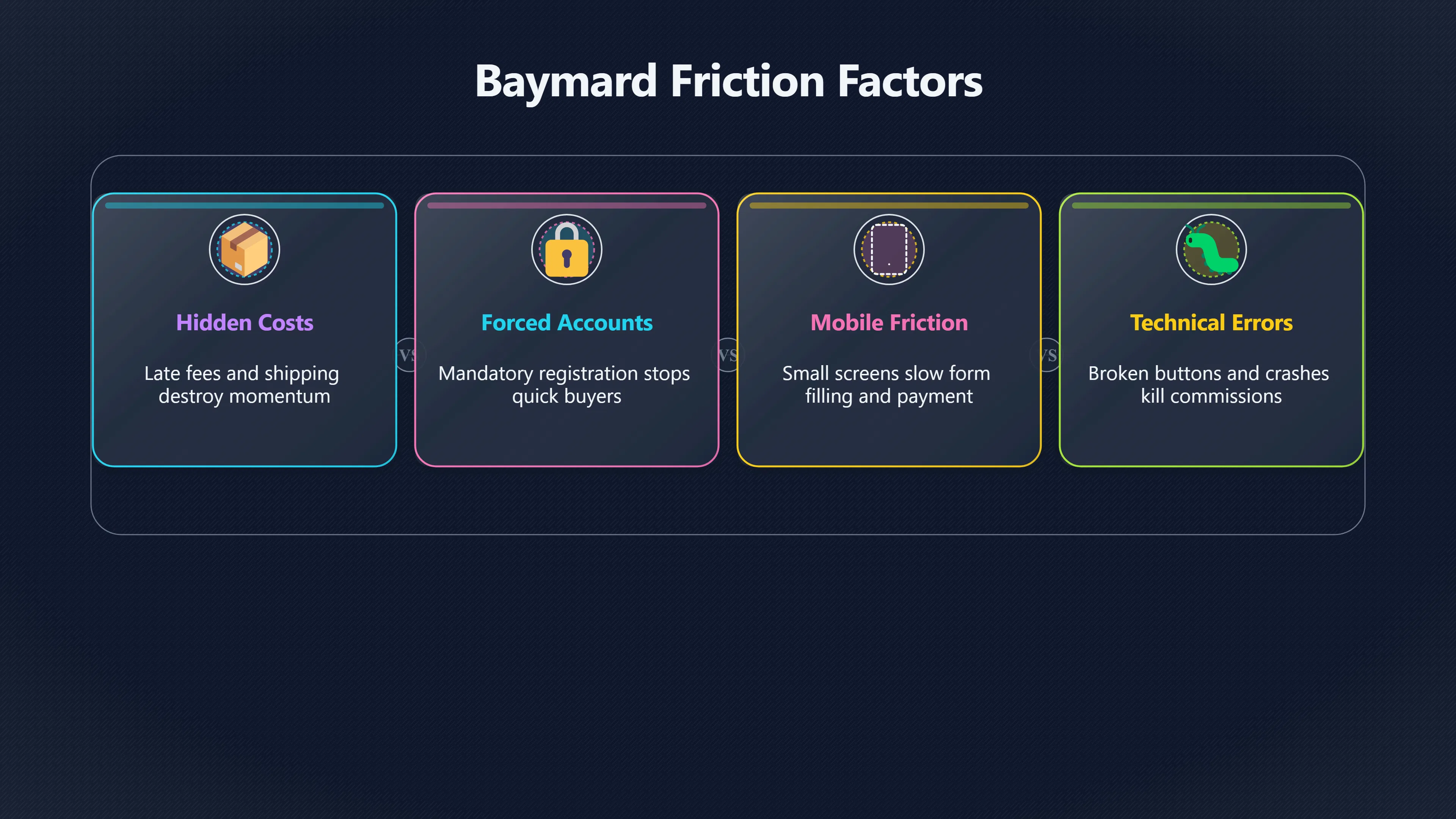
Hidden costs destroy buying momentum
One of the most common checkout failures occurs when the final price is significantly higher than the visitor expected.
Extra shipping fees, taxes, service charges, handling fees, insurance add-ons, and other late-stage costs create a feeling that the buyer has been misled. Baymard’s abandonment research repeatedly identifies unexpected costs as the leading reason shoppers leave during checkout.[Baymard Institute]baymard.comcart abandonment rateBaymard Institute50 Cart Abandonment Rate Statistics 2026 – Cart & Checkout22 Sept 2025 — Reasons for Abandoning Online Purchases at Chec…[Baymard Institute]baymard.comcart abandonment rateBaymard Institute50 Cart Abandonment Rate Statistics 2026 – Cart & Checkout22 Sept 2025 — Reasons for Abandoning Online Purchases at Chec…
For affiliate publishers, this matters because the visitor often associates the disappointment with the recommendation itself.
A page promoting a £49 product may appear attractive in search results, but if checkout raises the real cost to £67 after shipping and fees, the offer can become uncompetitive. The affiliate may continue sending traffic without realising the merchant is losing buyers at the final stage.
This is particularly damaging on:
- Budget-focused comparison pages
- “Best under £50” style content
- Voucher and discount pages
- Price-sensitive consumer electronics
- Home and garden products with large delivery charges
A website generation system should therefore evaluate total purchase cost, not just advertised product price.
Forced account creation creates unnecessary exits
Many merchants still interrupt checkout with mandatory registration requirements.
Baymard’s research identifies required account creation as a significant abandonment trigger. Users who intended to make a quick purchase are suddenly asked to create passwords, verify emails, and complete additional steps before payment.[Baymard Institute]baymard.comcart abandonment rateBaymard Institute50 Cart Abandonment Rate Statistics 2026 – Cart & Checkout22 Sept 2025 — Reasons for Abandoning Online Purchases at Chec…[MakeCommerce From an affiliate perspective]makecommerce.nethow to reduce cart abandonment in ecommerce 5 easy stepsHow to Reduce Cart Abandonment in Ecommerce: 5 Easy…10 Feb 2026 — Complex checkout processes remain a leading cause of abandonment, wi…, this is particularly dangerous because:
- The buyer already completed the difficult decision-making stage.
- Additional forms create friction without adding purchase value.
- Every extra step introduces another exit opportunity.
The affiliate effectively pays a conversion penalty because the merchant prioritises account creation over order completion.
When reviewing merchants, affiliates should test whether guest checkout is available and whether it is genuinely prominent rather than hidden behind registration prompts.
Mobile checkout problems quietly reduce commissions
Many affiliate traffic sources are heavily mobile. Product review pages, gift guides, comparison articles, and social-driven content frequently receive the majority of their visitors from phones.
Mobile users are more vulnerable to checkout friction because:
- Form filling is slower.
- Payment details are harder to enter.
- Small interface problems create larger frustrations.
- Switching between apps can interrupt checkout.
Affiliate conversion benchmarks consistently show lower mobile conversion rates despite large volumes of mobile traffic. Checkout usability is one of the major reasons.[floatingcta.com]floatingcta.comAffiliate Marketing Conversion Rates: 2026 Benchmarks by…May 1, 2026 — Awin reports over 50% of affiliate-driven visits come from mobi…
A merchant with an excellent desktop checkout but a frustrating mobile experience can significantly reduce the value of affiliate traffic.
This becomes especially important when building content clusters expected to attract mobile-first audiences, such as travel, fashion, lifestyle, gifts, and impulse-purchase consumer products.
Checkout errors and technical failures are invisible commission killers
Some merchants lose sales through simple operational failures:
- Broken checkout buttons
- Payment gateway errors
- Cart resets
- Coupon code failures
- Slow page loads
- Crashes during payment submission
The affiliate often receives no warning.
Traffic continues flowing. Click numbers remain healthy. Yet commissions suddenly decline because users cannot complete purchases successfully.
This is one reason large affiliates periodically perform test purchases or manually review merchant funnels. A technically broken checkout can destroy revenue long before programme managers acknowledge the issue.
Stock, Delivery, Returns, and Payment Trust
Stock availability matters more than many affiliates realise
A merchant can have an attractive affiliate programme while being unable to fulfil demand.
Common problems include:
- Popular products repeatedly out of stock
- Regional stock shortages
- Delayed replenishment
- Long dispatch times
- Inventory inaccuracies
An affiliate article may rank well and generate purchase intent, but unavailable products convert poorly regardless of commission structure.
This is particularly problematic for seasonal content.
Examples include:
- Christmas gift guides
- Black Friday pages
- Garden equipment in spring
- University laptop recommendations before term starts
A scalable affiliate system should monitor merchant reliability, not simply product relevance.
Delivery expectations influence conversion
Modern shoppers compare delivery experiences against large retailers.
Baymard’s abandonment data identifies slow delivery as a significant reason users abandon purchases.[Baymard Institute]baymard.comcart abandonment rateBaymard Institute50 Cart Abandonment Rate Statistics 2026 – Cart & Checkout22 Sept 2025 — Reasons for Abandoning Online Purchases at Chec…
This affects merchant selection decisions.
For example:
- A specialist retailer may pay 12% commission.
- A major retailer may pay 3%.
The specialist merchant appears more profitable on paper. However, if delivery estimates stretch to ten days while competitors offer next-day shipping, conversion rates may collapse.
Affiliate revenue depends on completed orders, not theoretical commissions.
Returns policies affect buying confidence
Returns policies influence purchases before a customer buys.
Visitors evaluating unfamiliar brands often check:
- Return windows
- Return costs
- Exchange procedures
- Refund timing
Baymard’s research shows unsatisfactory return policies contribute to abandonment behaviour.[Baymard Institute]baymard.comcart abandonment rateBaymard Institute50 Cart Abandonment Rate Statistics 2026 – Cart & Checkout22 Sept 2025 — Reasons for Abandoning Online Purchases at Chec…
This is especially important in categories with higher purchase anxiety:
- Clothing
- Furniture
- Mattresses
- Fitness equipment
- Expensive electronics
An affiliate recommendation becomes easier to trust when the merchant reduces perceived risk.
Payment trust is a conversion factor
Many affiliate publishers underestimate how much trust influences checkout completion.
Research repeatedly identifies payment security concerns as a significant abandonment driver. Shoppers leave when they do not trust the merchant with payment information or when the checkout feels unprofessional.[Baymard Institute]baymard.comcart abandonment rateBaymard Institute50 Cart Abandonment Rate Statistics 2026 – Cart & Checkout22 Sept 2025 — Reasons for Abandoning Online Purchases at Chec…[Growth Engines]growth-engines.comecommerce checkout optimizationBaymard's checkout usability study found that 19% of users abandoned a checkout in the…Read more…
Common warning signs include:
- Outdated page design
- Missing HTTPS security indicators
- Few recognised payment options
- Unclear company information
- Excessive information requests
- Confusing payment flows
A visitor who happily clicked an affiliate link may still abandon the purchase if the merchant appears unreliable at the moment payment details are requested.

How to Screen Merchant Pages Before Linking
Affiliate programmes often advertise commission rates, cookie windows, and payout structures. Those figures matter, but they do not reveal checkout quality.
A more useful evaluation process is to experience the merchant journey directly.
Test the entire buying path
Before giving a merchant prominent placement:
- Visit the landing page.
- Add products to the basket.
- Progress through checkout.
- Review shipping costs.[baymard.com]baymard.comcart abandonment rateBaymard Institute50 Cart Abandonment Rate Statistics 2026 – Cart & Checkout22 Sept 2025 — Reasons for Abandoning Online Purchases at Chec…
- Examine delivery estimates.
- Check payment methods.
- Read returns information.
Many conversion problems become obvious within minutes.
A merchant that looks strong in an affiliate network dashboard can reveal serious usability problems during a real purchase attempt.
Compare merchants as a buyer, not as an affiliate
A useful exercise is to open three competing merchants simultaneously and compare:
- Final delivered price
- Checkout steps
- Delivery speed
- Return terms
- Trust signals
- Mobile experience
The merchant offering the highest commission is often not the one providing the smoothest buying experience.
For affiliate sites built at scale, these comparisons can be standardised into merchant scoring systems that influence offer placement decisions.
Watch for friction patterns that repeat
Certain warning signs tend to predict poor affiliate performance:
- Prices that rise significantly at checkout
- Aggressive upsells before payment
- Excessive form fields
- Required account registration
- Limited payment methods
- Poor mobile layouts
- Slow page loading
- Unclear stock status
- Vague return information
Individually, each issue may seem minor. Combined, they can reduce conversion rates dramatically.
Baymard’s checkout research repeatedly shows that abandonment is often driven by accumulated friction rather than a single catastrophic problem.[Baymard Institute]baymard.comcart abandonment rateBaymard Institute50 Cart Abandonment Rate Statistics 2026 – Cart & Checkout22 Sept 2025 — Reasons for Abandoning Online Purchases at Chec…
Why Merchant Quality Belongs in Offer Matching
Offer matching is often discussed as a content problem: matching the right product to the right reader intent. But the merchant experience is part of the same system.
A recommendation only earns money when all stages succeed:
- The page matches search intent.
- The visitor clicks.
- The merchant builds confidence.
- Checkout remains friction-free.
- Payment completes successfully.
A weakness at any stage lowers revenue per visitor.
This is why mature affiliate operations frequently favour merchants that convert reliably over merchants that merely advertise attractive commissions. A lower-paying merchant with transparent pricing, strong stock availability, trusted payment options, clear returns policies, and a smooth checkout can generate more revenue across thousands of pages than a higher-paying programme that loses buyers after the click.
For large-scale website monetisation systems, merchant screening should therefore be treated as part of content monetisation logic rather than an afterthought. The recommendation is only as valuable as the checkout that follows it.
Amazon book picks
Further Reading
Books and field guides related to The Sale Can Still Fail After the Click. Use these as the next step if you want deeper reading beyond the article.
Don't Make Me Think, Revisited
Directly addresses friction that harms checkout completion.
The Design of Everyday Things
Provides principles behind reducing friction and user confusion.
eBay marketplace picks
Marketplace Samples
Example marketplace items related to this page. Use the search link to explore similar finds on eBay.



Endnotes
1.
Source: baymard.com
Link:https://baymard.com/research/checkout-usability
Source snippet
Baymard InstituteE-Commerce Cart & Checkout Usability ResearchAt Baymard we've tracked the global average cart abandonment rate for 14 ye...
2.
Source: baymard.com
Title: cart abandonment rate
Link:https://baymard.com/lists/cart-abandonment-rate
Source snippet
Baymard Institute50 Cart Abandonment Rate Statistics 2026 – Cart & Checkout22 Sept 2025 — Reasons for Abandoning Online Purchases at Chec...
3.
Source: wecantrack.com
Title: Finance affiliates often see 2-5%, while general retail sees 1-3%.Read more
Link:https://wecantrack.com/insights/affiliate-conversion-statistics/
Source snippet
70+ Affiliate Conversion Rate StatisticsMarch 23, 2026 — Average affiliate conversion rates range from 1-5% depending on niche...
Published: March 23, 2026
4.
Source: baymard.com
Link:https://baymard.com/learn/reduce-cart-abandonment
Source snippet
Unexpected costs appear too late · 2. Forced account creation · 3. Overly complex checkout...Read more...
5.
Source: makecommerce.net
Title: how to reduce cart abandonment in ecommerce 5 easy steps
Link:https://makecommerce.net/how-to-reduce-cart-abandonment-in-ecommerce-5-easy-steps/
Source snippet
How to Reduce Cart Abandonment in Ecommerce: 5 Easy...10 Feb 2026 — Complex checkout processes remain a leading cause of abandonment, wi...
6.
Source: floatingcta.com
Link:https://floatingcta.com/insights/affiliate-marketing-conversion-rate/
Source snippet
Affiliate Marketing Conversion Rates: 2026 Benchmarks by...May 1, 2026 — Awin reports over 50% of affiliate-driven visits come from mobi...
Published: May 1, 2026
7.
Source: baymard.com
Link:https://baymard.com/learn/audit-checkout-flow-hidden-friction
Source snippet
Baymard InstituteHow to Audit Your Checkout Flow for Hidden FrictionAnalytics show where users drop off; a UX audit tells you why. Use th...
8.
Source: growth-engines.com
Title: ecommerce checkout optimization
Link:https://growth-engines.com/insights/ecommerce/ecommerce-checkout-optimization
Source snippet
Baymard's checkout usability study found that 19% of users abandoned a checkout in the...Read more...
9.
Source: baymard.com
Link:https://baymard.com/blog/ecommerce-checkout-usability-report-and-benchmark
Source snippet
Reasons for Cart Abandonment – Why 70% of Do So21 Sept 2016 — The report is 718 pages long, and outlines 134 design guidelines on how to...
10.
Source: baymard.com
Title: current state of checkout ux
Link:https://baymard.com/blog/current-state-of-checkout-ux
Source snippet
Checkout UX Best Practices 202525 Nov 2025 — During testing, we observed that extensive and strict password rules can cause up to an 19%...
Additional References
11.
Source: impact.com
Link:https://impact.com/partnerships/the-holy-grail-of-affiliate-marketing-metrics/
Source snippet
The Holy Grail of Affiliate Marketing MetricsMost affiliate managers recognize that more revenues are better, higher conversion rates and...
12.
Source: linkedin.com
Link:https://www.linkedin.com/posts/baymard-institute_how-to-audit-your-checkout-flow-for-hidden-activity-7460629993577021440-dbxT
13.
Source: medium.com
Link:https://medium.com/%40balaji.y/solving-shopping-cart-abandonment-a-case-study-in-checkout-redesign-b98721f66911
Source snippet
Solving Shopping Cart Abandonment: A Case Study in...Unexpected Costs. This is the number one reason for cart abandonment. · Lack...
14.
Source: thrivecart.com
Title: affiliate marketers everything you need to know about conversion rates
Link:https://thrivecart.com/blog/affiliate-marketers-everything-you-need-to-know-about-conversion-rates/?srsltid=AfmBOoqkQcD75ZZ1MkoILOdE0gq3OWElFZQ2komInxW56_8qBYsBJ3xO
Source snippet
How to Compute Affiliate Marketing Conversion Rate31 Mar 2026 — The affiliate marketing conversion rate means the percentage of the numbe...
15.
Source: linkedin.com
Link:https://www.linkedin.com/pulse/why-holiday-shoppers-abandon-carts-how-good-ux-can-prevent-smith-a8ede
Source snippet
ollection raises concerns about misuse and marketing abuse...Read more...
16.
Source: zipchat.ai
Title: Seven in ten shoppers who add a product to a cart do not buy.Read more
Link:https://www.zipchat.ai/blog/cart-abandonment-benchmarks-and-causes
Source snippet
Cart Abandonment Rate Benchmarks & Causes (2026 Data)25 Apr 2026 — Summary: The global cart abandonment rate is 70.19% (Baymard Institute...
17.
Source: webeyez.com
Title: Conversion Rate Affiliate Marketing
Link:https://webeyez.com/insights/guides/conversion-rate-affiliate-marketing-optimization-guide
Source snippet
Conversion rate in affiliate marketing measures how effectively affiliate traffic converts into desired actions such as sales or sign-ups...
18.
Source: themehigh.com
Title: psychology of checkout optimization
Link:https://www.themehigh.com/blog/psychology-of-checkout-optimization/
Source snippet
The Psychology of Checkout Optimization19 Sept 2025 — Cart abandonment rates hover around 70% across industries, and the checkout process...
19.
Source: reddit.com
Title: We recently signup for impact.com
Link:https://www.reddit.com/r/Affiliatemarketing/comments/1mkmhfv/we_recently_signup_for_impactcom_now_not_sure/
Source snippet
Now not sure whats...We recently signed up for impact... Its been almost 21 days... it took them 15 days to get us onboarded properly t...
20.
Source: impact.com
Title: affiliate marketing benchmark
Link:https://impact.com/affiliate/affiliate-marketing-benchmark/
Source snippet
Affiliate Benchmark 2025: Fewer Buys, Higher Order ValueLonger research, shorter purchase windows. Discover how 2025 shopper behavior imp...
Topic Tree